



The All-American Legends: Why the 82nd Airborne Division Remains the World’s Premier Strike Force
Discover why the U.S. Army’s 82nd Airborne Division is considered the world’s most elite rapid-response force. Explore their storied history, from WWII to recent Iran tensions.
 Rajeev
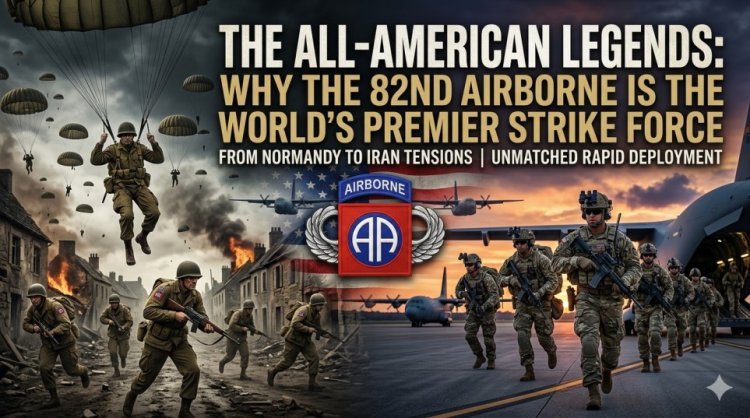

In the world of military might, few names command as much respect—and strike as much fear—as the 82nd Airborne Division. Known affectionately as the "All-Americans," this division isn't just a group of soldiers; they are the tip of the spear, the first to jump into the heart of darkness when the world catches fire.
But what exactly makes the 82nd Airborne "elite"? Is it their rigorous training, their storied history, or their unique role in modern geopolitics? To understand their prestige, we must look at their past, their purpose, and their recent high-stakes deployments.
The Legacy of the "All-Americans"
The 82nd Airborne Division was born in 1917. The nickname "All-American" comes from the fact that, at its inception, the division consisted of soldiers from all 48 U.S. states. However, it was during World War II that they truly earned their wings.
From the night drops over Normandy on D-Day to the frozen foxholes of the Battle of the Bulge, the 82nd proved that they could operate behind enemy lines, surrounded and outnumbered, yet still emerge victorious. This "no retreat" mentality is baked into the DNA of every paratrooper who wears the AA patch.
What Makes Them "Elite"?
While the 82nd is technically a conventional airborne infantry division, they function with the precision and speed of special operations. Here is why they are considered elite:
-
The 18-Hour Window: The 82nd serves as the core of the Global Response Force (GRF). They are capable of mobilizing and beginning an airborne assault anywhere in the world within 18 hours of being notified.
-
Airborne Insertion: They specialize in "forced entry." When an airfield is seized by an enemy, the 82nd doesn't wait for a cleared runway; they jump from C-130 and C-17 aircraft to take it by force.
-
Psychological Resilience: Every member is a volunteer. The training—culminating in the grueling Airborne School—is designed to weed out those who cannot handle the physical and mental stress of jumping into combat.
Modern Conflict: The Iran Tension and the Trump Era
The 82nd Airborne often finds itself at the center of modern political firestorms. A prime example occurred in early 2020 following the escalation of tensions between the United States and Iran.
After the strike on Iranian General Qasem Soleimani, the Trump administration required a rapid show of force to protect U.S. interests and deter further aggression. Within days, thousands of paratroopers from the 82nd’s Immediate Response Force (IRF) were deployed to Kuwait.
This "no-notice" deployment plan showcased the division's unique utility. Unlike other units that require months of logistical planning, the 82nd can be used as a "diplomatic hammer"—a signal to adversaries that the U.S. can put boots on the ground before the news cycle even finishes.
The Strategic Deployment Plan: How It Works
The 82nd Airborne operates on a rotational basis. At any given time, one brigade is on high alert.
-
N-Hour Sequence: Once the "go" order is given, the clock starts.
-
Outload: Vehicles are palletized, and parachutes are rigged.
-
The Drop: They utilize "heavy drop" techniques to air-drop not just soldiers, but also Humvees, artillery, and supplies, ensuring they have immediate firepower upon landing.
Why Viewers Trust the AA Patch
In an era of shifting global alliances and hybrid warfare, the 82nd Airborne remains a constant. They are the ultimate insurance policy for national security. For viewers interested in military strategy, the 82nd represents the pinnacle of American logistical and combat capability.
Whether it was stabilizing the chaos at Kabul Airport in 2021 or deterring aggression in Eastern Europe today, the 82nd Airborne Division continues to be the first choice for commanders-in-chief when failure is not an option.
The 82nd Airborne is more than just a military unit; it is a symbol of American readiness. Their history is written in the soil of every major conflict of the last century, and their future is tied to the very first hours of whatever conflict comes next.