India Rejects Elon Musk's Starlink Blockade Claim, Defends Fair Satellite Internet Policy
India rejects Elon Musk's allegations that Starlink is being blocked, defending its fair satellite internet policy and mandatory security approvals.
 Rajeev
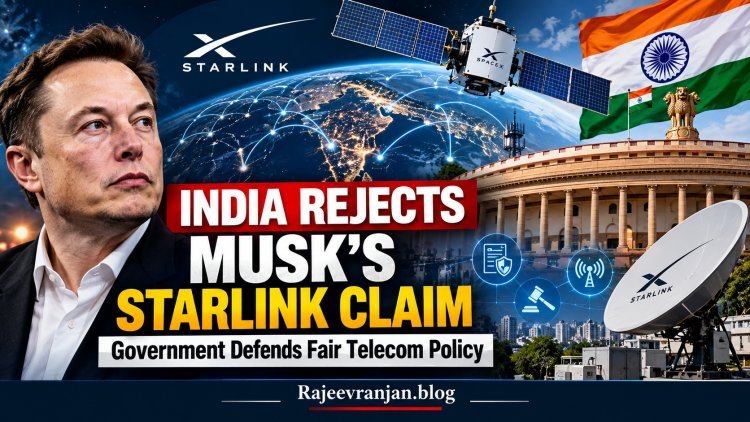

New Delhi, October 8, 2026: The Indian government on Thursday firmly rejected allegations by billionaire entrepreneur Elon Musk that powerful business interests were preventing his satellite internet venture, Starlink, from launching commercial services in India.
The Ministry of Communications described suggestions of discrimination in the country's satellite communication approval process as "baseless and misconceived", maintaining that its regulatory framework treats all eligible operators fairly.
The clarification followed Musk's public accusation that unnamed business interests were obstructing Starlink's entry into the Indian market to protect their dominance over telecommunications services.
According to the government, Starlink and two other licensed satellite communication providers are undergoing security assessments and remain at broadly the same stage of the approval process.
Elon Musk Alleges Powerful Interests Are Blocking Starlink
The controversy began after Musk responded to a social media discussion about the need for high-speed satellite internet in India's underserved and remote regions.
In his post on X, Musk alleged that "certain oligarchs" were preventing Starlink from entering the Indian market to preserve their existing control over telecommunications services.
He did not identify the individuals or companies he believed were responsible.
His remarks quickly attracted attention because India's telecommunications sector is dominated by major operators such as Reliance Jio and Bharti Airtel.
However, Musk's allegations do not establish that either company has interfered with Starlink's regulatory approvals. The government has rejected the broader claim that the process is discriminatory.
Government Defends Fair and Non-Discriminatory Telecom Policy
Responding to the controversy, the Ministry of Communications emphasized that India has established a transparent authorization system for telecommunications services, including satellite-based broadband.
The ministry explained that three companies have received Global Mobile Personal Communication by Satellite (GMPCS) authorizations:
- Starlink Satellite Communications
- OneWeb India Communications, backed by Bharti
- Jio Satellite Communications
All three operators must demonstrate compliance with prescribed security conditions before advancing to spectrum assignment.
The government stressed that the requirements are designed to protect national security, telecommunications infrastructure and users' data.
It also clarified that completing the security assessment would allow an operator to move to the next regulatory stage, rather than automatically begin commercial operations.
Why Is Starlink's India Launch Delayed?
Starlink has been seeking access to India's satellite broadband market for several years.
Although the company has secured initial telecommunications approvals, it still requires additional regulatory clearances and spectrum assignment before launching commercial services.
The key outstanding issues include security compliance, technical requirements and the allocation of satellite communication spectrum.
The government maintains that these procedures apply to competing operators as well.
As of October 8, 2026, no confirmed commercial launch date for Starlink's India service has been announced.
Starlink Says It Is Ready to Serve India
Despite the regulatory uncertainty, Starlink has continued preparing its infrastructure for operations in India.
At India Mobile Congress 2026 on October 7, Starlink Vice President of Business Operations Lauren Dreyer said the company had established infrastructure specifically designed to meet Indian requirements.
According to Dreyer, Starlink has developed 20 gateway sites across the country, incorporating hundreds of antennas.
She also stated that the company had implemented India-specific security controls and arrangements to keep Indian user data within the country.
These developments indicate that Starlink is investing in its planned Indian operations, although infrastructure readiness does not replace the need for final regulatory authorization.
Starlink vs Jio and Airtel: Competition in India's Satellite Internet Market
India represents an important growth opportunity for satellite broadband companies because of its large population and significant connectivity gaps in remote areas.
Traditional fiber-optic and mobile broadband networks can be expensive or technically difficult to deploy in mountainous regions, border areas, islands and sparsely populated communities.
Satellite internet services could help address these challenges.
The emerging market includes Starlink, Jio's satellite venture and Bharti-backed OneWeb, while Amazon's satellite broadband business is also pursuing opportunities in India.
Competition among these providers could eventually give businesses, institutions and consumers additional connectivity choices.
However, the affordability of satellite broadband will depend on equipment costs, subscription pricing, network capacity and regulatory conditions.
What Does This Mean for India's Digital Future?
The dispute highlights the challenge of balancing technological innovation with national security and regulatory oversight.
Satellite broadband has the potential to improve access to online education, telemedicine, digital payments and essential communications in areas where terrestrial networks remain limited.
For India, enabling competition could encourage investment and improve access to connectivity. At the same time, authorities must ensure that satellite operators comply with applicable security and data-protection requirements.
The central question is therefore not simply whether Starlink should enter India, but how quickly all eligible operators can complete a consistent, transparent approval process.
Could the Dispute Affect India-US Relations?
The controversy also comes at a sensitive time for economic relations between India and the United States.
Reuters reported that Washington has supported greater market access for Starlink during trade discussions with other countries, including India.
With SpaceX being a major American technology company, the satellite broadband approval process carries commercial and diplomatic significance.
Nevertheless, there has been no confirmed announcement that the latest exchange between Musk and the Indian government will directly change bilateral trade negotiations.
What Happens Next?
The next major development will be the completion of regulatory security assessments for the licensed satellite communication operators.
Once an operator satisfies the required conditions, it can proceed toward spectrum assignment and any remaining approvals.
Investors, telecom companies and potential customers will be watching for announcements concerning regulatory clearance, service availability, pricing and launch schedules.
For now, India's position remains clear: the government says its satellite communication rules are fair and apply equally to competing operators, while Musk continues to challenge the reasons behind Starlink's delayed commercial launch.
The broader outcome could shape the future of satellite internet competition and digital connectivity across India.































![States PCS: Bihar GK [बिहार सामान्य ज्ञान एवं सामान्य अध्ययन प्रश्न]](https://rajeevranjan.blog/uploads/images/2026/09/image_380x226_6a9e6f69b286c.jpg)