Saudi Arabia Airport Attack: 14 Killed in Riyadh Strikes, Umrah Pilgrims Among Victims
Saudi Arabia airport attack: Two strikes on Riyadh's King Khalid Airport kill 14 people. Umrah pilgrims among victims as Houthi attacks disrupt flights.
 Rajeev
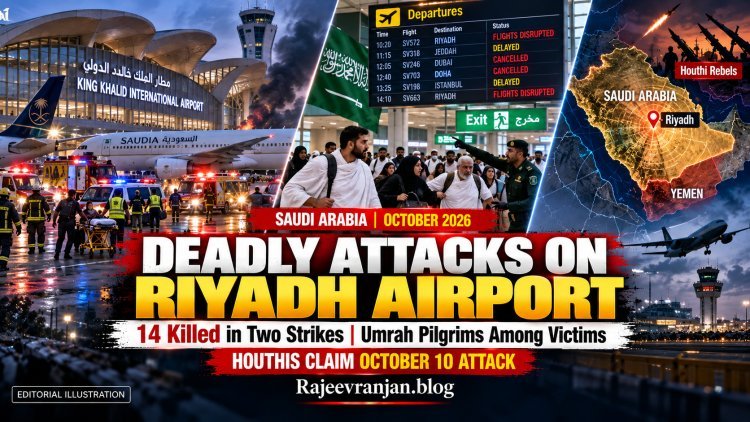

Riyadh Airport Under Attack: Umrah Pilgrims Among Victims as Deadly Houthi Strikes Trigger Aviation Emergency
Two days of deadly attacks have turned one of Saudi Arabia's busiest international airports into the centre of an escalating regional conflict. Verified footage shows the terrifying moments surrounding the assault, while aviation authorities struggle to restore normal operations.
RIYADH, October 12, 2026: Passengers preparing to board flights, families waiting inside airport terminals and religious pilgrims travelling through Saudi Arabia were caught in a deadly escalation after successive attacks struck King Khalid International Airport in Riyadh.
The violence began with a major attack on Saturday, October 10, which killed 12 people initially, with the death toll subsequently rising to 13.
Another projectile struck the airport's Terminal 4 on Sunday, October 11, killing one additional person and injuring 11 others.
The two attacks therefore resulted in 14 reported deaths, based on the latest figures available from Reuters.
More than 300 people were wounded in Saturday's attack alone.
Yemen's Iran-aligned Houthi movement claimed responsibility for Saturday's assault. Saudi authorities described the projectile involved in Sunday's attack as unidentified, although the incidents occurred amid a broader Houthi campaign against Saudi aviation infrastructure.
A Routine Journey Turns Into Chaos
For passengers inside Riyadh's international airport, the attacks transformed an ordinary travel experience into a frightening emergency.
Footage published by The Indian Express showed Umrah pilgrims caught during the boarding process when an attack struck the airport.
The video provided a disturbing glimpse of the dangers faced by travellers as the conflict between Saudi-backed forces and Yemen's Houthis increasingly affects civilian infrastructure.
The latest violence has raised particular concern because King Khalid International Airport is a major international transport hub used by passengers travelling for business, tourism and religious purposes.
The airport also serves travellers connecting to destinations across Saudi Arabia, including those undertaking Umrah.
Many of these passengers are international visitors unfamiliar with emergency procedures or local security conditions.
The attacks have therefore created concerns extending well beyond Riyadh.
What Happened on October 10?
Saturday's attack was the deadliest of the latest series of strikes against Riyadh airport.
Saudi Arabia's General Authority of Civil Aviation initially reported 12 deaths and 309 injuries.
The victims included Saudi citizens and foreign nationals.
According to the initial official breakdown, those killed included:
- Four Saudi citizens.
- Two Bangladeshi nationals.
- One citizen each from the United States, Jordan, Palestine, Syria, Sudan and Egypt.
The death toll subsequently increased to 13 after an Indian national died from injuries sustained in the attack.
Some of the victims were reportedly travelling for Umrah, adding a particularly tragic dimension to the incident.
Saudi authorities suspended airport operations following the strike, while emergency responders worked to assist the injured and manage the damage.
The attack intensified fears that the conflict in Yemen was increasingly threatening civilian aviation across the Gulf region.
Fresh Strike Hits Terminal 4 on October 11
Before the airport could fully recover from Saturday's deadly attack, another projectile struck Terminal 4 on Sunday.
According to Reuters, the impact caused a fire and resulted in one death and 11 injuries.
Saudi authorities did not immediately identify the projectile involved in the latest strike.
The renewed attack demonstrated the continuing danger faced by airport staff, passengers and emergency personnel.
It also complicated efforts to resume normal flight operations.
International airlines and aviation authorities began reviewing their operations in Saudi Arabia as the security situation deteriorated.
The repeated attacks have prompted questions about airport protection systems and the risks facing commercial aviation during regional military escalation.
Riyadh Airport Attacks: Key Facts
| Detail | Latest Reported Information |
|---|---|
| Location | King Khalid International Airport, Riyadh |
| First Major Attack | October 10, 2026 |
| Second Major Attack | October 11, 2026 |
| October 10 Death Toll | 13 |
| October 11 Death Toll | 1 |
| Combined Reported Death Toll | 14 |
| October 10 Injuries | More than 300 |
| October 11 Injuries | 11 |
| Claim of Responsibility | Houthis claimed October 10 attack |
| Umrah Pilgrims Affected | Yes, among reported victims |
| Airport Operations | Disrupted, with flight restrictions and cancellations |
Umrah Pilgrims Among Those Killed
One of the most heartbreaking aspects of the attacks is the reported deaths of people travelling for religious purposes.
Among those killed was a Bangladeshi Umrah pilgrim identified as Mufti Md Nasrullah Badrpuri, from the Cumilla district of Bangladesh.
Bangladesh's United News of Bangladesh reported that he died in the Riyadh airport attack while travelling to perform Umrah.
His death illustrates how the conflict has affected ordinary international travellers who were not participants in the fighting.
Saudi Arabia receives large numbers of Muslim visitors throughout the year.
Although Umrah is performed in Mecca, travellers may use several Saudi airports and domestic connections during their journeys.
The attacks have therefore raised concerns among pilgrims and their families about travel safety, flight disruptions and emergency assistance.
An Indian National Also Among the Victims
The Associated Press reported that an Indian national who had been injured in Saturday's strike subsequently died, increasing the death toll to 13.
The report highlights the international consequences of the airport attack.
Saudi Arabia is an important destination for Indian workers, business travellers and religious pilgrims.
Any sustained disruption to its aviation network could affect passengers travelling between India and Saudi Arabia.
However, the nationality of one victim does not establish that the individual was undertaking Umrah.
Details of individual travel purposes should be reported only when confirmed by authorities or reliable sources.
Viral Video Shows Airport Attack — But Not Every Clip Is Genuine
Videos circulating online have become a major part of coverage of the Riyadh airport attacks.
Al Jazeera published CCTV footage, originally released by Al Arabiya, showing the moment of Saturday's deadly strike.
Other reporting has shown passengers, including Umrah pilgrims, caught in the airport during the emergency.
These recordings have helped document the incident and the dangers faced by civilians.
However, the large number of videos circulating on social media has also created an opportunity for misleading content.
Fake Videos Circulate After Riyadh Airport Attacks
Fact-checking organisation Lead Stories identified a fabricated video that purported to show a missile directly striking and destroying a Saudia aircraft at Riyadh airport.
The organisation found that the footage was not authentic, although a real attack had occurred.
Separately, Misbar identified footage from Dubai that was misleadingly shared as video of damage at Riyadh's King Khalid International Airport.
These findings underline the importance of checking the original source, recording date and location before publishing videos of military incidents.
Watch Verified Coverage
Watch CCTV footage published by Al Jazeera
Viewer discretion advised: The footage documents a deadly attack and may be distressing.
Why Are Yemen's Houthis Attacking Saudi Airports?
The latest attacks are connected to the renewed escalation of Yemen's prolonged civil war.
The Houthi movement, which controls significant territory in Yemen, has been fighting forces aligned with Yemen's internationally recognised government.
Saudi Arabia has supported the internationally recognised government for years.
The conflict has intensified again following recent military operations aimed at reclaiming Houthi-controlled territory.
The Houthis have claimed responsibility for several attacks on Saudi aviation and energy infrastructure.
Their military spokesperson, Yahya Saree, has issued warnings concerning Saudi airports.
The group has also claimed attacks targeting Dammam airport and Saudi Aramco facilities.
Saudi authorities have condemned attacks on civilian infrastructure and warned of further military responses.
The escalation has raised concerns about regional security, particularly as military confrontation increasingly affects commercial transportation and energy facilities.
International Law and Civilian Airports
Civilian airports are protected under international humanitarian law unless particular facilities qualify as military objectives under the applicable legal rules.
Even where a legitimate military objective exists, parties to a conflict must comply with rules concerning distinction, proportionality and precautions to protect civilians.
Deliberately attacking civilians is prohibited.
The deaths of passengers and airport personnel have prompted international condemnation and renewed calls for the protection of civilian infrastructure.
International Airlines Disrupt Saudi Arabia Services
The attacks have created operational difficulties for airlines serving Saudi Arabia.
Several international carriers have suspended or adjusted flights amid concerns about airport security and regional airspace.
Earlier strikes had already affected flights and damaged a Saudia aircraft.
According to the Financial Times, international airlines including Qatar Airways, Turkish Airlines, Lufthansa and Singapore Airlines had suspended some services following the recent attacks.
Further strikes over the weekend increased uncertainty surrounding the restoration of normal operations.
Passengers travelling to or through Saudi Arabia should confirm their flight status directly with their airline rather than relying on previously published schedules.
Important Advice for Umrah Pilgrims and International Travellers
Travellers planning journeys to Saudi Arabia should take additional precautions while the security situation remains uncertain.
Before travelling:
- Check the latest flight status with the operating airline.
- Review official advisories issued by your country's foreign ministry.
- Contact your Umrah travel agency about airport transfers and alternative routes.
- Keep travel documents, emergency contacts and essential medication accessible.
- Avoid travelling to airports experiencing active security restrictions unless advised that operations have resumed.
- Follow official instructions from Saudi aviation and emergency authorities.
These precautions are particularly important for elderly travellers, families with children and those travelling in organised pilgrimage groups.
International Reaction: Concerns Grow Over Regional Escalation
The Riyadh airport attacks have drawn international condemnation.
Singapore's Senior Minister of State Zaqy Mohamad expressed concern over the targeting of civilians and civilian infrastructure.
The United States and United Kingdom also issued travel warnings as the security situation deteriorated.
The continuing strikes have raised concerns that the conflict between Yemen's Houthis and Saudi-backed forces could expand into a wider regional confrontation.
The attacks may also affect energy infrastructure, commercial shipping and international aviation.
The Bab al-Mandeb Strait, near Yemen, is an important maritime route linking the Red Sea with the Gulf of Aden.
Instability in the surrounding region can increase risks for international commerce.
However, the eventual economic impact will depend on the duration and geographical extent of the conflict.
What Happens Next?
Saudi aviation authorities face the immediate challenge of restoring safe airport operations while protecting passengers and staff.
Security forces are expected to continue monitoring potential missile and drone threats.
Airlines will assess whether routes can be operated safely.
Meanwhile, diplomatic attention will focus on efforts to prevent further attacks on civilian infrastructure.
The humanitarian consequences of Yemen's continuing conflict remain severe.
For Saudi Arabia, the attacks have exposed the vulnerability of major transport hubs.
For international travellers, including Umrah pilgrims, they have created uncertainty over one of the most important aspects of a journey: arriving safely.
Airport Attacks Turn Regional Conflict Into International Travel Crisis
The deadly strikes on Riyadh's King Khalid International Airport demonstrate how military conflicts can threaten civilians far beyond the battlefield.
The reported deaths of 14 people across the October 10 and 11 attacks, including international travellers and Umrah pilgrims, have intensified concerns about aviation security.
As Saudi Arabia responds to the attacks and airlines reassess their operations, passengers around the world are watching developments closely.
The latest violence is also a reminder that civilian airports, commercial aircraft and ordinary travellers can become vulnerable when regional conflicts escalate.
For families who lost loved ones during what should have been an ordinary journey, the tragedy is not merely a geopolitical development — it is an irreversible personal loss.