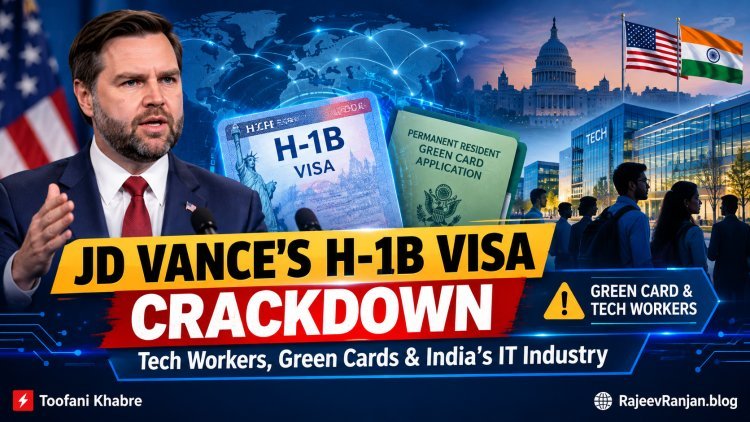
JD Vance’s H-1B Visa Crackdown: Are Tech Workers at Risk?
JD Vance’s H-1B visa crackdown targets alleged tech hiring abuses. Discover the latest US policy action, green card concerns and impact on Indian IT workers.
 Rajeev

JD Vance’s H-1B Visa Crackdown: Are Tech Workers at Risk?
The US immigration debate has entered a new phase after Vice President JD Vance accused major technology companies of exploiting foreign skilled workers. The latest action against the green-card sponsorship process has raised serious questions for Indian IT professionals, technology employers and the future of skilled immigration to America.
The United States has long attracted talented professionals from India and other countries who want to build careers in software engineering, artificial intelligence, cybersecurity, cloud computing and other technology fields. For many, an H-1B visa represents an opportunity to work with global companies, earn professional experience and build a future in America.
However, that opportunity is now at the centre of a heated political and economic debate.
On October 8, 2026, US Vice President JD Vance sharply criticised the use of employment-based immigration programmes by technology companies. The Trump administration also announced restrictions on several companies' participation in the Permanent Labor Certification, or PERM, programme, which is an important step in many employment-based green-card applications.
Vance described certain foreign workers as “foreign indentured servants,” arguing that employer-linked immigration arrangements can make workers vulnerable to exploitation and allow companies to undermine American wages.
The comments have brought renewed attention to an important question: Can the United States protect domestic workers without creating greater uncertainty for the skilled foreign professionals who help power its technology industry?
For Indian IT professionals, international students, employers and American workers, the answer could have far-reaching consequences.
What Did JD Vance Say About H-1B Visa Workers?
JD Vance's latest remarks focused on what the administration describes as the misuse of employment-based immigration programmes by major corporations.
According to Vance, some companies lay off American employees while continuing to rely on foreign skilled workers. He argued that certain employers take advantage of the dependence that visa holders may have on their sponsoring companies.
Under the H-1B programme, a worker's immigration status is connected to qualifying employment arrangements. Losing a job can therefore create additional immigration pressure that a US citizen would not face in the same way.
Vance argued that this imbalance can discourage some foreign employees from challenging workplace decisions, negotiating better conditions or leaving an unsatisfactory job.
He also questioned whether some companies genuinely need particular foreign workers or are using the programme to reduce labour costs.
These statements represent the administration's position. They should not be interpreted as proof that every company using H-1B visas has violated the law or that every foreign worker is underpaid.
The central issue is whether individual employers are following the rules and whether those rules adequately protect both American and foreign employees.
Why Has the H-1B Visa Programme Become Controversial?
The H-1B visa is a US non-immigrant visa category that allows eligible employers to hire foreign professionals for qualifying specialty-occupation positions.
Technology companies are among its most prominent users. Businesses may seek international talent when they need specialised expertise in software development, data science, engineering, semiconductor technology and other fields.
Supporters say the programme helps American businesses access global expertise, compete internationally and fill positions that require specialised knowledge.
Critics argue that weaknesses in recruitment, wage protections and enforcement can create opportunities for some employers to favour lower-cost labour over qualified domestic candidates.
The disagreement is not simply about whether foreign workers should be allowed to work in the United States. It is about how the system should operate, how employers should demonstrate legitimate hiring needs and how workers should be protected.
Three issues are particularly important.
1. Protection of American jobs
Critics of the programme want stronger safeguards against situations in which American employees are displaced while employers recruit foreign workers for comparable positions.
2. Fair wages and working conditions
Policymakers are concerned about whether employers pay appropriate wages and whether visa-related dependence makes certain workers less willing to report unfair treatment.
3. Access to international talent
Technology companies argue that international recruitment remains important for innovation, research, business expansion and access to specialised skills.
A policy that addresses only one of these concerns could create unintended consequences for the wider economy.
What Is the Latest US Action Against Technology Companies?
The latest development goes beyond political criticism.
On October 8, 2026, the Trump administration announced the suspension of Microsoft and several other technology and IT services companies from the Department of Labor's Permanent Labor Certification programme.
Companies identified in reports include Microsoft, Adobe, Cognizant, Infosys, Tata Consultancy Services, Wipro, HCL Technologies and Capgemini.
Officials cited alleged misuse of immigration and labour certification procedures. The administration's stated objective is to prevent companies from exploiting the system at the expense of American workers.
The announcement has attracted particular attention because several of the affected companies are major employers of Indian technology professionals.
However, the distinction between the two immigration processes is essential.
The H-1B visa allows eligible foreign professionals to work in qualifying US positions under the applicable immigration rules. PERM is a separate labour certification process that is generally required for many employer-sponsored employment-based green-card applications.
The reported PERM suspensions do not mean that every H-1B visa has been cancelled or that all foreign technology workers have automatically lost their legal status.
The practical consequences depend on the scope of the government action, the worker's individual immigration circumstances and any subsequent administrative or legal developments.
Readers should consult official US government announcements for the latest implementation details.
What Is the PERM Programme, and Why Does It Matter?
PERM stands for Program Electronic Review Management. It is the US Department of Labor's process for permanent labour certification in many employer-sponsored green-card cases.
In a typical PERM case, an employer must complete the required recruitment process and demonstrate that the applicable legal requirements have been satisfied. These include requirements concerning the availability of qualified US workers and the protection of wages and working conditions.
The process is designed to help ensure that employment-based immigration does not improperly disadvantage US workers.
After labour certification, an employer may need to pursue further steps in the employment-based immigration process, including an immigrant petition and, where applicable, adjustment of status or consular processing.
PERM is not required for every employment-based immigration category, and the process varies depending on the specific category and circumstances.
For a foreign professional hoping to obtain permanent residence, a disruption to the employer's ability to file or continue a PERM application can nevertheless be significant.
Possible consequences include delays, uncertainty about future sponsorship and the need to evaluate alternative immigration options with a qualified attorney.
This is particularly important for workers whose ability to extend their stay or pursue permanent residence depends on the timing and progress of their employment-based case.
Why Are Indian IT Professionals Particularly Concerned?
India has a substantial presence in the US technology workforce. Indian professionals work across software engineering, enterprise technology, financial services, artificial intelligence, research and consulting.
Major Indian IT services companies also maintain extensive US operations and serve customers across numerous industries.
For many Indian professionals, employment-based immigration involves several interconnected decisions: accepting a job offer, relocating internationally, supporting family members, building a career and planning for long-term residence.
An interruption in the green-card sponsorship process can therefore affect much more than a single application.
1. Greater uncertainty about permanent residence
A professional may have spent years building a career in the United States while waiting for an employment-based green card.
If an employer cannot initiate or continue the relevant labour certification process, the worker may need to reassess the expected timeline.
The effect will not be identical for every worker. Some may have already completed important stages, while others may be at the beginning of the process.
2. Increased pressure on job decisions
Workers whose immigration status depends on continued qualifying employment may need to consider immigration consequences when evaluating a job change, redundancy or new offer.
This can make career planning more complicated than it is for workers who do not require employer-linked immigration sponsorship.
3. Possible disruption to family planning
Long-term immigration uncertainty can affect decisions about education, housing, family relocation and financial commitments.
These consequences are individual and depend on the family's circumstances, but they help explain why changes to sponsorship procedures attract so much attention.
4. More scrutiny of employers and recruitment practices
The latest action may encourage employers to review their hiring procedures, wage practices, recruitment records and immigration compliance systems.
Companies that rely on international talent may also need to communicate more clearly with affected employees about the status of their applications.
For Indian professionals, the immediate priority should be obtaining reliable, case-specific information rather than assuming that every application will be treated in the same way.
Is the H-1B Visa Programme Being Abolished?
No. The reported action against selected companies' participation in PERM should not be confused with the abolition of the H-1B visa programme.
The H-1B category continues to operate under the relevant US immigration laws and regulations, subject to applicable rules and policy changes.
The administration's action targets particular employer participation in the permanent labour certification process. It does not, by itself, establish that all H-1B workers must leave the United States.
Nevertheless, the distinction does not make the development unimportant.
For a worker whose employer-sponsored green-card process is affected, a PERM restriction could complicate long-term immigration planning even if the worker's current H-1B status remains valid.
The correct approach is to separate three questions:
- Is the worker's current immigration status valid?
- Can the employer continue the relevant sponsorship process?
- Are there other lawful options available under the worker's individual circumstances?
These questions have different answers and should not be treated as interchangeable.
Are H-1B Workers Really “Indentured Servants”?
The phrase used by JD Vance is emotionally powerful, but it needs to be examined carefully.
Historically, indentured servitude referred to a system in which a person was bound by an agreement to work for a specified period under restrictive conditions. The modern H-1B immigration framework is not legally identical to that historical institution.
Vance used the expression as a political criticism of what he considers an imbalance between employers and foreign workers.
There is a legitimate policy question behind the rhetoric: can immigration arrangements tied to employment make workers more vulnerable to pressure from employers?
For some people, the consequences of losing a job can be particularly serious because a new job, a change of employer or an extension of authorised stay may involve specific legal requirements and deadlines.
However, it would be misleading to suggest that every H-1B worker is powerless or that all employers exploit their employees.
Foreign professionals may have employment rights, access to legal advice and lawful options for changing employers or addressing workplace violations. The availability and timing of those options depend on the facts of each case.
The more useful discussion is therefore not whether a provocative label applies to an entire group of workers. It is whether existing rules provide adequate protection, whether employers comply with the law and whether workers can exercise their rights without unreasonable fear of immigration consequences.
Could the Crackdown Benefit American Workers?
The administration argues that stronger enforcement can help protect American employees from unfair competition and abusive recruitment practices.
If an employer has violated applicable wage or recruitment requirements, effective enforcement can help correct the problem and discourage similar conduct.
Stronger oversight may also encourage businesses to invest in domestic recruitment, professional training and the development of local talent.
However, the outcome will depend on how the measures are implemented.
Technology companies often compete in international markets where specialised expertise is essential. Restrictions that create substantial uncertainty around recruitment or permanent-residence sponsorship may also affect their ability to retain experienced employees.
A successful policy must distinguish between legitimate recruitment of specialised international talent and unlawful practices that disadvantage domestic workers.
It must also ensure that allegations are investigated fairly and that enforcement decisions follow applicable legal procedures.
Protecting American workers and treating foreign workers fairly are not necessarily contradictory goals. Both depend on transparent hiring, lawful wages, consistent enforcement and meaningful accountability.
Could the New Rules Affect America's Technology Industry?
The United States has developed a leading technology ecosystem supported by universities, research institutions, entrepreneurs, domestic employees and international professionals.
Immigration policy is one element of this wider system.
Greater scrutiny of employment-based immigration may lead some employers to review recruitment strategies and sponsorship practices. Companies may also reassess how they document hiring decisions and manage the immigration needs of existing employees.
Several possible effects deserve attention.
Recruitment planning: Employers may place greater emphasis on demonstrating genuine hiring needs and maintaining complete compliance records.
Employee retention: Workers who face uncertainty about permanent residence may reconsider long-term employment plans.
Competition for specialist skills: Companies may expand domestic training while continuing to compete for experienced international professionals where permitted.
Business costs: Legal reviews, delayed applications and changes to workforce planning can increase administrative expenses.
Innovation and research: The longer-term effect will depend on whether the new approach successfully addresses abuses without creating unnecessary barriers to legitimate hiring.
These are potential consequences, not guaranteed outcomes. The actual impact will become clearer as official implementation details, company responses and legal developments emerge.
What Does This Mean for Indian IT Companies?
The developments are especially relevant to Indian IT services companies with significant US operations.
Firms that depend on cross-border technology delivery must balance several considerations: customer requirements, domestic hiring, international mobility, wage compliance and immigration sponsorship.
A more restrictive sponsorship environment could encourage companies to expand recruitment of US-based employees, develop local talent pipelines and reassess how they assign staff to international projects.
It could also lead businesses to review which employees need US-based assignments and whether particular projects can be delivered through alternative lawful arrangements.
For workers, the implications may include greater uncertainty around permanent-residence sponsorship or changes in employer communication and mobility planning.
Yet the effects will vary by company, role and individual case. It would be premature to conclude that every Indian IT company will reduce US operations or that every Indian professional will be affected in the same way.
The wider question is how businesses will adapt while maintaining compliance and meeting the needs of their customers.
What Should H-1B Visa Holders Do Now?
For people already working in the United States, accurate information is more useful than speculation.
The following general steps can help workers understand their position.
1. Confirm your current immigration status.
Review the validity of your relevant immigration documents and understand the conditions attached to your authorised stay and employment.
2. Ask your employer about your specific case.
If your company is affected by the announced restrictions, request written clarification about whether your current application or future sponsorship is covered.
3. Obtain qualified immigration advice.
An immigration attorney can assess the facts of your case, including pending applications, relevant deadlines and possible lawful alternatives.
4. Keep copies of important records.
Maintain copies of your immigration paperwork, employment documents and communications concerning your sponsorship.
5. Avoid making assumptions about automatic cancellation.
A company-level restriction does not automatically answer every question about an individual employee's status or eligibility.
6. Follow official updates.
Immigration rules, administrative decisions and court proceedings can change. Confirm important developments through official government sources rather than relying exclusively on social media posts or headlines.
These are general informational suggestions, not individual legal advice.
What Could Happen Next?
Several developments will determine the longer-term significance of the latest announcement.
First, affected companies and employees will need clarity about the precise scope of the restrictions and how existing applications will be handled.
Second, the companies may review the government's allegations and determine what legal or administrative responses are available.
Third, immigration attorneys, business groups and industry representatives may challenge or seek clarification of the measures where appropriate.
Fourth, the administration's enforcement approach may influence how other employers structure their recruitment and sponsorship procedures.
Finally, the consequences for Indian professionals will depend on the interaction between employer-level restrictions, existing immigration rules and the circumstances of individual cases.
The situation should therefore be treated as an evolving policy development rather than a final verdict on the future of skilled immigration.
The Bigger Debate: Protecting Workers Without Blocking Talent
The controversy surrounding JD Vance's comments reflects a broader disagreement about the role of skilled immigration in the American economy.
One side emphasises the need to protect domestic workers, enforce wage requirements and prevent companies from exploiting immigration programmes.
Another highlights the importance of international expertise, the contribution of skilled immigrants to innovation and the need for businesses to recruit people with specialised knowledge.
These positions do not have to be mutually exclusive.
A well-designed system can support fair competition, require employers to follow the law, protect workers against exploitation and allow businesses to recruit qualified international professionals when legitimate needs exist.
The real test is whether policy measures can achieve those objectives without imposing unnecessary uncertainty on workers, employers and families.
For India, the issue also matters because the country has a deep connection with the American technology sector. Indian professionals contribute to companies, research institutions and business networks that operate across borders.
The debate is therefore about more than a visa category. It concerns labour standards, international mobility, technology competitiveness and the relationship between two major economies.
Conclusion: A Critical Moment for US Immigration Policy
JD Vance's criticism of H-1B employment practices and the Trump administration's latest action against selected companies' PERM participation have placed skilled immigration under renewed scrutiny.
The administration says it wants to prevent abuse, protect American jobs and ensure that employers follow the rules. At the same time, the restrictions have created important questions for foreign professionals whose long-term plans depend on employer-sponsored permanent residence.
For Indian IT workers, the most important distinction is between changes to the green-card sponsorship process and the legal status of an individual H-1B worker. They are related, but they are not the same.
The coming weeks and months will help establish how the measures are implemented, how affected employers respond and whether further legal or policy changes follow.
Ultimately, the challenge for policymakers is to build an immigration system that protects workers, encourages fair hiring and preserves America's ability to attract legitimate international talent.
What do you think? Should the United States tighten H-1B visa enforcement to protect domestic jobs, or should it focus on stronger worker protections while continuing to welcome skilled international professionals? Share your views in the comments.