Yemen Government Forces Claim 1,860 Houthis Neutralised in Major Counteroffensive
Yemen's army claims 1,860 Houthi fighters neutralised in 2,103 operations as its Saudi-backed counteroffensive intensifies near the Red Sea.
 Rajeev

Yemen Government Forces Claim 1,860 Houthis Neutralised as Major Counteroffensive Intensifies
Yemen's internationally recognised government says its military has carried out more than 2,100 operations against Houthi positions in a major offensive aimed at reclaiming strategic territory. The escalation has raised concerns over civilian casualties, regional security and vital Red Sea shipping routes.
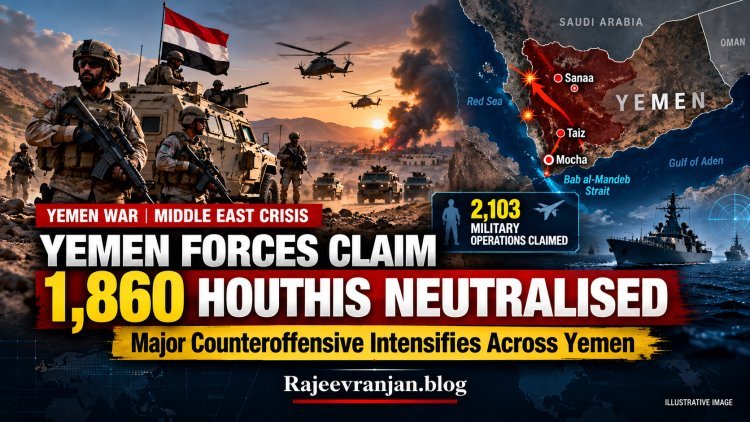
Sanaa/Aden, October 8, 2026: Yemen's internationally recognised government has claimed that its armed forces have neutralised 1,860 Houthi fighters during a sweeping military counteroffensive against the Iran-aligned rebel group.
The operation, known as "Dawn of Yemen," was launched earlier this week to reclaim territory controlled by the Houthis, including strategically important areas along Yemen's Red Sea coastline.
According to military spokesperson Colonel Majid al-Nuzaili, government forces carried out 2,103 precision targeting operations across multiple battlefronts.
The military said the strikes targeted Houthi positions, movements, fortifications, supply routes and military equipment.
However, the spokesperson did not clarify how many of the reported 1,860 fighters had been killed or wounded.
The military's casualty figures have not been independently verified, and the Houthis had not immediately responded to the latest claims.
Yemen Army Reports 2,103 Military Operations Against Houthis
The Yemeni armed forces announced the figures late Wednesday, October 7, as fighting intensified across several regions.
According to Colonel al-Nuzaili, government troops have conducted coordinated attacks against Houthi military installations and troop movements.
The army claimed that hundreds of pieces of military equipment, weapons and defensive positions had been destroyed.
The military spokesperson also released footage purportedly showing strikes on Houthi positions and supply lines.
While the government described the operation as successful, independent confirmation of the reported battlefield losses remains unavailable.
The latest figures are therefore being treated as official military claims rather than verified casualty totals.
What Is Operation 'Dawn of Yemen'?
Operation Dawn of Yemen was announced on Sunday, October 4, by Rashad al-Alimi, chairman of Yemen's Presidential Leadership Council.
The large-scale military campaign aims to reclaim territory captured by Houthi forces and restore the authority of Yemen's internationally recognised government.
A major objective is to regain control over the capital, Sanaa, which has been under Houthi control since 2014.
The operation also seeks to reverse recent Houthi territorial gains along Yemen's western coastline.
Government troops, supported by Saudi-led coalition airpower, have been conducting operations across several fronts.
The renewed fighting marks one of the most significant escalations in Yemen's conflict since a United Nations-brokered truce in 2022 substantially reduced hostilities.
Fierce Fighting Near Strategic Bab al-Mandeb Strait
One of the most important battlegrounds is the area surrounding the Bab al-Mandeb Strait, a narrow maritime passage connecting the Red Sea with the Gulf of Aden.
The strait is a critical route for international commerce, particularly shipments travelling between Asia, Europe and the Middle East.
Recent fighting has focused on areas near the strait and the coastal town of Mocha.
The Houthis captured territory in the region during their September offensive, prompting government forces to launch operations aimed at regaining control.
The outcome of these battles could have significant implications for regional security and global maritime trade.
Any prolonged disruption around Bab al-Mandeb could affect commercial shipping, increase transportation costs and place additional pressure on international energy markets.
Saudi-Led Coalition Reports Strikes on 82 Houthi Military Targets
The counteroffensive has also involved intensified military action by the Saudi-led coalition.
On Wednesday, the coalition announced that it had destroyed 82 Houthi military targets across several Yemeni governorates.
The reported strikes took place in Saada, Hodeidah, al-Jawf and Marib.
According to coalition officials, the targeted facilities included ballistic missile storage locations, command centres, communication systems and weapons depots.
The coalition said its operations were intended to reduce the Houthis' ability to carry out missile and drone attacks.
These developments followed a series of attacks targeting Saudi Arabian infrastructure.
Houthi Attacks on Saudi Airports Kill Three People
The military escalation extended beyond Yemen after missile and drone attacks targeted major airports in Saudi Arabia.
According to Saudi civil aviation authorities, attacks on King Khalid International Airport in Riyadh and Abha International Airport resulted in three deaths and 36 injuries.
One person was killed and eight others were wounded in the Riyadh attack.
At Abha airport, two people were killed and 28 were injured.
The attacks heightened concerns about the expansion of the conflict beyond Yemen's borders.
The Saudi-led coalition subsequently announced retaliatory operations against Houthi military positions.
The Houthis have also launched attacks against infrastructure in areas controlled by Yemen's internationally recognised government.
Yemen's Humanitarian Crisis Worsens as Fighting Intensifies
Beyond the battlefield, the renewed conflict is placing severe pressure on Yemen's civilian population.
According to figures released by the United Nations International Organization for Migration (IOM) on October 7, more than 200,000 people have been displaced by the recent escalation.
Displacement has increased dramatically since mid-September, when approximately 76,000 people had been forced from their homes.
The fighting has affected several governorates, with Taiz among the hardest-hit areas.
Thousands of people have fled their communities in search of food, shelter and safety.
Humanitarian organisations warn that renewed hostilities could deepen food insecurity and further restrict access to healthcare and essential services.
Yemen has already endured years of civil war, economic collapse and widespread humanitarian suffering.
The latest escalation threatens to reverse previous efforts to stabilise the country.
Why Is the Yemen Conflict Important for the Global Economy?
The conflict has implications that extend beyond the Arabian Peninsula.
Yemen's location near the southern entrance to the Red Sea places it close to one of the world's most strategically important maritime corridors.
The Bab al-Mandeb Strait links shipping routes between the Indian Ocean and the Suez Canal.
Escalating military activity in this region could create additional risks for commercial vessels and energy shipments.
Potential consequences include higher shipping insurance costs, longer delivery routes and increased volatility in oil markets.
The situation is particularly significant because regional tensions have already disrupted some energy transportation routes.
For major oil-importing economies such as India, any sustained increase in international crude prices could create economic pressures.
However, the extent of these effects will depend on whether fighting disrupts shipping and energy supplies.
Background: Why Have Yemen's Government and Houthis Been Fighting?
Yemen's prolonged conflict intensified after the Houthi movement seized the capital, Sanaa, in September 2014.
The takeover weakened the internationally recognised government and led to a major political and military crisis.
In March 2015, a Saudi-led military coalition intervened in support of the government.
The conflict subsequently developed into a prolonged struggle involving local political factions and competing regional interests.
Saudi Arabia and its allies accuse Iran of supporting the Houthis with weapons and military assistance.
Iran rejects allegations of directly controlling the movement, while the Houthis maintain that they act independently.
The United Nations-brokered truce in 2022 helped reduce large-scale hostilities, but it did not resolve Yemen's underlying political divisions.
The latest military escalation demonstrates how fragile that period of relative calm has become.
What Happens Next in the Yemen War?
The immediate focus is likely to remain on government military operations near Bab al-Mandeb, Mocha and Taiz.
The key questions are whether government forces can hold territory they reclaim, whether the Houthis can sustain their counterattacks and whether diplomatic efforts can prevent further escalation.
Another major concern is the possibility of additional attacks on civilian infrastructure and commercial shipping routes.
International organisations are expected to continue monitoring the humanitarian consequences.
The United Nations and aid agencies have repeatedly stressed the importance of protecting civilians and allowing humanitarian assistance to reach affected communities.
Independent verification of battlefield casualty figures will also remain essential as competing military claims emerge.
Yemen Faces Another Dangerous Escalation
The Yemeni government's claim that 1,860 Houthi fighters have been neutralised highlights the reported scale of its ongoing military offensive.
With more than 2,100 targeting operations announced, the campaign represents a major effort to challenge Houthi control over strategic territory.
However, the true number of deaths and injuries remains unclear.
As government forces and Houthi fighters continue battling for control of key areas, civilians face growing displacement, insecurity and humanitarian hardship.
The latest developments underscore the urgent need to protect civilian lives and pursue a sustainable political settlement.
For Yemen, the greatest challenge remains achieving lasting peace after more than a decade of devastating conflict.






























![States PCS: Bihar GK [बिहार सामान्य ज्ञान एवं सामान्य अध्ययन प्रश्न]](https://rajeevranjan.blog/uploads/images/2026/09/image_380x226_6a9e6f69b286c.jpg)