PM Modi at India Mobile Congress 2026: ₹5 Lakh Crore Saved Through DBT, Mobile Phones Transform India
PM Modi at India Mobile Congress 2026 says DBT prevented ₹5 lakh crore in leakages. Highlights mobile banking, healthcare, 5G and participation from 100+ countries.
 Rajeev
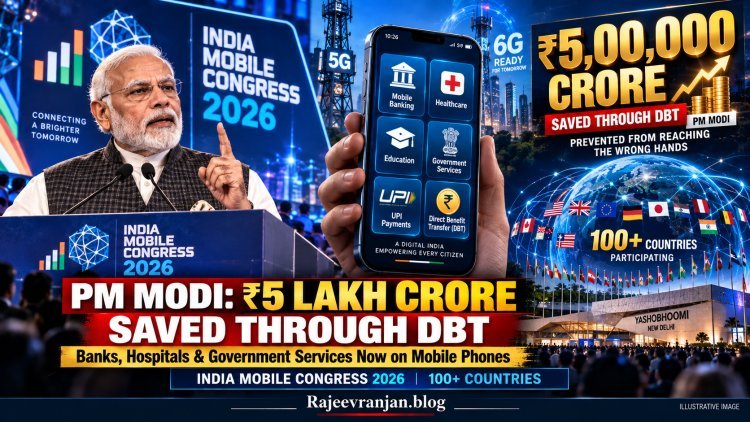

PM Modi Says Banks, Hospitals Are Now in Mobile Phones; Claims ₹5 Lakh Crore Saved as India Mobile Congress Goes Global
New Delhi, October 8, 2026: Prime Minister Narendra Modi on Thursday highlighted India's rapidly expanding digital economy, saying that mobile phones have transformed from basic communication devices into powerful platforms for banking, healthcare, education and government services.
Addressing the 10th edition of India Mobile Congress (IMC 2026) at Yashobhoomi in New Delhi, the Prime Minister said India's Direct Benefit Transfer (DBT) system had prevented nearly ₹5 lakh crore in government funds from being diverted or reaching unintended recipients.
Modi also highlighted the growing international stature of India Mobile Congress, which began as a primarily domestic telecommunications event and has expanded into a global technology platform attracting participants from more than 100 countries.
The Prime Minister described mobile connectivity as a central pillar of India's digital transformation, emphasizing its contribution to greater convenience, reduced costs and improved access to essential services.
The event, jointly organized by the Department of Telecommunications and the Cellular Operators Association of India, is being held from October 7 to 10 under the theme "Scale Without Boundaries."
'Banks, Hospitals and Government Offices Are Now in Your Phone': PM Modi
During his address, Prime Minister Modi explained how mobile technology has changed the daily lives of millions of Indians.
He said that services which previously required citizens to travel long distances, stand in queues or visit government offices can increasingly be accessed through smartphones.
Banking services, healthcare appointments, educational resources and government assistance are now available through digital platforms.
The Prime Minister emphasized that technological development should not be measured only through faster internet speeds or sophisticated devices, but also through the benefits it delivers to ordinary citizens.
He explained that mobile connectivity has helped reduce travel, waiting times and service costs while improving convenience.
Modi called these improvements technology's biggest citizen dividend.
He said the government's Digital India initiative had placed mobile connectivity at the centre of efforts to make technology accessible to people across income groups and geographical regions.
₹5 Lakh Crore Prevented From Reaching 'Wrong Hands', Claims PM
One of the most significant announcements during the event concerned the government's Direct Benefit Transfer system.
Prime Minister Modi said that more than ₹50 lakh crore had been transferred directly into beneficiaries' bank accounts through DBT.
According to the Prime Minister, digital transfers have helped eliminate intermediaries, reduce irregularities and prevent government funds from being diverted away from their intended recipients.
He claimed that approximately ₹5 lakh crore had been prevented from reaching the wrong hands because of changes in the distribution of welfare benefits.
The Prime Minister argued that the money would have been lost through leakages under the previous system.
He also emphasized his government's determination to continue efforts against irregularities in public welfare distribution.
The ₹5 lakh crore figure represents the government's reported estimate of prevented leakages, rather than an independently verified cash recovery.
What Is Direct Benefit Transfer?
Direct Benefit Transfer is a mechanism through which government subsidies, financial assistance and welfare payments are deposited directly into eligible beneficiaries' bank accounts.
The system aims to improve transparency and reduce administrative inefficiencies by limiting unnecessary intermediaries.
DBT is used in several central government programmes, including financial assistance for farmers, scholarships and selected welfare schemes.
Digital payment infrastructure and bank-account connectivity have helped support this approach.
However, the effectiveness of welfare delivery also depends on accurate beneficiary identification, accessible banking services and mechanisms for resolving payment failures.
PM-KISAN: Over ₹4 Lakh Crore Transferred to Farmers
The Prime Minister also highlighted the government's flagship PM-KISAN Samman Nidhi programme.
He said more than ₹4 lakh crore had been transferred to eligible farmers through the programme.
Under PM-KISAN, qualifying farmer families receive financial assistance directly into their bank accounts.
The scheme is designed to help eligible farming households meet agricultural and domestic expenses.
Modi presented the programme as an example of how technology can deliver government assistance without relying on multiple intermediaries.
He emphasized that direct digital payments help ensure that public funds reach intended beneficiaries.
India Mobile Congress Expands From Domestic Event to Global Platform
Prime Minister Modi also celebrated the growth of India Mobile Congress as it marked its tenth edition.
The event, which began in 2017, has evolved into an international gathering of technology companies, policymakers, telecommunications operators, researchers and startup founders.
According to the government's official event announcement, IMC 2026 is expected to attract participants from more than 100 countries.
The projected scale of the event includes:
| Category | Expected Participation |
|---|---|
| Participating countries | 100+ |
| Visitors and attendees | 1.5 lakh+ |
| Partners and exhibitors | 500+ |
| Startups | 600+ |
| Industry experts and thought leaders | 900+ |
| Technology use cases | 2,000+ |
| Conference sessions | 120+ |
These are the organizers' expectations for the event, rather than final attendance figures.
The expanding international participation reflects India's ambition to strengthen its position in global telecommunications research, manufacturing and digital innovation.
India's 5G Network Reaches Every District, Says PM Modi
Speaking about telecommunications infrastructure, Modi highlighted the rapid expansion of fifth-generation mobile networks.
He said that India had established more than 5.5 lakh 5G base stations, extending coverage to every district in the country.
The Prime Minister also stated that the expansion of high-speed mobile networks had increased internet speeds substantially.
India launched commercial 5G services in October 2022, and operators have since invested in expanding network coverage.
The government regards the development of telecommunications infrastructure as a major component of its broader digital economy strategy.
Improved mobile connectivity can support video consultations, remote education, digital payments and online business operations.
However, district-level 5G availability does not necessarily mean that every household or village has reliable access to the network.
Differences in infrastructure, device affordability and service quality remain important considerations.
Smartphones Are Transforming India's Healthcare System
The Prime Minister highlighted the growing role of digital technology in healthcare.
Mobile phones increasingly allow patients to access healthcare-related services without making repeated physical visits to hospitals.
Digital platforms can support appointment booking, online consultations, medical information and access to certain health records.
Telemedicine services are particularly useful for people living in areas where specialist healthcare facilities are limited.
Mobile connectivity also helped support remote medical consultations during the COVID-19 pandemic.
Although digital healthcare cannot replace physical examinations or emergency treatment, it can improve access to selected medical services.
For India's large rural population, better telecommunications infrastructure could help reduce travel costs and make routine healthcare consultations more convenient.
Digital Education: Government Aims to Reach 25 Crore Students
Education was another major focus of Modi's speech.
The Prime Minister highlighted the role of mobile devices and internet connectivity in making educational content accessible beyond traditional classrooms.
He referred to the DIKSHA digital learning platform and its role in supporting online education.
According to the Prime Minister, the government's broader objective is to connect approximately 25 crore students with digital and online learning resources.
Such platforms can provide access to educational videos, study materials and interactive learning programmes.
However, the success of digital education also depends on affordable internet access, suitable devices, accessible content and support for students who face connectivity barriers.
The Prime Minister presented digital education as an important opportunity to reduce geographical inequalities in learning.
From Digital Payments to Gaming: India's Mobile Economy Expands
Modi also highlighted how smartphones are supporting new economic opportunities.
Beyond communication, mobile devices increasingly serve as platforms for financial transactions, entertainment, online education and content creation.
The rapid adoption of digital payments has made smartphones important tools for small businesses and consumers.
At the same time, improved connectivity has helped expand India's mobile gaming and digital content industries.
The Prime Minister said that more than 50 crore Indians participate in the gaming ecosystem, with growing opportunities in esports and related digital activities.
He also highlighted the rise of content creators, particularly those producing regional-language entertainment and educational material.
These sectors represent emerging opportunities for entrepreneurship and employment, although individual earnings and business outcomes vary considerably.
PM Modi Calls for Global Action Against Cyber Fraud and Deepfakes
While celebrating India's digital achievements, the Prime Minister warned that rapidly expanding connectivity also creates new security challenges.
He identified cyber fraud, identity theft and deepfake technology as major concerns.
Modi called for international cooperation to strengthen the security of telecommunications infrastructure and digital financial transactions.
He urged governments, telecom operators, financial institutions and technology companies to develop mechanisms capable of detecting and preventing fraudulent activities before they reach consumers.
The Prime Minister argued that people should be able to trust the identity of callers, the authenticity of messages and the security of digital transactions.
He also advocated a global framework to address the misuse of artificial intelligence and deepfake technologies.
His remarks highlighted the importance of strengthening digital trust as more public services and financial activities move online.
India Targets 6G, Semiconductors and Telecom Self-Reliance
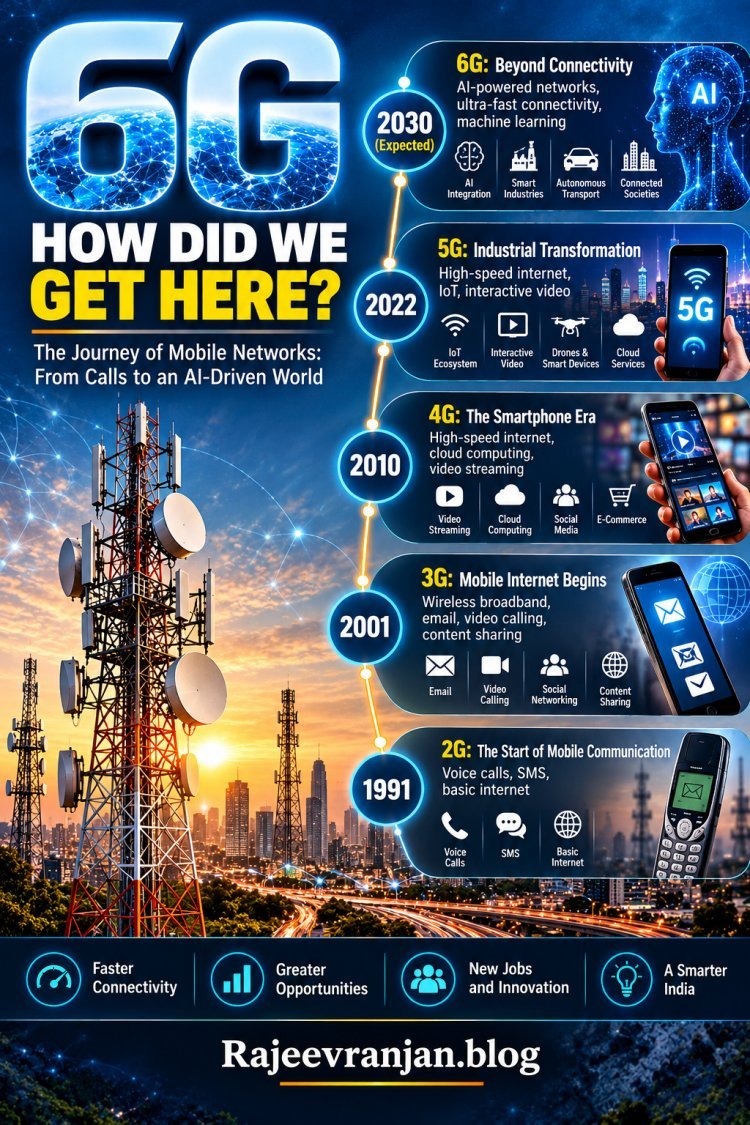
Prime Minister Modi also outlined India's ambition to move beyond telecommunications consumption toward domestic innovation and manufacturing.
He said India was increasingly focused on developing its own technology, product designs and intellectual property.
The government's priorities include expanding semiconductor manufacturing, strengthening electronics production and developing next-generation communication systems.
India Mobile Congress 2026 is showcasing technologies related to:
- 5G and 6G connectivity: Advanced mobile networks and next-generation telecommunications research.
- Artificial intelligence: AI-powered network management and digital services.
- Semiconductors: Domestic chip manufacturing and electronics supply chains.
- Cybersecurity: Technologies to prevent digital fraud and protect users.
- Quantum communication: Emerging approaches to secure information transmission.
- Smart mobility and industrial robotics: Connected transportation and automation technologies.
The Prime Minister linked these initiatives to India's broader ambition of increasing technological self-reliance and expanding its role in global supply chains.
Why PM Modi's Mobile Congress Speech Matters
The Prime Minister's address connected three major elements of India's digital transformation: technological infrastructure, public-service delivery and economic opportunity.
The government's emphasis on Direct Benefit Transfer reflects its argument that digital systems can improve transparency in welfare administration.
At the same time, expanding mobile connectivity has helped create opportunities in education, healthcare, financial services and digital entrepreneurship.
The growing international presence at India Mobile Congress also demonstrates the government's ambition to position India as a major centre for technology development and telecommunications investment.
Nevertheless, challenges remain, including uneven connectivity, digital literacy, online fraud, privacy protection and access to affordable devices.
The long-term success of India's digital transformation will depend not only on infrastructure expansion but also on whether technological benefits reach citizens across different regions and income groups.
Smartphones Become Central to India's Digital Future
Prime Minister Narendra Modi's address at India Mobile Congress 2026 highlighted the expanding role of smartphones in India's economy and public administration.
From mobile banking and healthcare access to digital classrooms and government welfare transfers, smartphones are increasingly becoming gateways to essential services.
His claim that DBT has prevented nearly ₹5 lakh crore in leakages underscores the government's emphasis on technology-driven welfare delivery.
Meanwhile, the participation of more than 100 countries in India Mobile Congress reflects the event's growing international significance.
As India looks toward 6G networks, artificial intelligence and advanced semiconductor manufacturing, the challenge will be to combine technological innovation with accessibility, affordability and digital security.
The central message of the Prime Minister's speech was that the value of technology lies not simply in faster networks but in how effectively it improves people's lives.
























![States PCS: Bihar GK [बिहार सामान्य ज्ञान एवं सामान्य अध्ययन प्रश्न]](https://rajeevranjan.blog/uploads/images/2026/09/image_380x226_6a9e6f69b286c.jpg)