Social Media Ban for Minors in India: Protection or Illusion? Why Experts Are Divided
Should India ban social media for minors? Discover why child psychologists, cyber experts, and policymakers debate this move, its risks, and practical alternatives.
 Rajeev
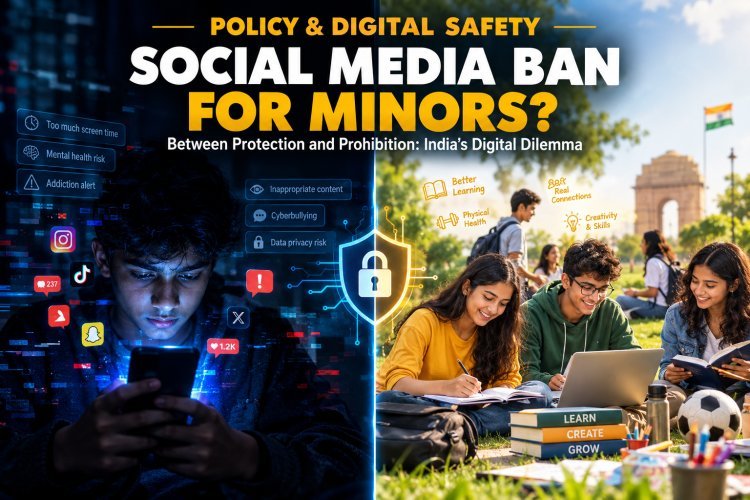

Social Media Ban for Minors in India: A Necessary Shield or a Policy Trap?
Across the globe, governments are rethinking how young audiences interact with digital feeds. Following high-profile legislative moves in nations like Australia and parts of the European Union, India has entered a fierce policy debate: should minors be outright barred from social media platforms?
With over 750 million smartphone users and one of the largest Gen-Z digital populations in the world, any policy decision taken in New Delhi carries massive social, psychological, and technological implications. While parents and child safety advocates celebrate proposed restrictions as a long-overdue shield against rampant cyber risks, tech policy researchers and digital rights advocates warn that blanket bans rarely work—and often backfire.
Why Experts Insist Restrictions Are Urgently Needed
Medical professionals, school counselors, and child rights advocates emphasize that today's algorithms are not designed with developing adolescent brains in mind.
-
Neurocognitive and Mental Health Toll: Constant exposure to algorithmic dopamine loops, infinite scroll interfaces, and hyper-curated aesthetics has correlated sharply with attention deficits, sleep deprivation, body dysmorphia, and clinical anxiety among teenagers.
-
Predatory Algorithms and Cyber Harms: Minors frequently encounter predatory behaviors, financial sextortion, cyberbullying, and unmoderated AI-generated adult content. Advocates argue that leaving children to fend for themselves against sophisticated behavioral engineering is fundamentally unfair.
-
The "Age-Gating" Precedent: Proponents compare social media access to regulated domains like driving licenses, purchasing alcohol, or adult entertainment. The logic is simple: society routinely institutes age minimums when young people lack the emotional maturity to navigate severe systemic risks independently.
-
Protecting the Permanent Digital Footprint: In their early teens, children often share sensitive personal opinions, intimate photos, or geo-locations without understanding that digital data persists indefinitely, potentially damaging future academic or career opportunities.
Why an Outright Ban Could Seriously Backfire
Despite genuine welfare concerns, an outright statutory ban faces severe practical, technical, and human-rights hurdles.
-
Driving Teens Underground: Prohibition rarely ends curiosity. Technologists warn that barring youth from mainstream, audited platforms (like Instagram or YouTube) will drive teenagers toward unmoderated, fringe apps, peer-to-peer networks, and VPN workarounds where child protection safeguards are virtually non-existent.
-
The Age-Verification Surveillance Dilemma: Enforcing a ban requires verifying every user's real-world identity. Requiring government IDs (such as Aadhaar) or facial recognition scans to open social accounts exposes millions of regular citizens to severe privacy vulnerabilities and data breach risks.
-
India’s Shared-Device Reality: In millions of Indian tier-2, tier-3, and rural households, families share a single smartphone. Disentangling a parent's legitimate account usage from a child's access on a shared handset is practically impossible for automated moderation systems.
-
Severing Digital Learning and Communities: For millions of aspiring creators, student coders, rural students, and marginalized youth, social channels offer free access to educational content, peer mentorship, and micro-entrepreneurship opportunities. A blanket prohibition cuts off these positive avenues along with the bad.
The Pragmatic Alternative: Safety by Design, Not Exclusion
Rather than building digital walls, progressive policy analysts advocate for algorithmic accountability and strict systemic defaults:
-
Private by Default: Mandate that accounts registered to minors automatically enforce private visibility, disable direct messages from strangers, and shut off location tracking.
-
Banning Algorithmic Profiling for Kids: Prohibit ad-tech companies from building behavioral tracking profiles or deploying manipulative recommendation feeds targeting under-18s.
-
Mandatory Friction: Implement hard cooldown timers and enforce screen-time cutoffs during late-night hours without requiring intrusive surveillance.
-
Digital Literacy in School Curricula: Equip children early with critical thinking frameworks to spot deepfakes, resist addictive loops, and safeguard their own privacy.
Protecting India's youth in the 21st century requires designing safer digital roads, not banning teenagers from stepping outside.





























![States PCS: Bihar GK [बिहार सामान्य ज्ञान एवं सामान्य अध्ययन प्रश्न]](https://rajeevranjan.blog/uploads/images/2026/09/image_380x226_6a9e6f69b286c.jpg)