Global Tax Rules Being Rewritten: FM Nirmala Sitharaman Urges BRICS to Shape Future of Cross-Border Taxation
Union Finance Minister Nirmala Sitharaman addressed the 2026 BRICS Tax Heads Meeting, urging developing nations to secure a stronger voice as global tax rules are overhauled for the next generation.
 Rajeev
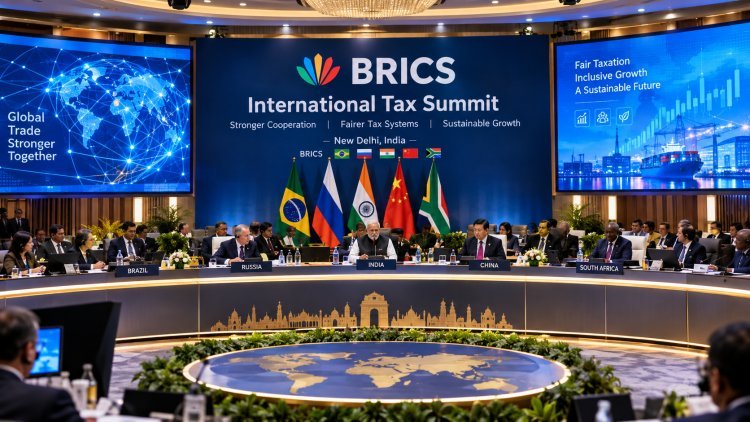

Global Tax Architecture Under Revision: Sitharaman Calls on BRICS for a United Front
International taxation is experiencing its most critical structural transformation in decades. Speaking at the BRICS Tax Heads Meeting 2026 in New Delhi, India’s Union Finance Minister Nirmala Sitharaman emphasized that the multilateral rules governing cross-border economic activity are actively being renegotiated.
Sitharaman underscored that decisions finalized over the coming years—most notably under initiatives like the United Nations Framework Convention on International Tax Cooperation—will define cross-border taxation for an entire generation. Because of this, emerging markets and source jurisdictions across the Global South must assert their perspectives to guarantee the new framework is both fair and sustainable.
Why the Voice of the Global South Matters
Historically, global tax rules were drafted primarily by developed countries, often favoring residence jurisdictions over market or source countries. Developing nations generate substantial economic activity and consumer demand, yet frequently struggle with revenue leakages, profit shifting, and disproportionate enforcement costs.
Highlighting this disparity, Sitharaman noted:
-
Source Jurisdictions: BRICS economies serve primarily as source jurisdictions where real economic value and consumption occur.
-
Hard-Won Capacity: These nations have built extensive domestic tax administrations from the ground up, giving them practical insights into compliance realities.
-
Equity & Durability: Without deep involvement from major developing economies, any renegotiated international tax architecture risks remaining lopsided and ineffective.
India Proposes Two Key BRICS Working Groups
To transform high-level policy dialogue into actionable, long-term collaboration, India’s BRICS Chairship has proposed the creation of two institutional working groups:
-
Working Group on International Taxation and Transfer Pricing:
Transfer pricing disputes present a heavy operational and financial burden for revenue departments in developing countries. This group will function as a permanent platform for member states to share intelligence on treaty interpretations, advance pricing agreements (APAs), mutual agreement procedures (MAPs), and joint audit practices.
-
Working Group on Revenue Statistics:
Standard global revenue frameworks frequently fail to capture the fiscal realities of emerging markets. This group aims to build standardized measurement metrics that accurately reflect the domestic economic baselines of BRICS economies.
Revenue Secretary Arvind Shrivastava echoed the Finance Minister’s sentiments, noting that while developing nations represent a massive share of the world's population and trade, their collective voice in global tax standard-setting has historically remained insufficient.
Leveraging Technology for Tax Administration
India also shared its domestic transformation towards modernizing tax compliance through public digital infrastructure. Sitharaman pointed to India's scalable adoption of:
-
Faceless Assessment Schemes: Eliminating territorial bias and individual discretion.
-
Real-Time Data Integration: Deploying pre-filled income tax forms and automated invoice authentication.
-
AI-Assisted Taxpayer Support: Streamlining taxpayer queries while detecting anomalies in real time.
To assist fellow member states, practical instruments such as a BRICS Tax Collaboration Tool, a Tax Knowledge Hub, and a Cross-Learning Lab are being rolled out to facilitate continuous technical exchange.
Looking Beyond Single Presidencies
India stressed that these initiatives are structured to outlast any single year's chairship. By building durable institutional mechanisms, the BRICS bloc can ensure sustained momentum as leadership rotates in subsequent years, preserving a united stance during UN multilateral negotiations.
As cross-border digital services, remote work, and international supply chains blur traditional geographical boundaries, the push led by India signals a determined effort by emerging powers to rewrite global fiscal policies on an equal footing.



























![States PCS: Bihar GK [बिहार सामान्य ज्ञान एवं सामान्य अध्ययन प्रश्न]](https://rajeevranjan.blog/uploads/images/2026/09/image_380x226_6a9e6f69b286c.jpg)