US-Russia Diesel Deal 2026: Trump-Putin Agreement Sends Fuel Prices Lower
Trump announces a US-Russia diesel deal as sanctions ease and diesel futures fall nearly 5%. Explore its impact on fuel prices, Ukraine and global markets.
 Rajeev
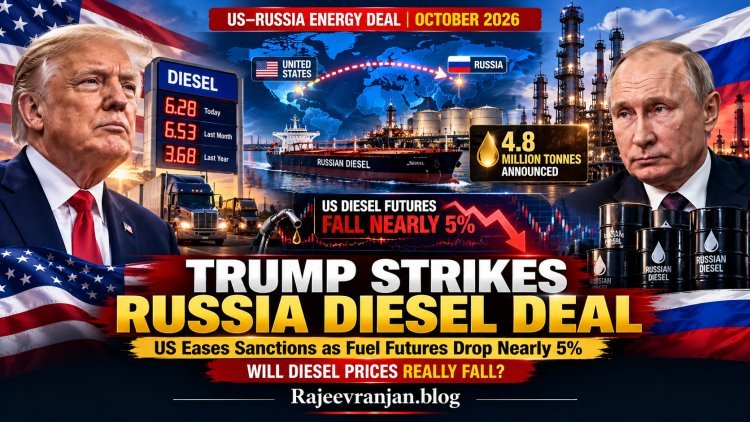

Trump's Russian Diesel Deal Shakes Global Energy Markets: Fuel Prices Fall, but Will Americans Really Benefit?
Washington's unexpected decision to reopen the door to Russian diesel has sent energy markets lower while raising difficult questions about Ukraine, sanctions and America's energy security.
WASHINGTON, October 10, 2026: A phone conversation between US President Donald Trump and Russian President Vladimir Putin has produced one of the most controversial energy agreements of the year.
On Friday, October 9, Trump announced that Russia had agreed to supply substantial quantities of diesel to American and international markets, a move intended to address soaring fuel costs ahead of the November 3 US congressional elections.
The announcement was followed by a sharp decline in American diesel futures and a temporary relaxation of US restrictions on Russian diesel shipments.
Yet the agreement has created an uncomfortable contradiction in Washington's foreign policy.
For years, the United States has attempted to restrict Russia's energy revenues because of Moscow's war in Ukraine. Now, with American farmers, truck drivers and businesses struggling under near-record diesel prices, the Trump administration is turning to Russia for additional supplies.
The agreement has drawn criticism from Ukrainian President Volodymyr Zelenskyy and lawmakers in Washington, while energy analysts question whether it will deliver meaningful savings at the pump.
The Deal: How Much Diesel Will Russia Supply?
Trump announced the agreement following what he described as a successful conversation with President Putin.
According to the US president, Russia has committed to supplying diesel in several stages, beginning with an immediate shipment of more than 300,000 metric tonnes.
Further deliveries are expected over the coming months.
Russia's Announced Diesel Supply Plan
| Supply Schedule | Diesel Quantity |
|---|---|
| Immediate supply | More than 300,000 metric tonnes |
| November 2026 | 500,000 metric tonnes |
| Subsequent delivery | 1 million metric tonnes |
| Additional conditional supply | 3 million metric tonnes |
| Total announced commitment | Approximately 4.8 million metric tonnes |
The final 3 million tonnes depend on the condition and operational capacity of Russian refineries.
The announcement therefore represents a proposed supply schedule, not confirmation that all shipments have already been delivered.
Trump said his primary objective was to reduce fuel costs for American farmers, ranchers and truck drivers.
However, officials have not publicly clarified the complete commercial terms of the arrangement, including payment mechanisms, specific buyers and delivery schedules.
Why Is Trump Buying Diesel From Russia?
The answer lies in a global fuel supply crisis that has pushed diesel prices in the United States to historically high levels.
Diesel is essential to the American economy because it powers freight trucks, agricultural machinery, industrial equipment and parts of the transportation network.
When diesel becomes expensive, the effects spread far beyond petrol stations.
Businesses face higher transportation expenses, farmers pay more to operate machinery, and retailers may pass increased distribution costs on to consumers.
The situation has become particularly challenging because of disruptions to global energy supplies linked to the wars in Iran and Ukraine.
Damage to refining infrastructure, restrictions on exports and uncertainty surrounding important shipping routes have reduced the availability of refined fuels.
Trump's agreement with Russia is intended to increase available diesel supplies and reduce pressure on the market.
However, whether additional Russian shipments can sustainably lower prices remains uncertain.
Diesel Futures Drop Nearly 5% Following Announcement
Financial markets reacted quickly to Trump's announcement.
US diesel futures declined by more than 4.8% following news of the proposed Russian supplies.
The decline reflected expectations that additional fuel could help ease shortages in an already strained market.
However, lower futures prices do not automatically translate into immediate reductions at retail fuel stations.
Several factors influence the price consumers pay, including refining costs, transportation expenses, regional supply conditions, taxes and retailer margins.
US Diesel Market: Key Figures
| Indicator | Reported Figure |
|---|---|
| US average diesel price | Approximately $6.28 per gallon |
| September 22 diesel price peak | Approximately $6.53 per gallon |
| Average price a year earlier | Approximately $3.68 per gallon |
| Diesel futures reaction | Down more than 4.8% |
| Announced Russian supply | Approximately 4.8 million metric tonnes |
The figures illustrate the financial pressure facing American businesses and households.
Even after the initial market decline, diesel remains significantly more expensive than it was a year ago.
Washington Temporarily Relaxes Sanctions on Russian Diesel
The agreement represents a significant change in Washington's approach to Russian energy exports.
Following Russia's invasion of Ukraine in 2022, the United States introduced restrictions intended to limit Moscow's ability to earn revenue from international energy markets.
These measures formed part of broader Western economic pressure on Russia.
On October 9, however, the US Treasury Department issued a temporary authorization allowing qualifying Russian diesel shipments to enter international markets.
The authorization extends until April 7, 2027.
The measure is intended to facilitate diesel supplies during the current energy shortage.
Importantly, the authorization does not mean that all US sanctions against Russia have been removed.
Other restrictions connected to Russia's financial system, energy industry and war in Ukraine remain separate from this temporary measure.
The policy change nevertheless marks a notable relaxation of pressure on one part of Russia's energy trade.
Zelenskyy Criticises Trump-Putin Agreement
The announcement triggered a strong reaction from Ukraine.
President Volodymyr Zelenskyy criticised the decision, arguing that allowing Russian fuel exports could strengthen Moscow's ability to finance its military campaign.
Ukraine has repeatedly urged Western governments to maintain pressure on Russia's energy sector.
Oil and gas exports are important sources of revenue for the Russian economy.
Any relaxation of restrictions that increases Russian energy earnings could therefore carry consequences beyond international fuel markets.
The decision has also created debate within the United States.
Some lawmakers argue that easing sanctions undermines Washington's efforts to pressure Russia over the conflict.
Others may view the agreement as a pragmatic response to rising American living costs.
The central dispute concerns whether short-term economic relief should take priority over maintaining pressure on Moscow.
A Political Gamble Ahead of the US Midterm Elections
The timing of the agreement is politically significant.
Americans are scheduled to vote in congressional elections on November 3, 2026.
Rising fuel prices and broader inflation have become major economic concerns.
Diesel costs are particularly important because they influence the price of food, manufactured goods and transportation services.
Higher freight expenses can increase the cost of moving products from farms and factories to stores.
For the Trump administration, reducing diesel prices could help address dissatisfaction among voters concerned about the cost of living.
However, the agreement also creates political risks.
Critics have questioned why the United States is easing restrictions on Russian energy while continuing to oppose Moscow's military actions in Ukraine.
The administration must now balance its domestic economic priorities with its international commitments.
Whether the agreement produces meaningful fuel-price relief before the election remains uncertain.
The Bigger Question: Can Russian Diesel Really Lower Global Fuel Prices?
Despite the dramatic announcement, several energy-market specialists remain sceptical about the likely economic impact.
The problem is not simply the availability of Russian diesel.
The global market is also facing disruptions to refining capacity and established transportation routes.
A temporary increase in Russian exports may improve supply in particular regions without resolving the broader shortage.
Three Reasons the Price Impact Could Be Limited
First, the additional supply may be relatively small compared with global demand.
The initial shipment of approximately 300,000 metric tonnes represents about 2.25 million barrels of diesel.
For comparison, the United States exports approximately 1.5 million barrels of diesel per day.
That means the initial Russian supply is not large enough, by itself, to transform the global market.
Second, Russian exports may simply change trade routes.
If Russian diesel is redirected from existing customers to the United States, those customers may need to purchase fuel elsewhere.
Such changes can alter regional prices without substantially increasing worldwide supply.
Third, global refining disruptions remain unresolved.
Energy infrastructure damage and shipping difficulties continue to restrict the availability of refined petroleum products.
Analysts therefore believe the agreement could provide some limited relief, but a sustained decline in diesel prices will depend on broader improvements in supply.
Energy specialists interviewed by the Associated Press expressed doubts that the deal would substantially reduce prices across the United States or Europe.
Why Russia Could Benefit More Than American Consumers
Although the agreement is being presented as an attempt to reduce American fuel costs, Russia could emerge as a significant beneficiary.
Energy exports remain a major source of revenue for Moscow.
The temporary relaxation of sanctions may allow Russian companies to sell additional refined petroleum products into international markets.
This could create fresh revenue opportunities at a time when Russian refining operations have been disrupted by Ukrainian attacks.
Russia has also faced difficulties supplying its domestic fuel market.
Earlier restrictions on diesel exports were introduced partly to protect domestic availability.
The ability to resume exports therefore depends on whether Russian refineries can produce sufficient quantities without creating new shortages at home.
Some analysts believe the agreement could provide Moscow with economic benefits even if American consumers experience only modest fuel-price reductions.
The commercial outcome will depend on actual shipments, prevailing market prices and the implementation of sanctions relief.
What Does the US-Russia Diesel Agreement Mean for India?
India has maintained significant energy-trade relations with Russia since the beginning of the Ukraine war.
Russian crude oil has been an important component of India's energy import strategy.
The new agreement may therefore have implications for discussions about international energy trade and sanctions.
However, the effects on India are not straightforward.
1. Questions About Consistency in US Energy Policy
Washington has previously criticised countries for maintaining substantial energy ties with Russia.
The latest American decision may prompt questions about whether restrictions are being applied consistently.
India has long emphasised the importance of securing affordable energy supplies to meet its domestic requirements.
The US-Russia agreement could strengthen arguments that governments often prioritise energy security during periods of market disruption.
Nevertheless, the latest diesel authorization does not automatically change the sanctions or trade rules applicable to every Indian transaction.
2. Potential Impact on International Oil Prices
If Russian diesel exports genuinely increase global supplies, some pressure on refined fuel markets could ease.
That could indirectly benefit energy-importing economies.
However, India's domestic diesel prices depend on several factors, including crude oil costs, refining margins, exchange rates, taxes and domestic pricing decisions.
A decline in American diesel futures should not be interpreted as confirmation that diesel prices in India will fall.
3. Opportunities and Challenges for Indian Refiners
India has significant refining capacity and participates in international petroleum-product markets.
Changes in diesel trade flows may affect export opportunities and regional price differences.
If Russian diesel becomes more widely available, it could increase competition in certain markets.
Alternatively, improved global supply conditions could reduce price volatility.
The direction of the impact will depend on where Russian supplies are delivered and how refiners adjust their commercial strategies.
4. Possible Implications for the Indian Rupee
Energy prices influence India's import bill and demand for foreign currency.
Sustained reductions in global crude oil prices can help ease import-related pressure.
However, the diesel agreement alone is unlikely to determine movements in the rupee.
Currency markets will also respond to global interest rates, capital flows, geopolitical developments and broader economic conditions.
For India, the key issue is whether the agreement leads to a lasting improvement in international energy supplies rather than a temporary market reaction.
What Happens Next? Five Developments Worth Watching
The significance of the agreement will become clearer over the coming weeks.
Russian deliveries: Markets will examine whether the announced quantities are actually exported according to schedule.
US retail prices: Diesel prices at American fuel stations will provide an indication of whether wholesale market declines are reaching consumers.
Russian refinery capacity: Damage to energy infrastructure may limit Russia's ability to fulfil the announced commitments.
Ukraine's response: Kyiv and its international partners may increase pressure on Washington to reconsider sanctions relief.
Global oil and diesel markets: Traders will watch refinery operations, shipping routes and supply disruptions in the Middle East.
These developments will help determine whether Trump's announcement marks the beginning of a sustained energy-market adjustment or a temporary attempt to ease prices.
The Bottom Line: A Deal With Economic Promise and Political Costs
Donald Trump's decision to seek diesel supplies from Russia represents an important shift in American energy policy.
The administration hopes additional fuel will reduce pressure on businesses and consumers at a politically sensitive moment.
Markets have already reacted, with diesel futures falling nearly 5% following the announcement.
But the longer-term consequences remain uncertain.
Energy analysts warn that the additional supply may not be sufficient to resolve global shortages, while critics argue that relaxing sanctions could strengthen Russia's finances during the war in Ukraine.
For the United States, the deal creates a difficult balance between domestic economic relief and foreign-policy commitments.
For Russia, it offers the possibility of renewed energy revenues.
And for energy-importing countries such as India, the eventual impact will depend on whether the agreement meaningfully changes global fuel supplies and prices.
The central question is no longer whether Trump can secure diesel from Russia. It is whether doing so can deliver cheaper fuel without weakening Washington's broader strategic objectives.