Drone Attack Near Strait of Hormuz: 2 Indian Seafarers Missing, India Issues Strong Condemnation
A drone attack on the commercial tanker MT Petro Dolphin near the Strait of Hormuz has left 2 Indian seafarers missing. India condemns the strikes and demands urgent rescue updates.
 Rajeev
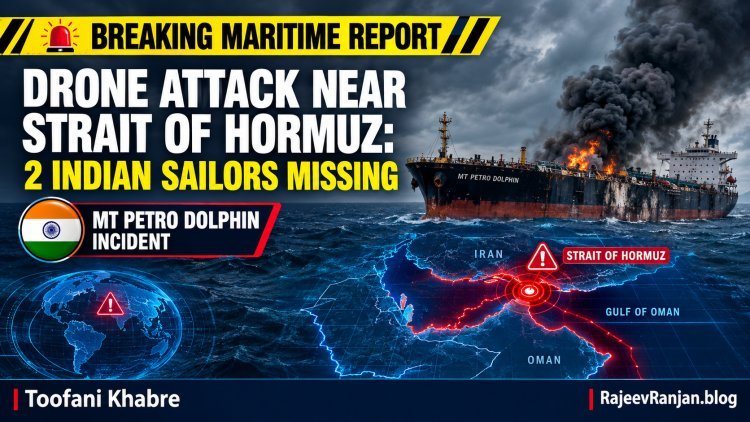

Drone Attack Near Strait of Hormuz Leaves Two Indian Seafarers Missing: India Issues Strong Condemnation and Calls for Immediate Halt on Ship Strikes
Maritime & Geopolitics Desk: Tensions in West Asia's critical maritime routes surged once again after a commercial oil tanker carrying an Indian crew was struck by an unmanned aerial vehicle (drone) near the vital Strait of Hormuz. The attack on the Nicaragua-flagged vessel, MT Petro Dolphin, occurred off Sohar Anchorage, Oman. While nine Indian crew members were safely rescued, two seafarers—identified as Bir Bahadur Yadav and Amit Singh—remain missing as search and rescue operations continue.
The Government of India and the Forward Seamen’s Union of India (FSUI) have expressed severe concern over the escalation of strikes on commercial merchant vessels navigating international waters.
1. Details of the Attack off Sohar Anchorage
According to maritime reports and official statements, the commercial vessel MT Petro Dolphin was targeted at Sohar Anchorage near the Gulf of Oman, an essential gateway leading into the Strait of Hormuz.
-
Crew Onboard: The vessel was manned by a 12-member crew, including 11 Indian national seafarers.
-
Impact & Damage: The drone impact sparked flames on board the vessel. Local emergency teams and nearby naval units rendered immediate assistance to extinguish the fire and pull sailors out of danger.
-
Rescued vs. Missing: Nine sailors were successfully evacuated to safety. However, intense efforts are currently underway to trace the two missing Indian crew members.
2. India Condemns Escalating Maritime Attacks
Following the incident, New Delhi voiced strong condemnation regarding deliberate strikes on civilian merchant ships.
-
Call for Restraint: India reiterated that freedom of navigation and the safety of international commercial crews are non-negotiable.
-
Union Demands Action: The Forward Seamen’s Union of India (FSUI) urged global maritime bodies and United States Central Command (CENTCOM) to step up protection measures for merchant sailors operating in high-risk West Asian corridors.
3. Strategic Importance of the Strait of Hormuz
The Strait of Hormuz, connecting the Persian Gulf with the Gulf of Oman and the Arabian Sea, is the world's most critical oil transit chokepoint.
| Dimension | Key Highlight |
| Global Petroleum Trade | Nearly 20% to 25% of the world's petroleum supply passes through this narrow maritime passage. |
| Indian Maritime Workforce | Thousands of Indian seafarers work onboard global commercial fleets transiting through these volatile waters daily. |
| Escalating Threat | Recent regional conflicts in West Asia have heightened drone and missile risks for civilian oil tankers. |
4. Safety Protocol Advisory for Indian Seafarers
Maritime authorities and naval monitoring agencies have issued updated advisories for shipping lines operating in the Gulf of Oman and Arabian Sea:
-
Enhanced Vigilance: Maintaining round-the-clock visual and radar watches for low-flying drones or unflagged speedboats.
-
Naval Escort Coordination: Registering transit details with naval coalitions and regional maritime security coordination centers.
-
Crew Safety Protocols: Designated safe-haven zones (citadels) inside vessels equipped with emergency communications equipment.
Urgent Action Needed to Safeguard Merchant Mariners
The attack on MT Petro Dolphin serves as a grim reminder of the rising dangers faced by international merchant sailors in conflict zones. As families await news of the missing crew members, international maritime organizations must collaborate to enforce strict security corridors and protect seafarers who keep global trade moving.




























![States PCS: Bihar GK [बिहार सामान्य ज्ञान एवं सामान्य अध्ययन प्रश्न]](https://rajeevranjan.blog/uploads/images/2026/09/image_380x226_6a9e6f69b286c.jpg)