


Sabarimala Row & Kerala Polls 2026: Left’s Vague Stand on Women Entry
With Kerala Assembly Polls 2026 nearing, the Sabarimala women’s entry row resurfaces. Analyze the LDF's shifting stance, the Supreme Court's 9-judge bench hearing, and political impact
 Rajeev
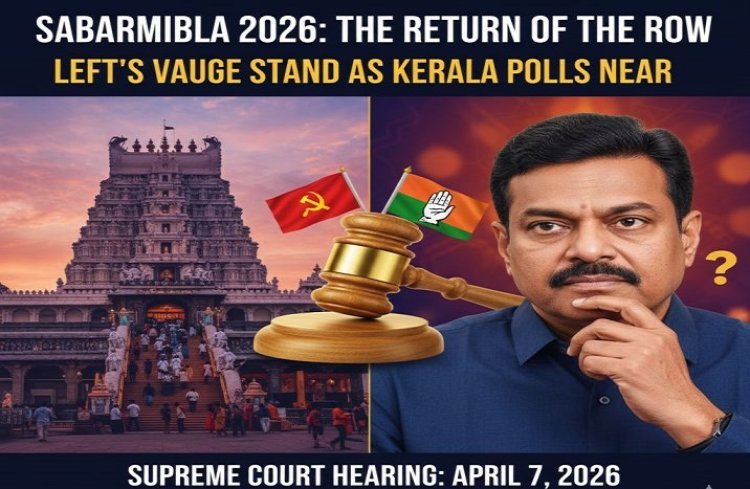

As Kerala gears up for the high-stakes 2026 Assembly Elections, the ghost of the Sabarimala women’s entry controversy has returned to haunt the political landscape. The ruling Left Democratic Front (LDF), which once championed "renaissance values" and social reform by supporting the entry of women of all ages, appears to have shifted toward a more "vague" and "cautious" position to avoid a repeat of the 2019 Lok Sabha debacle.
The timing is critical. On February 16, 2026, the Supreme Court of India announced that a nine-judge Constitution Bench will begin final hearings on the review petitions starting April 7, 2026.
The Left’s Diplomatic "Flip-Flop"
In 2018, the Pinarayi Vijayan-led government was adamant about implementing the Supreme Court verdict that allowed women of menstruating age into the hill shrine. Fast forward to 2026, and the tone has changed significantly.
Kerala’s Law Minister, P. Rajeev, recently stated that the issue is a "complex constitutional matter" that cannot be answered with a simple "yes or no."
"The government stands to protect the faith of devotees. However, the Supreme Court has framed seven fundamental questions regarding religious freedom that require deep deliberation," Rajeev told reporters.
Why the Shift?
Political analysts suggest the Left is playing it safe for three main reasons:
-
The 2019 Lesson: The LDF suffered a near-total washout in the 2019 Lok Sabha polls, winning only one seat, largely due to a consolidated "devotee vote" against the government’s aggressive stance.
-
Caste Organizations: Powerful groups like the Nair Service Society (NSS) and the SNDP Yogam have reiterated that traditional customs must be preserved.
-
Governance vs. Ideology: CPI(M) State Secretary M.V. Govindan hinted that the government’s administrative stance need not always mirror the party’s ideological line, allowing the government room to maneuver in court without alienating its base.
Opposition Sharpens Its Claws
The United Democratic Front (UDF) and the BJP are leaving no stone unturned to corner the Chief Minister.
-
UDF (Congress-led): Leader of the Opposition V.D. Satheesan has challenged the government to withdraw its 2018 affidavit supporting women’s entry. The UDF has promised that if voted to power, they will file a fresh affidavit to "protect the traditions" of Lord Ayyappa.
-
NDA (BJP-led): The BJP has combined the faith issue with allegations of "gold theft" at the temple, turning it into a campaign about the "mismanagement of Hindu temples" by a secular government.
Supreme Court's "Tight Schedule" for April 2026
The nine-judge bench, led by Chief Justice Surya Kant, has set a strict timeline for the proceedings that will conclude just as the Kerala election campaigning hits its peak:
| Date Window | Agenda |
| April 7 – April 9 | Hearing petitioners challenging the 2018 verdict (Pro-Tradition) |
| April 14 – April 16 | Hearing those opposing the review (Pro-Reform) |
| April 21 – April 22 | Rejoinders and concluding submissions by Amicus Curiae |
Impact on 2026 Polls
With the LDF seeking a historic third consecutive term, the "Sabarimala factor" remains a wild card. By refusing to take a definitive stand, the Left hopes to neutralize the opposition’s attack while keeping its progressive image intact. However, in a state where "faith vs. reform" can swing thousands of votes in key constituencies like Pathanamthitta and Pandalam, a "vague stand" might be as risky as a firm one.
As April 2026 approaches, Kerala finds itself at a familiar crossroads: between the constitutional mandate of equality and the deeply held traditions of a million devotees.