CJP Protest Delhi: Abhijeet Dipke Released, Fresh Jantar Mantar Demonstrations Face Police Action
CJP protest Delhi: Abhijeet Dipke released after detention as Cockroach Janta Party resumes Jantar Mantar protests demanding CEC Gyanesh Kumar's resignation.
 Rajeev
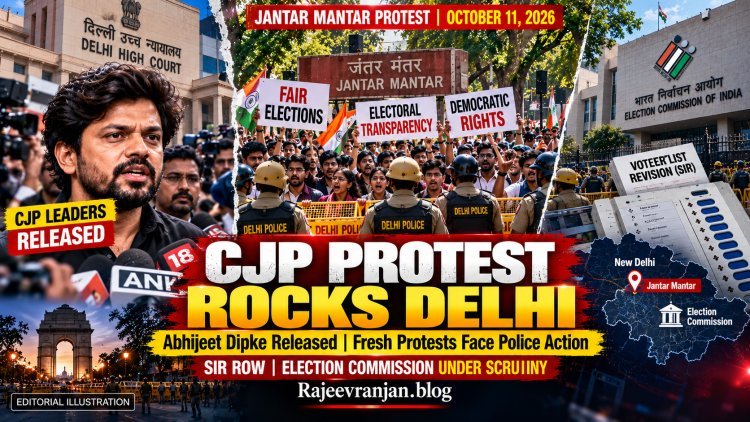

Delhi Protest Escalates: CJP Leaders Freed, but Demonstrators Return to Streets Over Election Commission Row
Police restrictions fail to end the confrontation as the youth-led Cockroach Janta Party vows to continue its campaign against Chief Election Commissioner Gyanesh Kumar.
NEW DELHI, OCTOBER 11, 2026 — The release of three detained protest leaders was expected to ease tensions in the national capital. Instead, Delhi witnessed another day of demonstrations, police restrictions and renewed demands for accountability from the Election Commission of India.
Supporters of the Cockroach Janta Party (CJP) and allied student organisations continued protesting on Sunday, demanding the resignation of Chief Election Commissioner Gyanesh Kumar over the controversial Special Intensive Revision (SIR) of electoral rolls.
CJP founder Abhijeet Dipke, along with fellow leaders Saurav Das and Ashutosh Ranka, was released following a court order after being detained at Delhi airport on Saturday.
The three had travelled to Delhi to participate in a planned demonstration at Jantar Mantar but were intercepted by police before reaching the protest venue.
Their release came as fresh demonstrations erupted across parts of the capital.
According to Reuters, hundreds of protesters were detained for a second consecutive day on Sunday.
The developments have transformed the dispute over voter-list revisions into a wider confrontation over electoral transparency, political dissent and the right to peaceful assembly.
From Airport Detention to Court-Ordered Release: What Happened to Abhijeet Dipke?
The events began on Saturday morning when Abhijeet Dipke arrived at Indira Gandhi International Airport from Mumbai.
He was accompanied by CJP leaders Saurav Das and Ashutosh Ranka.
All three were detained by Delhi Police shortly after their flight landed.
Their detention came ahead of the October 10 demonstration planned at Jantar Mantar.
Police had denied permission for the protest, citing security concerns and the organisers' failure to meet the prescribed advance-notice requirements.
The CJP leadership criticised the move, arguing that the police restrictions were intended to prevent citizens from expressing legitimate concerns about the Election Commission.
The following day, a New Delhi court ordered the release of the three leaders.
According to Associated Press reporting, the release was subject to a condition requiring them to maintain public peace.
The precise interpretation of the release conditions subsequently became a point of disagreement.
Nevertheless, the court's decision allowed the CJP leadership to resume its political activities outside detention.
CJP Announces Fresh 'Chalo Jantar Mantar' Protest
Despite the police action on Saturday, the Cockroach Janta Party announced another demonstration for Sunday morning.
The organisation urged supporters to assemble at Jantar Mantar at 10 AM.
CJP leader Ajinkya Shinde criticised the previous day's detentions and declared that the movement would continue pressing for Chief Election Commissioner Gyanesh Kumar's resignation.
Organisers said they would not abandon their campaign because of restrictions imposed by police.
Student groups and civil society activists also expressed support for renewed demonstrations.
However, Delhi Police maintained restrictions around sensitive locations.
According to The Indian Express, authorities warned that groups of five or more people assembling in restricted areas could face detention.
The police said public-order concerns remained significant, even as some restrictions were eased.
These competing positions set the stage for another day of confrontation between protesters and security personnel.
Hundreds Detained as Protests Continue for Second Day
Sunday's demonstrations followed an extensive police operation on Saturday.
During the first day of protests, Delhi Police detained large numbers of demonstrators attempting to reach Jantar Mantar.
Protesters also gathered at other locations after access to the designated protest site was restricted.
According to The Indian Express, spontaneous demonstrations took place around Connaught Place, Raj Ghat, Dilli Haat and the Safdarjung flyover.
Police used buses and other vehicles to transport detained demonstrators away from protest locations.
The newspaper reported an estimated 7,000 detentions across Delhi on Saturday.
That figure refers to people detained during the police operation and should not be interpreted as the number formally arrested or charged.
On Sunday, Reuters reported that hundreds more protesters were detained as demonstrations continued.
The scale of the police response has attracted criticism from opposition figures and civil society organisations.
Authorities, meanwhile, have defended restrictions as necessary for maintaining public order.
The competing accounts underscore the importance of distinguishing between temporary detention, formal arrest and allegations of excessive police force.
CJP Delhi Protest: Latest Developments at a Glance
| Development | Latest Reported Status |
|---|---|
| Protest Organisation | Cockroach Janta Party (CJP) |
| Key Leader | Abhijeet Dipke |
| Main Protest Location | Jantar Mantar, New Delhi |
| First Major Demonstration | October 10, 2026 |
| Fresh Protest Call | October 11, 2026 |
| Main Demand | Resignation of CEC Gyanesh Kumar |
| Reason for Protest | Alleged irregularities in electoral-roll revision |
| Dipke's Status | Released following court intervention |
| Other Released Leaders | Saurav Das and Ashutosh Ranka |
| Police Action | Continued restrictions and detentions |
| Sunday's Developments | Hundreds reportedly detained |
| Overall Situation | Protests and political dispute continuing |
Source: Reuters, Associated Press and The Indian Express, October 11, 2026.
Why Is the Cockroach Janta Party Protesting?
At the centre of the controversy is the Election Commission's Special Intensive Revision of electoral rolls.
The SIR process is intended to update voter lists by identifying entries that may require correction or removal.
These can include records relating to deceased individuals, voters who have relocated and duplicate or otherwise ineligible registrations.
However, opposition parties and protest organisations have challenged the scale and implementation of the exercise.
They argue that the process could result in eligible citizens losing their voting rights.
Reports concerning more than 130 million voter-list entries have become a major point of political disagreement.
Protest groups have cited these figures while alleging that the revision disproportionately affects certain communities.
The Election Commission and the government have rejected allegations of deliberate electoral manipulation.
They maintain that verification is necessary to protect the accuracy and credibility of electoral rolls.
An important distinction: The number of voter-list entries identified or removed during a revision exercise does not, by itself, establish that every affected person was an eligible voter wrongfully disenfranchised.
Determining whether legitimate voters were excluded requires evidence about individual cases, verification procedures and opportunities for appeal.
Who Is Abhijeet Dipke, the Face of the CJP Movement?
Abhijeet Dipke has emerged as a prominent organiser associated with the youth-led Cockroach Janta Party.
The movement has attracted attention for its unconventional name and its confrontational approach to public demonstrations.
CJP supporters have adopted the cockroach as a symbol of resilience.
According to Associated Press reporting, the movement's identity developed amid public anger over remarks comparing unemployed young people to parasites.
The organisation subsequently used the imagery to express its belief that politically marginalised young citizens should not be dismissed or silenced.
Dipke's public statements have focused on electoral transparency and opposition to restrictions on demonstrations.
His detention at Delhi airport on October 10 brought additional attention to the movement.
However, the size of the CJP's nationwide support cannot be reliably determined from protest attendance or social-media engagement alone.
Why Delhi Police Refused Permission for the Protest
The decision to deny permission for the October 10 demonstration has become one of the most controversial aspects of the incident.
According to The Indian Express, the protest application was submitted on October 7.
Police said organisers were required to provide 10 days' advance notice.
Authorities cited the timing of the application and security concerns when refusing permission.
Police subsequently deployed personnel across major roads and sensitive locations in Delhi.
Security measures included barricades, traffic restrictions and checks designed to prevent large gatherings at Jantar Mantar.
Delhi Police maintained that these steps were necessary to prevent disruption and protect public safety.
Protest organisers disagreed, arguing that peaceful demonstrations should not be prevented through extensive restrictions.
The disagreement reflects a broader legal question about how authorities should balance public-order requirements with the constitutional right to assemble peacefully.
What Does Indian Law Say About Peaceful Protests?
Article 19(1)(b) of the Indian Constitution guarantees citizens the right to assemble peaceably and without arms.
However, that right is subject to reasonable restrictions in the interests of India's sovereignty and integrity or public order.
Authorities may regulate demonstrations through lawful procedures, including restrictions on location, time and crowd management.
Such regulations do not automatically amount to unconstitutional suppression.
Equally, the existence of public-order powers does not place police decisions beyond legal scrutiny.
Courts can examine whether restrictions are lawful, necessary and proportionate.
The CJP controversy therefore raises questions that go beyond the immediate dispute between one protest movement and the police.
It has become a test of how the legal framework governing public demonstrations operates during politically sensitive events.
Delhi Chief Minister Rekha Gupta Defends Public Order
Delhi Chief Minister Rekha Gupta also responded to the disruption caused by the demonstrations.
According to The Indian Express, Gupta said the capital could not be allowed to be held hostage by protest-related disturbances.
Her comments reflected the government's position that public safety, transportation and the daily lives of residents must be protected.
Protest organisers and several opposition voices offered a sharply different interpretation.
They argued that the security measures themselves caused significant disruption while preventing citizens from reaching the protest venue.
This disagreement is central to the political controversy.
Authorities say their actions were intended to preserve public order.
Critics argue that the scale of the response was disproportionate to the threat posed by peaceful demonstrators.
Neither the existence of police restrictions nor the claims made by protesters alone settle whether individual enforcement actions were justified.
Allegations of Police Misconduct Surface
The protests have also generated allegations about the treatment of detained demonstrators.
Social-media posts associated with student organisations accused police of using excessive force against some protesters.
Reuters reported the allegations but said it could not independently verify them.
Delhi Police had not responded to Reuters' requests for comment on those specific claims at the time of its report.
The distinction matters because allegations shared online should not automatically be treated as established facts.
Any claims of unlawful force would require examination of available videos, medical evidence, eyewitness accounts and official records.
The allegations have nevertheless added to calls for greater transparency regarding police operations during the protests.
The Political Significance: Why This Protest Matters Beyond Delhi
The Cockroach Janta Party's demonstrations are taking place against a wider political backdrop.
The Election Commission's voter-list revision exercise has become a major issue for opposition parties.
At the same time, the CJP movement has sought to mobilise students and younger citizens around concerns about institutional accountability.
These developments intersect with three broader questions about Indian democracy.
Electoral Transparency
Accurate voter lists are essential for conducting credible elections.
Removing duplicate or invalid entries can improve electoral administration.
However, a verification process must also protect eligible citizens from wrongful exclusion.
The disagreement over SIR demonstrates how public confidence can weaken when political parties and citizens question the fairness of electoral procedures.
Youth Participation in Politics
The protests illustrate how student groups and youth-led organisations can influence national political discussions.
The CJP's ability to generate public attention demonstrates the importance of political mobilisation outside traditional party structures.
But public visibility does not necessarily establish electoral strength or broad public endorsement.
Freedom of Assembly
The extensive security response has renewed debate over when and how police may restrict public demonstrations.
Supporters of the restrictions point to public safety and the need to prevent disruption.
Critics argue that extensive preventive detentions can discourage legitimate political participation.
The long-term implications will depend partly on whether the restrictions and detentions face further judicial examination.
What Happens Next for CJP and Abhijeet Dipke?
The court-ordered release of Dipke, Das and Ranka marks an important development, but it has not ended the dispute.
CJP leaders have indicated that their movement will continue until their concerns about the Election Commission are addressed.
Police have also maintained that restrictions on unauthorised gatherings will be enforced.
Several issues remain unresolved:
- Whether CJP will organise further demonstrations in Delhi or other cities.
- Whether restrictions on public assemblies will be challenged in court.
- Whether authorities will release additional information about the number and legal status of detained protesters.
- How the Election Commission will respond to continuing demands concerning SIR.
- Whether political parties and civil society organisations will seek an independent examination of disputed voter-list entries.
These developments will determine whether the demonstrations remain a short-term political confrontation or develop into a sustained national movement.
Court-Ordered Release Fails to End Delhi Protest Standoff
The second day of the CJP protest has demonstrated that releasing its detained leaders has not resolved the underlying political controversy.
Abhijeet Dipke and his colleagues are out of detention, but the Cockroach Janta Party continues demanding Chief Election Commissioner Gyanesh Kumar's resignation.
Delhi Police remain focused on preventing unauthorised gatherings, while student organisations and other protesters continue challenging the restrictions.
At the heart of the dispute are two questions that deserve careful public examination: how to ensure that India's voter lists remain accurate without excluding eligible citizens, and how to protect peaceful political participation while maintaining public order.
The confrontation at Jantar Mantar has become more than a dispute over one demonstration. It is now part of a wider debate about electoral accountability, institutional trust and the rights of citizens to express dissent.