



War of Narratives: Iran Rejects Trump’s "Peace Deal" as Escalation Deepens
Iran's leadership mocks Donald Trump’s 15-point peace plan, dismissing claims of a "settlement" as fake news while U.S. paratroopers deploy to the Middle East.
 Rajeev
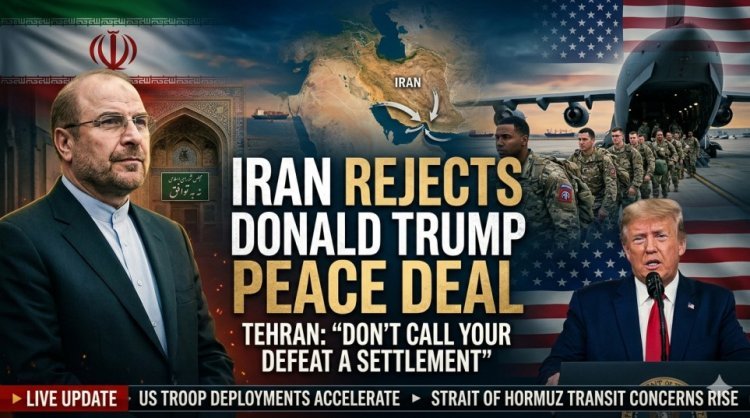

The geopolitical landscape of March 2026 has reached a fever pitch. As smoke still rises from energy facilities across the Persian Gulf, a new "war of narratives" has broken out between Washington and Tehran. While U.S. President Donald Trump touts "very productive" negotiations and a 15-point peace framework, the Iranian leadership has issued a stinging rebuttal, telling the White House: "Don't call your defeat a settlement."
The "15-Point" Proposal: Diplomacy or Ultimatum?
Earlier this week, reports surfaced that the Trump administration delivered a comprehensive 15-point ceasefire plan to Tehran via intermediaries in Pakistan.
-
Nuclear Dismantlement: A demand for Iran to hand over all enriched uranium and halt enrichment permanently.
-
Maritime Security: The immediate reopening of the Strait of Hormuz, which has seen transit drop by 95% since the conflict began on February 28.
-
Regional De-escalation: An end to the funding of regional proxies.
In exchange, the U.S. reportedly offered the lifting of several sanctions and assistance in developing a strictly civilian nuclear program.
Tehran’s Sharp Rebuttal: "Negotiating with Yourselves"
The response from Iran’s high command has been anything but conciliatory.
The rhetoric grew even more pointed when military spokesperson Lt. Col. Ebrahim Zolfaghari mocked the American administration.
"Your era of empty promises has come to an end... Don't dress up your defeat as an agreement." — Lt. Col. Ebrahim Zolfaghari
Deployment Amidst Dialogue
The skepticism in Tehran is fueled by a stark contradiction: while the White House speaks of peace, the Pentagon is moving the "Hammer."
Reports indicate that the U.S. is deploying elements of the 82nd Airborne Division to the region to reinforce Marines already stationed there.
The Economic Stakes: Oil and the Strait
The primary driver behind this sudden diplomatic push is the global energy crisis. With the Strait of Hormuz effectively closed to "hostile" vessels, oil prices have hovered near $100 a barrel, threatening the global economy.
Iran has recently signaled it may allow "non-hostile" vessels to pass, but the definition of "hostile" remains at the center of the dispute.
What Happens Next?
The "five-day pause" on strikes against Iranian power plants, announced by President Trump to allow for talks, is set to expire this Friday.
As the 82nd Airborne moves into position and Tehran holds its defiant line, the world watches to see if this is the beginning of the end of the war, or merely the eye of the storm.
























![States PCS: Bihar GK [बिहार सामान्य ज्ञान एवं सामान्य अध्ययन प्रश्न]](https://rajeevranjan.blog/uploads/images/2026/09/image_380x226_6a9e6f69b286c.jpg)