Trump Directs Federal Rebrand to ‘Super Intelligence,’ Vows US Will Dominate Global Tech Race
President Donald Trump issues an executive order declaring the "Era of Super Intelligence," directing US federal agencies to phase out "AI" and asserting America will lead the high-stakes tech rivalry against China.
 Rajeev
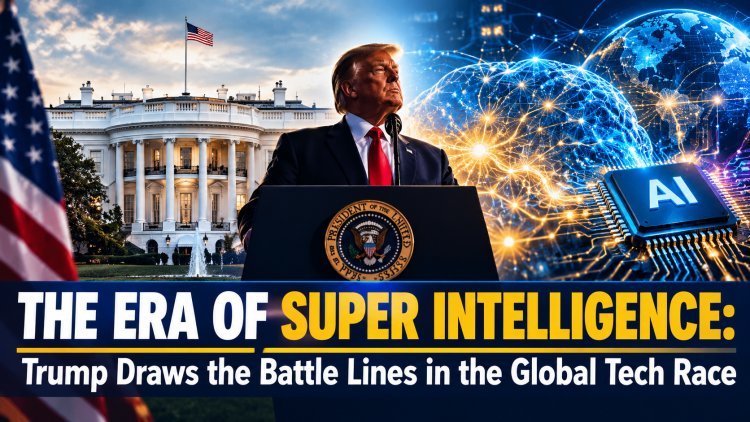

Trump Declares ‘Era of Super Intelligence,’ Vowing America Will Never Settle for Second Place in Tech Race
WASHINGTON — In an aggressive move to redefine global technological leadership, President Donald Trump has issued a sweeping executive order inaugurating what the administration terms the "Era of Super Intelligence".
Speaking after high-level meetings with leading tech executives, Trump framed the rapid advancement of frontier computing not merely as a domestic industry milestone, but as a winner-take-all geopolitical contest.
"Whoever wins Super Intelligence, wins it all," Trump stated at the White House. "There will be a winner, and there will be a loser. There won't be any second place. America is going to remain number one".
A Calculated Shift in Vocabulary and Policy
The directive formally mandates that federal agencies transition their public terminology from standard "AI" to "Super Intelligence" or "SI" to the maximum extent permitted by current law.
The White House rationalized the linguistic shift by arguing that the term "artificial intelligence"—coined nearly seven decades ago—fails to represent the compute scale, autonomous problem-solving power, and economic disruption unleashed by modern neural models.
The administration is also linking the terminology overhaul to immediate digital governance. Officials highlighted the rollout of enhanced federal portals, such as America.gov, intended to harness advanced machine intelligence directly for citizen-facing services, streamlining federal bureaucracy and expediting service delivery.
The Geopolitical Stakes: The Race Against Beijing
Behind the rhetoric lies a sharp geopolitical objective: countering China’s accelerated state-backed push into semiconductor fabrication, data center buildouts, and frontier language models.
National intelligence and security officials in Washington have repeatedly cautioned that dominance in frontier algorithms will dictate 21st-century military superiority, economic leverage, and defensive cyber capabilities. By labeling the national effort as "Super Intelligence," the White House seeks to rally private capital, accelerate domestic energy permitting for mega-data campuses, and remove regulatory hurdles that industry leaders claim slow Western progress.
The order follows a sequence of extensive private-sector infrastructure projects, including major multi-billion-dollar domestic computing consortiums and nationwide compute clusters, engineered to ensure American firms retain access to superior compute clusters, energy grids, and next-generation silicon.
Tech Leaders and Silicon Valley React
The announcement follows closed-door White House consultations that brought together prominent technology executives, infrastructure financiers, and administration officials. Industry delegates discussed the "White House Accord," an initiative addressing domestic capacity, national security alignment, and safety protocols for frontier deployment.
While Silicon Valley remains divided on whether shifting names from "AI" to "SI" represents meaningful structural policy or executive branding, there is broad agreement on the underlying pressure: compute demands are outstripping power grid capacity, and regulatory clarity is essential to prevent high-tier capital flight.
By framing compute capacity as vital national power, the administration has placed frontier technology at the center of US economic and foreign policy, sending a clear message to Silicon Valley, Capitol Hill, and international capitals: Washington considers the technological frontier non-negotiable.






























![States PCS: Bihar GK [बिहार सामान्य ज्ञान एवं सामान्य अध्ययन प्रश्न]](https://rajeevranjan.blog/uploads/images/2026/09/image_380x226_6a9e6f69b286c.jpg)