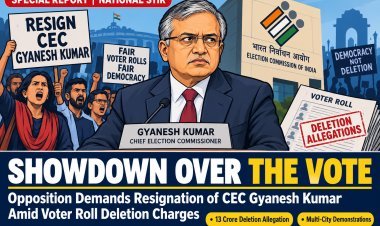
"Weapon of the Ruling Regime": Nationwide Outcry Against CEC Gyanesh Kumar Over Electoral Roll Row
Political parties and student groups held massive protests on October 4, 2026, demanding the resignation of CEC Gyanesh Kumar over alleged voter roll deletions and SIR in Maharashtra.
 Rajeev
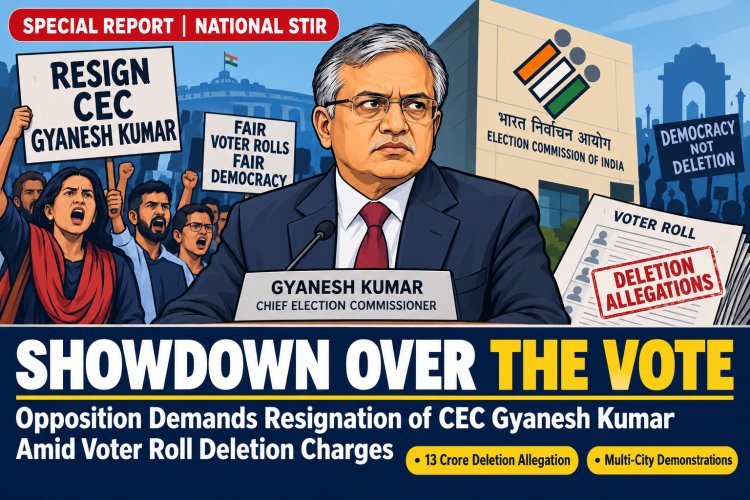

Electoral Integrity in the Crosshairs: Massive Demonstrations Demand CEC Gyanesh Kumar’s Ouster
Political tensions across India reached a boiling point on Sunday, October 4, 2026, as opposition alliances, civil society leaders, and student organisations staged large-scale demonstrations demanding the immediate resignation of Chief Election Commissioner (CEC) Gyanesh Kumar.
The protests, which paralyzed key areas from New Delhi's Jantar Mantar to the streets of Mumbai, center on allegations of systemic voter deletions, procedural discrepancies in the Special Intensive Revision (SIR) of electoral rolls, and institutional bias toward the ruling government.
Mumbai: Unlikely Unity and the 'Garjana Morcha'
In Maharashtra, the controversy brought estranged cousins Uddhav Thackeray (Shiv Sena-UBT) and Raj Thackeray (Maharashtra Navnirman Sena - MNS) onto a shared political platform. Leading the massive Virat Garjana Morcha, the leaders directed cadres to march exclusively under the Indian tricolour, framing the fight not as partisan politics but as a constitutional defense.
-
"CEC is a Weapon": Addressing the rally, Uddhav Thackeray launched a scathing broadside against the Election Commission of India (ECI), alleging that CEC Gyanesh Kumar was acting as a "weapon" of the ruling Bharatiya Janata Party (BJP).
-
Call to Scrap SIR: Raj Thackeray demanded that the Special Intensive Revision process be immediately halted in Maharashtra, alleging that roughly 2 crore voters have been arbitrarily excluded in the state alone, alongside an estimated 13 crore deletions nationwide.
-
Return to Paper Ballots: The morcha leaders renewed demands for the reintroduction of physical ballot papers, arguing that public confidence in electronic voting infrastructure had deteriorated.
National Capital: Security Clampdown and Crackdown at Jantar Mantar
While Mumbai witnessed carnival-like marches, New Delhi remained heavily fortified. Demonstrations organized by youth movements, the All India Students' Association (AISA), and the INDIA bloc saw intense police resistance.
-
Transit Disruptions: Multiple Delhi Metro stations across Central Delhi—including Rajiv Chowk, Janpath, and Central Secretariat—faced periodic closures and restricted access to curb assemblies.
-
Mass Detentions: Following days of standoff since Gandhi Jayanti (October 2), hundreds of demonstrators, civil society figures including Yogendra Yadav, and student leaders were taken into preventive custody while marching from India Gate toward Parliament.
-
Internal ECI Dissensus: Protest convenors highlighted media reports showing internal discord within Nirvachan Sadan, citing instances where fellow Election Commissioners had officially expressed reservations regarding decisions made without broad consensus.
Political Repercussions and What Lies Ahead
Opposition leaders have signaled that the October 4 mobilizations are merely the opening salvo. The INDIA bloc has formally scheduled a follow-up "Save Democracy" agitation in Jammu on October 7, with simultaneous demonstrations planned outside regional ECI offices nationwide.
As scrutiny mounts over electoral roll audits and the transparency of the revision drive, the standoff poses one of the most severe tests of institutional credibility for India's election machinery in recent memory.






















![States PCS: Bihar GK [बिहार सामान्य ज्ञान एवं सामान्य अध्ययन प्रश्न]](https://rajeevranjan.blog/uploads/images/2026/09/image_380x226_6a9e6f69b286c.jpg)