Russian Strikes Kill 12 in Ukraine's Zaporizhzhia, Including 3 Children
Russian airstrikes kill at least 12 people, including three children, in Ukraine's Zaporizhzhia. Zelenskyy condemns attacks amid Trump's Russia diesel deal.
 Rajeev
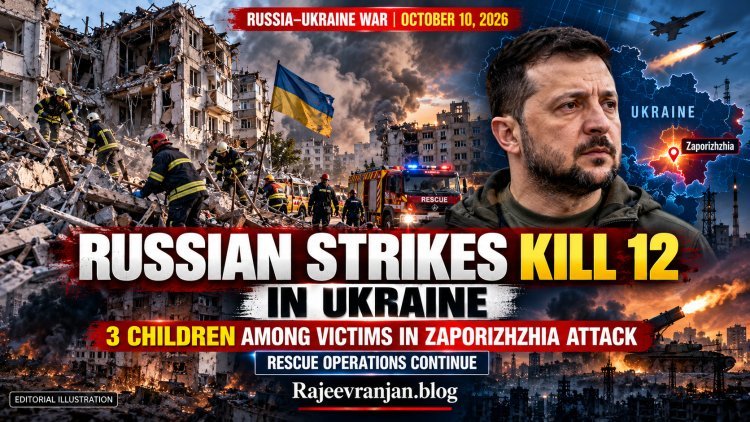

Russian Airstrikes Devastate Zaporizhzhia: Children Among Dead as Ukraine Faces Another Deadly Day
Rescue teams search through shattered apartment buildings after Russian aerial bombs hit residential neighbourhoods. The latest attack has intensified concerns over civilian safety and raised fresh questions about international efforts to end the war.
ZAPORIZHZHIA, UKRAINE | OCTOBER 10, 2026
A residential building reduced to rubble. Emergency workers searching through broken concrete. Families desperately awaiting news of missing relatives.
These were the scenes in Ukraine's southern city of Zaporizhzhia on Saturday after Russian aerial strikes hit residential areas, killing at least 12 people, including three children, according to the latest casualty figures reported by Reuters.
At least 14 others were injured in the attack, which struck multiple locations during the early hours of October 10.
The bombardment devastated portions of residential buildings, leaving emergency services searching for survivors beneath collapsed structures.
Ukrainian officials accused Russian forces of deliberately targeting civilian neighbourhoods.
The attack occurred amid an intensifying aerial campaign against Ukrainian cities, with repeated strikes causing civilian casualties, damage to residential infrastructure and widespread disruptions to electricity supplies.
It also came just one day after US President Donald Trump announced an agreement concerning Russian diesel exports, a decision strongly criticised by Ukrainian President Volodymyr Zelenskyy.
A Saturday Morning Turned Into Tragedy
The attacks struck before many residents had begun their daily routines.
According to Ukrainian authorities, Russian forces used guided aerial bombs against several locations in Zaporizhzhia.
One bomb struck a five-storey residential building, destroying part of the structure.
Other residential properties were also damaged.
Emergency crews rushed to the affected areas, where firefighters and rescue workers searched through debris for people believed to be trapped.
The destruction left portions of apartment buildings exposed, with collapsed walls, damaged floors and scattered household belongings.
Some survivors were pulled from the wreckage and taken for medical treatment.
Ukrainian officials reported that rescue operations continued as authorities attempted to establish the full number of people affected.
The casualty figures rose throughout the day as emergency teams recovered victims from damaged buildings.
Three Children Among the Victims
Among the most devastating details of the attack was the deaths of three children.
Reuters reported that a six-year-old girl was among those killed when part of an apartment building collapsed.
Her grandfather, Anatoliy Chumniy, spoke to reporters as emergency workers recovered victims from the wreckage.
He said the child would have celebrated her birthday later in October.
The loss highlights the human consequences of continued attacks on populated areas, where families remain vulnerable even when they are far from active ground combat.
The identities of all victims had not been publicly established in the initial reports.
Ukrainian authorities continued working to identify the dead, assist injured residents and determine whether others remained missing.
The deaths of children have intensified calls for stronger protection of civilians and more effective Ukrainian air defences.
Zaporizhzhia Attack: Key Developments
| Detail | Reported Information |
|---|---|
| Date | October 10, 2026 |
| Location | Zaporizhzhia, Southern Ukraine |
| Type of Attack | Russian aerial bombardment |
| Reported Weapons | Guided aerial bombs |
| Deaths | At least 12, according to Reuters |
| Children Killed | 3 |
| Injured | At least 14, according to Reuters |
| Buildings Affected | Residential apartment buildings and nearby properties |
| Rescue Operations | Search and recovery efforts continued |
| Ukrainian Response | Zelenskyy condemned the attacks |
Casualty update: The figures have changed as rescue work progressed. Reuters reported 12 deaths in Zaporizhzhia, while a later Associated Press report cited at least 15 deaths in the wider Zaporizhzhia region and 16 wounded. These figures reflect different reporting updates and geographical descriptions, and should not be combined into a single total without further confirmation.
Why Is Russia Targeting Zaporizhzhia?
Zaporizhzhia is one of Ukraine's strategically important industrial cities.
Located in the country's southeast, it lies close to territories occupied by Russian forces.
The city is a major centre of manufacturing, transportation and energy infrastructure.
Before Russia's full-scale invasion in February 2022, Zaporizhzhia had a population exceeding 700,000.
Its proximity to the front line has made it particularly vulnerable to aerial attacks.
The city has repeatedly faced missile, drone and guided-bomb strikes throughout the conflict.
Russian forces have increasingly used guided aerial bombs to attack Ukrainian targets.
These weapons can be released from aircraft at a distance, making them difficult to intercept using conventional short-range air-defence systems.
However, the precise military objectives of Saturday's individual strikes have not been independently established.
The fact that residential buildings were struck raises serious concerns about civilian protection under international humanitarian law.
International law prohibits deliberately directing attacks against civilians and requires parties to distinguish between civilian and military targets.
Whether a particular attack constitutes a war crime requires examination of evidence, including the intended target, weapon used, information available to the attacker and precautions taken.
Zelenskyy Condemns Russia and Questions US Sanctions Relief
Ukrainian President Volodymyr Zelenskyy strongly condemned the attacks and linked them politically to Washington's decision to ease restrictions on Russian diesel exports.
In a statement on Saturday, Zelenskyy said Russian forces had dropped five glide bombs on residential buildings in Zaporizhzhia.
He argued that reducing economic pressure on Moscow could encourage continued military attacks.
The Ukrainian president maintained that Russia interpreted sanctions relief as a sign that it could continue its military campaign without facing sufficient international consequences.
Zelenskyy called for stronger coordinated measures to limit Russia's ability to finance and sustain the war.
His criticism came amid growing frustration in Kyiv over the direction of American policy toward Moscow.
There is no independently established evidence that the US diesel decision directly caused Saturday's attack. The two events occurred one day apart, and Zelenskyy's remarks express his assessment of the political consequences of sanctions relief.
Trump's Russia Diesel Agreement Adds a New Dimension to the Conflict
On Friday, October 9, US President Donald Trump announced an agreement with Russian President Vladimir Putin concerning diesel supplies.
The arrangement is intended to increase available fuel and address high diesel prices in the United States.
Trump's administration also moved to ease certain restrictions affecting Russian diesel exports.
The decision represents a notable adjustment in Washington's approach to Russian energy trade.
Since Russia's full-scale invasion of Ukraine, Western sanctions have attempted to restrict Moscow's access to international financial and energy markets.
Ukrainian officials fear that allowing additional Russian fuel exports could increase Moscow's revenues and indirectly support its war effort.
Supporters of the American decision argue that additional energy supplies could help ease pressure on international fuel markets.
Critics maintain that economic relief should not come at the cost of weakening sanctions against a country engaged in a continuing military invasion.
The renewed attacks on Zaporizhzhia have intensified this debate.
For Ukraine, the central concern is whether international economic policy will increase or reduce pressure on Russia to end hostilities.
Ukraine's Humanitarian Crisis Deepens as Winter Approaches
The Zaporizhzhia attack is part of a wider escalation in Russian aerial operations.
Recent strikes have damaged apartment buildings, transportation infrastructure and electricity facilities across Ukraine.
Earlier this week, Russian attacks killed dozens of civilians in multiple regions.
Ukrainian emergency services have faced enormous pressure as repeated bombardments require extensive rescue and recovery operations.
The attacks have also created concerns about the approaching winter.
Electricity supplies are particularly important for heating, hospitals, water systems and essential public services.
Damage to the power grid can disrupt everyday life even in locations that have not been directly struck.
Kyiv Faces Fresh Missile Attacks and Power Disruptions
The Ukrainian capital has also experienced renewed attacks.
On Saturday, missiles struck Kyiv, injuring four people, according to the city's mayor.
Separate attacks on energy infrastructure left parts of Kyiv and surrounding areas without electricity.
The disruption temporarily halted Metro services, affecting public transportation.
Ukraine has continued requesting additional air-defence systems and ammunition from its international partners.
These systems are intended to intercept incoming missiles and drones before they reach residential and industrial areas.
The Human Cost Behind the Statistics
Casualty figures provide an essential measure of the war's destruction, but they cannot fully represent its human consequences.
Every damaged apartment building contains the remnants of ordinary lives.
Bedrooms, kitchens, photographs and children's belongings become part of rescue sites.
Families who survive may lose their homes, personal documents, possessions and access to essential services.
Those injured can face prolonged medical treatment and rehabilitation.
For children living in affected cities, repeated air alerts and explosions can disrupt schooling and create lasting psychological distress.
Humanitarian organisations have repeatedly emphasised the need for safe housing, medical assistance and support for displaced families.
The latest tragedy in Zaporizhzhia demonstrates how civilians continue to bear a heavy burden as the military conflict enters another year.
Ukraine War: Why Peace Remains Difficult
More than four years after Russia launched its full-scale invasion of Ukraine, efforts to secure a lasting settlement remain complicated.
The two sides continue to disagree over territory, security arrangements and the conditions for ending hostilities.
Ukraine has demanded safeguards against renewed Russian aggression and the protection of its sovereignty.
Russia has maintained territorial and security demands that Kyiv rejects.
International diplomatic initiatives have attempted to narrow these differences, but repeated military escalations have undermined confidence.
The latest attacks took place as Ukrainian, American and European representatives pursued discussions on a possible framework for ending the conflict.
According to Reuters, talks involving US negotiators were held in Miami on Friday.
However, progress toward a comprehensive agreement remains uncertain.
The continued bombardment of Ukrainian cities illustrates the challenge of conducting peace negotiations while military operations remain intense.
What Happens Next in Zaporizhzhia?
The immediate priority for Ukrainian authorities is the completion of rescue operations and assistance to affected residents.
Emergency workers are expected to continue assessing damaged buildings and determining whether additional people remain trapped.
Medical facilities are treating injured civilians.
Local authorities will also need to evaluate the structural safety of residential properties affected by the strikes.
Beyond the immediate response, attention will remain focused on several developments: whether Russia continues launching attacks against Ukrainian cities, whether Kyiv receives additional air-defence support, how Western governments respond to the latest civilian casualties, and whether diplomatic efforts produce meaningful progress toward a ceasefire.
For residents of Zaporizhzhia, however, the most urgent concern is far simpler: the ability to live safely without the constant threat of aerial bombardment.
Zaporizhzhia Attack Underscores the Urgent Need to Protect Civilians
Saturday's deadly attack on Zaporizhzhia has once again exposed the severe humanitarian consequences of the Russia-Ukraine war.
The reported deaths of at least 12 people, including three children, have intensified outrage and renewed calls for international action.
While political leaders debate sanctions, energy agreements and possible peace negotiations, Ukrainian families continue confronting the immediate consequences of war.
The timing of the attacks has also deepened tensions between Kyiv and Washington over the US decision to ease Russian diesel restrictions.
Yet beyond these geopolitical disagreements lies an urgent humanitarian reality.
The destruction in Zaporizhzhia is another reminder that the true cost of war is measured not only in territory or military resources, but in the lives of civilians who never chose to become part of the conflict.



























![States PCS: Bihar GK [बिहार सामान्य ज्ञान एवं सामान्य अध्ययन प्रश्न]](https://rajeevranjan.blog/uploads/images/2026/09/image_380x226_6a9e6f69b286c.jpg)