Hijack Alert on Dubai to Tel Aviv Flight: Transponder Triggers Air Defense Scare Over Middle East
A Flydubai flight en route to Tel Aviv triggered emergency alerts after transmitting squawk code 7500, prompting air defense readiness and a safe diversion into Saudi Arabia.
 Rajeev

Hijack Alert on Dubai to Tel Aviv Flight: How a Transponder Code Triggered an International Security Scramble
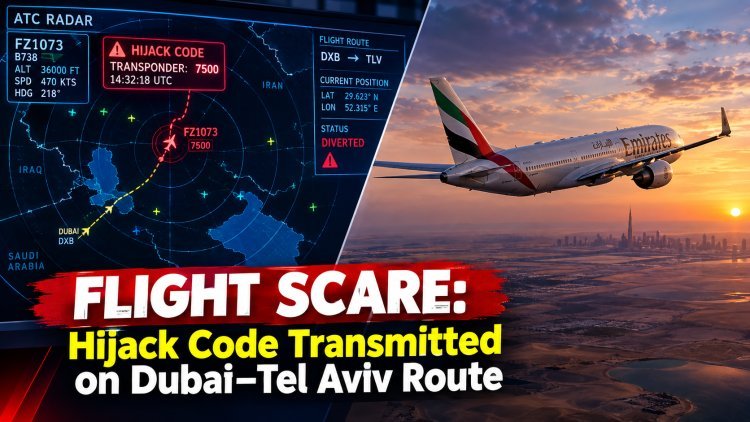
TEL AVIV / DUBAI — A routine commercial flight from Dubai to Tel Aviv triggered intense regional security protocol after the aircraft unexpectedly transmitted transponder squawk code 7500—the globally recognized signal indicating unlawful interference or a possible hijacking onboard.
The Boeing 737 aircraft, operated by Flydubai as flight FZ1073, was carrying approximately 180 passengers, including more than 100 Israeli citizens.
The Mid-Air Sequence: Code 7700 to Squawk 7500
Roughly an hour and a half into the flight, as the airliner cruised through regional airspace, air traffic monitors first detected squawk code 7700—the standard transponder frequency used to declare general mid-air emergencies.
Minutes later, the transponder reading briefly transitioned to code 7500. In civil aviation, squawk 7500 is reserved exclusively for uncommanded interference, hostage situations, or an active cockpit compromise.
The sudden transmission triggered immediate protocols:
-
Civil aviation authorities flagged the trajectory for high-priority monitoring.
-
Israeli defense and aviation security teams convened rapid contingency evaluations.
-
Regional air corridors monitored the flight’s turn away from its planned approach toward Ben Gurion Airport.
Pilots quickly initiated a descent and turned off their original flight path, coordinating with regional air traffic control to divert the aircraft directly into Saudi Arabia for an unscheduled precautionary landing.
Safe Landing in Saudi Arabia
The aircraft touched down without incident in Saudi territory, where emergency ground services and security personnel met the plane on the tarmac as a standard safety protocol. Ground checks quickly confirmed that passengers and crew were safe, with no immediate evidence of physical violence or an active takeover inside the cabin.
Aviation safety experts note that while squawk code 7500 demands an immediate operational response, incidents involving the code often trace back to electrical transponder anomalies, data corruption, misdialing during an ongoing cockpit emergency, or false alarms during standard cockpit communications.
Airlines and civil aviation authorities operate under a zero-tolerance framework: whether a signal stems from human error or an active threat, regional militaries and radar networks treat every 7500 transmission as genuine until the aircraft is grounded, secure, and physically cleared.
Understanding Aviation Transponder Codes
Commercial cockpits utilize specific universal four-digit transponder squawks to inform air traffic radar networks of critical emergencies without needing continuous voice transmission:
| Squawk Code | Operational Meaning | Standard Aviation Protocol |
| 7500 | Unlawful Interference / Hijacking | Triggers military air defense scramble and emergency route isolation. |
| 7600 | Radio Communication Failure | Ground control reserves flight levels; crew follows pre-planned route. |
| 7700 | General In-Flight Emergency | Gives flight immediate right-of-way and cleared descent vectors. |
Investigators from regional aviation safety boards and the airline are reviewing cockpit audio recordings and telemetry logs to confirm whether the hijack signal resulted from a technical glitch or an accidental input during the handling of an initial onboard emergency.