Oil Tankers Hit in Flurry of Attacks Around Strait of Hormuz | Maritime Security Report
Multiple commercial oil tankers have sustained damage from projectile strikes near the Strait of Hormuz and Gulf of Oman, reigniting global energy supply concerns.
 Rajeev

Oil Tankers Hit in Flurry of Attacks Around Strait of Hormuz
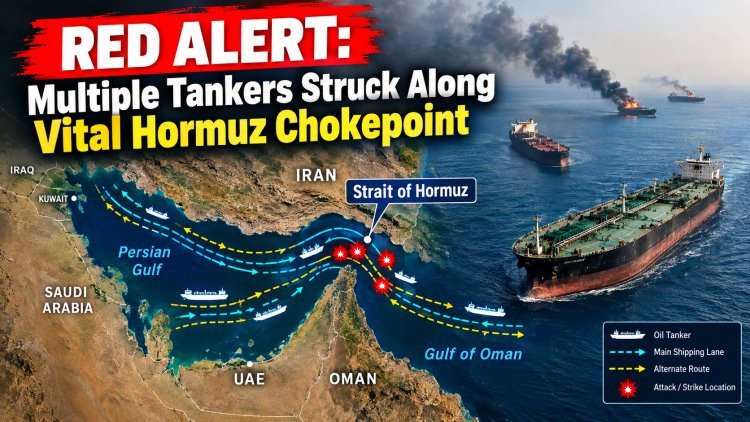
DUBAI / LONDON — A rapid succession of projectile strikes on commercial tankers navigating the Strait of Hormuz and the outer waters of the Gulf of Oman has triggered a severe security alert across global maritime lanes, threatening the stability of the world's most critical crude transport corridor.
The incidents, monitored by the United Kingdom Maritime Trade Operations (UKMTO) and private maritime intelligence monitors, involved multiple commercial carriers targeted by unidentified incoming munitions within hours of each other.
While master advisories confirmed no crew fatalities or catastrophic oil spills from this latest wave, the tempo and precision of the strikes have rattled commercial shipping lines operating throughout the Persian Gulf.
Anatomy of the Strikes
The escalation began when the first tanker transiting near the narrowest transit corridor reported an explosion caused by an incoming airborne projectile. The impact resulted in an immediate electrical blackout and secondary fire on deck.
Less than 24 hours later, a second alert sounded when another crude carrier operating in deep water off Oman was struck on its port flank.
| Incident Metric | Verification Status | Operational Impact |
| Vessels Targeted | Multiple crude & product carriers | Moderate structural damage; localized fires |
| Casualties | Zero reported | Crews intact; no emergency evacuations required |
| Environmental Hazard | No hull breach detected | No active crude discharges observed |
| Chokepoint Flow | Slowed transit speeds | War-risk insurance underwriters reviewing premiums |
The strikes follow an intense week in which at least four additional vessels—including very large crude carriers (VLCCs) and liquefied natural gas (LNG) tankers—reported hostile contact in adjacent waters.
Economic Repercussions: War-Risk Rates and Freight Spikes
Roughly 20 percent of globally traded petroleum and liquefied natural gas passes directly through the Strait of Hormuz, linking major Gulf producers to industrial economies across Asia, Europe, and North America.
Maritime insurers based in London have initiated immediate reassessments of "additional premium" zones covering the southern Gulf and Gulf of Oman. A sustained rise in war-risk surcharges directly inflates spot charter freight rates, which will eventually be passed along to end consumers through higher refining and pump costs.
Several tanker operators have begun ordering vessels to hold positions outside the entrance of the Gulf of Oman while corporate security desks assess transit windows and wait for escort updates.
Diplomatic Brinkmanship and the Chokepoint Dilemma
The strikes arrive amid an already volatile standoff over regional navigation rights. Western naval task forces have maintained heightened maritime patrols, yet the vast expanse of the Gulf approach leaves merchant shipping vulnerable to low-profile drones, anti-ship cruise missiles, and sea-skimming munitions.
Naval authorities continue to advise commercial vessels transiting the Strait of Hormuz to maintain maximum distance from contested territorial boundaries, verify onboard firefighting systems, and report any unscheduled surveillance or erratic surface craft to maritime operational hubs immediately.





























![States PCS: Bihar GK [बिहार सामान्य ज्ञान एवं सामान्य अध्ययन प्रश्न]](https://rajeevranjan.blog/uploads/images/2026/09/image_380x226_6a9e6f69b286c.jpg)