Reliance Retail Shuts 31 7-Eleven Stores in India After ₹90 Crore Loss
Reliance Retail shuts all 31 remaining 7-Eleven stores in Mumbai and Pune after nearly ₹90 crore FY26 loss. Why did the global convenience chain struggle in India?
 Rajeev
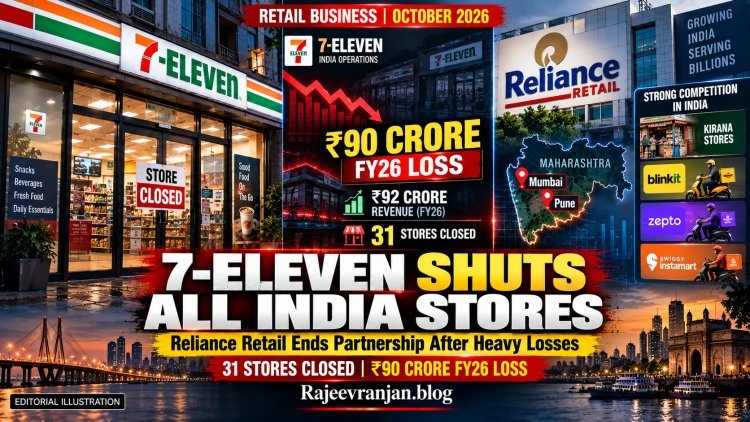

Why Reliance Retail's 7-Eleven Dream Collapsed: 31 Stores Shut as Losses Near ₹90 Crore
One of the world's most recognisable convenience-store brands arrived in India with the backing of the country's biggest retailer. Five years later, every outlet has closed. The story reveals how India's neighbourhood shops, delivery apps and operating costs challenged an international retail model.
MUMBAI, OCTOBER 14, 2026 — In October 2021, Reliance Retail opened India's first 7-Eleven convenience store in Mumbai's Andheri East, introducing a familiar international retail concept to Indian shoppers.
The ambition was straightforward: offer customers a modern neighbourhood store where they could quickly purchase snacks, beverages, groceries, fresh food and everyday essentials.
Backed by Reliance Industries, the venture appeared well-positioned to expand across India's rapidly developing organised retail market.
Five years later, the experiment has come to an end.
Reliance Retail has closed all 31 remaining 7-Eleven stores in Mumbai and Pune, ending its franchise partnership with the Japanese-owned convenience-store chain.
The final outlets shut on September 30, 2026, following the conclusion of the five-year master franchise agreement.
The shutdown comes after the Indian venture reported revenue of approximately ₹92 crore and a net loss approaching ₹90 crore during the financial year ended March 2026.
The closure marks the end of 7-Eleven's current retail presence in India, although its Japanese parent has indicated that the brand remains interested in returning to the market.
The development raises a significant question for the Indian retail industry:
If a globally successful convenience-store brand could not achieve profitability with Reliance Retail's support, what does that reveal about India's changing shopping habits?
From Ambitious Launch to Complete Shutdown
When Reliance Retail signed its master franchise agreement with 7-Eleven in 2021, the partnership attracted considerable attention.
7-Eleven is one of the world's largest convenience-store chains, with a substantial international presence.
Reliance Retail, meanwhile, possessed the financial resources, distribution network and local market experience needed to support an Indian expansion.
The first store opened in Andheri East, Mumbai, in October 2021.
It featured convenience products, snacks, fresh food and locally adapted offerings designed to appeal to Indian consumers.
The format was intended to serve customers looking for convenient purchases without visiting a large supermarket.
Reliance subsequently expanded the chain across Mumbai and Pune.
At its peak, the Indian network had approximately 60 outlets. Industry reporting placed the number at 63 in December 2025.
However, the business struggled to develop a sufficiently large and profitable store network.
By September 2026, only 31 outlets remained.
Those final stores closed at the end of the month.
7-Eleven India: The Journey in Numbers
| Business Indicator | Reported Details |
|---|---|
| Indian Franchise Partner | Reliance Retail |
| Global Brand | 7-Eleven |
| Japanese Parent Company | Seven & i Holdings |
| India Launch | October 2021 |
| First Store | Andheri East, Mumbai |
| Cities Covered | Mumbai and Pune |
| Peak Store Network | Approximately 60–63 outlets |
| Remaining Stores Before Exit | 31 |
| Final Closure Date | September 30, 2026 |
| FY26 Revenue | Approximately ₹92 crore |
| FY26 Net Loss | Nearly ₹90 crore |
| Current Status | All Indian stores closed |
| Future Plans | Brand remains open to exploring an India return |
Sources: Entrepreneur India, C-Store Dive, Business Standard and industry reporting.
₹92 Crore Revenue, Nearly ₹90 Crore Loss: The Financial Warning Signs
The financial performance of 7-Eleven's Indian venture illustrates the challenges facing the business.
According to reported financial figures, the operation recorded approximately ₹92 crore in revenue during FY2025–26.
However, its net loss was close to ₹90 crore over the same period.
For perspective, the reported loss was almost as large as the business's annual revenue.
The figures suggest that the operating model was struggling to generate sufficient income to cover its costs.
A convenience-store business must maintain enough customer traffic and sales per outlet to offset recurring expenses.
These expenses may include retail rent, employee salaries, electricity, inventory management, logistics and product wastage.
Unlike larger supermarkets, convenience stores operate in relatively compact spaces and often rely on frequent purchases of lower-priced products.
That model can become difficult when customers are highly price-sensitive or can access competing products more cheaply elsewhere.
Importantly, the ₹90 crore figure represents the reported FY26 net loss of the Indian 7-Eleven venture, not the total financial loss incurred by Reliance Retail across its businesses.
Why Did 7-Eleven Struggle in India?
The shutdown cannot be attributed to one factor alone.
Retail industry analysts have identified several challenges that made the convenience-store model difficult to operate profitably.
1. India's Kirana Stores Remain Powerful Competitors
For millions of Indian households, neighbourhood kirana shops already provide the convenience that international chains attempt to offer.
These small retailers frequently operate close to residential communities.
Many maintain personal relationships with customers and offer products in small, affordable quantities.
Some also provide informal credit, home delivery and flexible purchasing arrangements.
Their operating costs can be lower than those of branded convenience stores.
A customer who needs milk, biscuits or household essentials may therefore have little incentive to visit a branded outlet if a familiar kirana shop already offers comparable convenience.
This established retail ecosystem creates a major competitive challenge for international convenience-store operators.
2. Quick Commerce Has Changed Consumer Expectations
India's quick-commerce industry has grown rapidly in major urban centres.
Platforms such as Blinkit, Zepto and Swiggy Instamart have popularised the delivery of groceries and everyday essentials in short time windows.
For customers seeking convenience, ordering through an app may be more attractive than travelling to a physical store.
This creates an unusual competitive situation.
Traditional kirana shops compete on proximity, personal relationships and low operating costs.
Quick-commerce platforms compete on doorstep delivery and ease of ordering.
A branded convenience store must offer sufficient additional value to persuade customers to visit.
However, analysts caution that quick commerce alone does not explain 7-Eleven's failure. Store economics, location selection, product strategy and the inability to achieve scale were also important challenges.
3. High Commercial Rents Put Pressure on Store Economics
Mumbai and Pune are important consumer markets, but retail property can be expensive in high-footfall locations.
Convenience stores require accessible premises near residential areas, offices or transport hubs.
Such locations may involve significant rental expenses.
These fixed costs can become difficult to recover when average purchases are relatively small.
A successful convenience-store network must generate sufficient sales volume throughout the day to justify its operating expenses.
Without strong customer traffic, even a well-designed store can struggle financially.
4. Limited Scale Weakened the Business Model
International convenience-store chains often benefit from extensive store networks.
A larger network can support better distribution efficiency, purchasing arrangements and brand visibility.
Reliance Retail's 7-Eleven operation never expanded beyond a relatively small network concentrated in two cities.
This limited footprint may have made it harder to spread logistics, management and supply-chain expenses across a sufficiently large sales base.
The business was therefore unable to establish the scale that might have improved its operating economics.
5. Convenience Means Something Different in India
The 7-Eleven model has achieved major success in markets where customers routinely purchase ready-to-eat meals, packaged food and daily essentials from compact stores.
India's retail preferences are more varied.
Shopping behaviour differs significantly across cities, income groups and neighbourhoods.
Customers may prefer kirana stores for routine household purchases, supermarkets for larger shopping trips and online services for urgent needs.
A convenience-store format must adapt to these differences rather than relying solely on its international brand recognition.
The Indian venture offered locally adapted food and products, but that was not sufficient to establish profitability.
Did Reliance Retail Fail, or Was It a Strategic Business Decision?
The closure of 7-Eleven stores should be understood within the broader context of Reliance Retail's operations.
Reliance Retail operates across multiple segments, including grocery, fashion, electronics and digital commerce.
The company has established a large retail network through several different store formats.
The 7-Eleven venture represented only one part of its wider business portfolio.
The decision to end the franchise arrangement therefore does not mean that Reliance Retail is exiting grocery retail or that its overall retail business is facing the same financial problems.
Instead, the closure suggests that the 7-Eleven format did not deliver the commercial results required to justify continued operations.
Industry reports indicate that employees associated with the venture are being absorbed into Reliance Retail's broader grocery and neighbourhood retail businesses.
However, Reliance Retail has not issued a detailed public explanation breaking down the factors behind the decision.
What Has 7-Eleven's Japanese Parent Said?
Seven & i Holdings, the Japanese parent of 7-Eleven, has confirmed the closure of the Indian outlets.
A company spokesperson stated that Reliance Retail, its master franchisee, had closed all 31 stores in Mumbai and Pune as of September 30, 2026.
The company expressed appreciation to customers in India for their support.
Significantly, Seven & i has not ruled out returning to the Indian market.
It has indicated that it remains interested in exploring opportunities for a long-term presence.
That distinction is important.
7-Eleven has ended its current Indian store operations, but the brand has not announced that it will permanently abandon India.
Any future expansion would require a viable business strategy and potentially a different operating or partnership model.
No confirmed timeline for a relaunch has been announced.
Why 7-Eleven's India Exit Matters for the Retail Industry
The shutdown offers several lessons for companies planning to enter India's consumer market.
Global Brand Recognition Is Not Enough
A successful international business model does not automatically translate into profitability in India.
Local purchasing habits, price expectations and competitive conditions can be substantially different.
Even well-established global brands must adapt their products, pricing and operations to the realities of the Indian market.
The Future May Require Hybrid Retail Models
Traditional convenience stores face growing competition from digital platforms.
Retailers may need to combine physical outlets with delivery services, online ordering and neighbourhood-focused product assortments.
Such models could help stores reach customers beyond walk-in shoppers.
However, additional delivery services also bring costs and operational complexities.
Store Profitability Matters More Than Rapid Expansion
Opening new outlets can increase brand visibility, but expansion does not guarantee financial success.
Retail operators must ensure that individual stores generate sufficient revenue to cover their expenses.
The 7-Eleven experience demonstrates the importance of sustainable unit economics before pursuing aggressive growth.
India's Consumer Market Remains Attractive
The closure should not be interpreted as evidence that India's retail market lacks growth potential.
India has a large consumer base, expanding urban markets and increasing digital adoption.
However, businesses entering the market must compete against strong domestic retailers and rapidly developing e-commerce platforms.
The opportunity remains significant, but success requires a business model that matches Indian consumer behaviour.
Is This 7-Eleven's First Failed Attempt to Enter India?
Interestingly, Reliance Retail was not the first Indian company to explore a partnership with 7-Eleven.
In 2019, Future Group entered into a franchise agreement to introduce the international convenience-store chain to India.
The partnership generated ambitious expansion plans.
However, Future Group did not successfully open stores under the arrangement.
The agreement ended in October 2021.
Reliance Retail subsequently became 7-Eleven's Indian franchise partner and opened the first store within days of signing its agreement.
The latest closure therefore represents the end of another attempt to establish the brand in India.
The experience underscores how difficult it can be to introduce an established foreign convenience-store model into a competitive domestic market.
What Happens to Employees and Existing Store Locations?
The closure raises practical questions about employees, leased premises and the future use of the stores.
According to industry reporting, workers from the 7-Eleven operation are being absorbed into Reliance Retail's other grocery and neighbourhood retail businesses.
The company has not publicly provided a comprehensive store-by-store transition plan.
Likewise, there has been no confirmed announcement that every former 7-Eleven location will be converted into another Reliance-branded outlet.
Any future use of the properties may depend on existing lease agreements, commercial viability and operational requirements.
For customers, the immediate effect is straightforward: the 7-Eleven stores previously operating in Mumbai and Pune are no longer open.
Could 7-Eleven Return to India?
Although its current operations have ended, the company has left open the possibility of returning.
A future strategy could involve a new franchise partner, a revised store format or a more focused expansion model.
Another possibility would be developing stores around specific customer needs, such as ready-to-eat food, commuter convenience or late-night purchases.
These are potential business approaches rather than confirmed plans.
A successful return would depend on overcoming the same challenges that affected the Reliance partnership.
That means identifying profitable locations, building customer loyalty and competing effectively against kirana stores, supermarkets and online delivery services.
For now, Seven & i Holdings has expressed continued interest in India without announcing a specific relaunch strategy.
The Bigger Picture: India's Retail Market Is Changing Faster Than Ever
The end of the Reliance–7-Eleven partnership reflects a fundamental change in urban retail competition.
Convenience is no longer defined simply by how close a store is to a customer's home.
It can also depend on delivery speed, product availability, pricing and the simplicity of completing a purchase.
Indian consumers increasingly have several ways to buy the same products.
They can visit neighbourhood kirana shops, shop at large supermarkets, order groceries through e-commerce services or use quick-commerce apps.
This abundance of options makes it difficult for a new retailer to justify a premium without offering a clear advantage.
The 7-Eleven venture entered a market where convenience was already available through multiple established channels.
Its challenge was not merely attracting attention.
It was persuading enough customers to change their purchasing habits while maintaining a profitable operating model.
That proved difficult.
A Global Brand Meets the Reality of Indian Retail
The closure of all 31 remaining 7-Eleven stores in Mumbai and Pune brings an ambitious five-year experiment to an end.
Despite the international recognition of the 7-Eleven brand and the financial strength of Reliance Retail, the partnership failed to establish a sustainable convenience-store network.
The reported FY26 loss of nearly ₹90 crore illustrates the financial challenges behind the decision.
Competition from neighbourhood kirana shops, rising quick-commerce services, high operating costs and limited scale all contributed to a difficult business environment.
Yet the story is not necessarily over for 7-Eleven.
Its Japanese parent continues to see potential in India and may consider another strategy in the future.
The central lesson is clear: in India's retail market, global reputation may open doors, but understanding local consumers is what keeps stores open.