


"No State Neglected in Budget": FM Nirmala Sitharaman Shreds Opposition's Claims
FM Nirmala Sitharaman dismantles opposition claims of fiscal discrimination in Budget 2026-27, asserting 41% tax devolution to states and hitting back at "politically motivated" allegations.
 Rajeev
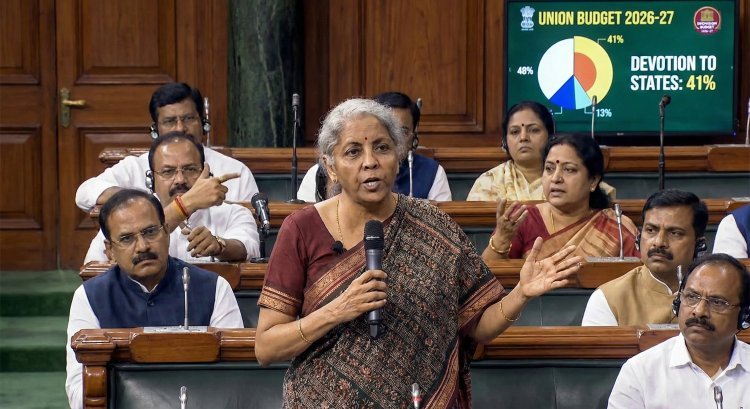

NEW DELHI — In a fiery rebuttal on the floor of the Lok Sabha this Wednesday, Union Finance Minister Nirmala Sitharaman systematically dismantled the Opposition's allegations that non-NDA ruled states were "shortchanged" in the Union Budget 2026-27. Terming the accusations as "politically motivated" and factually incorrect, Sitharaman asserted that the Centre has adhered strictly to the fiscal federalism framework, transferring the full 41% of the divisible tax pool to states as mandated by the Finance Commission.
The 41% Devolution Defense
The debate on the Union Budget 2026-27 reached a crescendo when the Finance Minister rose to reply to the discussion, which had been dominated by Opposition protests claiming "zero allocation" for states like Tamil Nadu, Kerala, and West Bengal.
"Credit kahin kam nahin (Credit is nowhere less)," Sitharaman stated, directly addressing the claims of fiscal bias. "I assure the House, it is the full 41% that we have transferred to the States. We have not reduced any State's devolvable tax."
She cited data regarding the 15th Finance Commission's period (2020-2026), emphasizing that the Centre had accepted and implemented the recommendation to devolve 41% of central taxes to states. "The 16th Finance Commission analysis of 2018-23 data concludes that in each of these years, the devolution made by the Centre exactly matches the recommendation," she added.
For the upcoming fiscal year, the Minister projected that the States' share of taxes is estimated at Rs 25.44 lakh crore, marking a significant increase of Rs 2.7 lakh crore from the previous year.
Counter-Attack: "Reading Without Understanding"
Sitharaman did not pull her punches when addressing specific opposition leaders. She launched a scathing attack on Leader of the Opposition Rahul Gandhi, accusing him of critiquing the budget "without reading it."
Referring to Gandhi’s speech, which focused heavily on the "weaponization of finance" and alleged threats to the Constitution, Sitharaman retorted, "He did not read the budget but came here to talk. He spoke the language of 'jujutsu'—grip and control—but failed to see the provisions made for the poor and farmers."
She specifically countered the narrative that the budget neglected the poor, pointing out the allocation of Rs 2.27 lakh crore for food subsidies and the continuation of free food grains for 80 crore citizens.
Debunking the "Zero for Tamil Nadu" Narrative
A significant portion of the Finance Minister's speech was dedicated to debunking the "Zero for Tamil Nadu" campaign led by the DMK. The regional party had alleged that the southern state was completely ignored in the central allocations.
"Sweeping statements like these without any basis are not right at all," Sitharaman said. She listed specific projects benefiting the state, including:
-
The Rare Earth Corridor: A major strategic initiative that will directly benefit Tamil Nadu's industrial sector.
-
Girls' Hostels: A new scheme to construct hostels in every district, including all districts in Tamil Nadu.
-
Fisheries and Coconut Schemes: Allocations that directly impact the state's coastal economy.
"If you claim we gave 'zero', are these projects invisible?" she questioned, accusing the state government of using federal fairness as a "political tool" rather than a governance issue.
Capex and Growth Focus
Beyond the political crossfire, Sitharaman highlighted the government's aggressive push for infrastructure. While the headline capital expenditure (Capex) for the Centre stands at Rs 12.2 lakh crore, she clarified that the effective capital expenditure—which includes grants-in-aid to states for creating capital assets—actually stands at Rs 17.1 lakh crore, amounting to 4.4% of the nation's GDP.
"This budget strengthens the foundation of a 'Viksit Bharat' (Developed India)," she concluded. "We are willing to collaborate with any state that wants to enter new-age sectors like industrial textiles or technical hubs. The Centre is an enabler, not a barrier."
As the House adjourned, the Finance Minister's speech was seen as a strong consolidation of the government's economic narrative, attempting to shift the focus from political optics back to the hard numbers of fiscal distribution.