"UCC Bulldozer Is to Polarise Society": Congress Slams Modi Govt Over Maharashtra Panel Resignation
Congress alleges the Modi government is using the UCC as an instrument of division and permanent societal polarisation, following Justice R.C. Chavan's panel resignation. Read details here.
 Rajeev
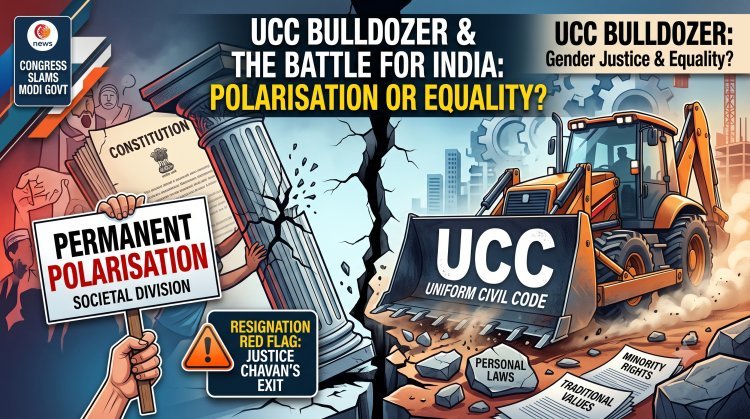

Congress Attacks Center: "UCC Bulldozer Meant to Permanently Polarise Society"
The debate surrounding the Uniform Civil Code (UCC) in India reached a boiling point on Wednesday after the Congress launched a scathing counter-offensive against the ruling Bharatiya Janata Party (BJP). Terming the push for regional civil codes a political "bulldozer," the opposition accused the Modi government of turning a complex constitutional subject into an instrument of societal division, disruption, and permanent electoral polarisation.
The latest escalation was triggered by the sudden resignation of former Bombay High Court judge Justice R.C. Chavan from the Maharashtra government's high-level UCC drafting committee.
The Trigger: Justice R.C. Chavan Steps Down Over "Yes/No" Consultation
In July, the Maharashtra government instituted a seven-member panel chaired by retired Supreme Court judge Ranjana Desai to frame the state's proposed Uniform Civil Code. However, the drafting process suffered a major blow when Justice Chavan tendered his resignation, raising strong ethical and procedural reservations.
In his resignation letter, Justice Chavan highlighted key concerns:
-
Binary Treatment of Complex Matters: Chavan pointed out that crucial socio-legal issues—such as matrimonial disputes, delayed marriages, and marital stability—were reduced to rigid "Yes/No" questionnaire formats solely for convenience in data processing.
-
Absence of Consensus Building: He stated that reducing delicate social equations into binary metrics defeated the entire objective of open, deep public consultation and collective consensus.
Jairam Ramesh Questions State-Wise "Non-Uniform" Civil Codes
Seizing on the jurist's exit, Congress General Secretary in-charge of Communications, Jairam Ramesh, stated that the incident exposed systemic flaws in how the UCC is being executed.
Ramesh questioned whether the framers of the Constitution in the Constituent Assembly ever envisioned a scenario where disparate states enacted independent, state-level versions of what is supposed to be a single, uniform civil code.
Key arguments raised by the opposition party include:
-
Inconsistent Regional Laws: While Uttarakhand operationalised its UCC in early 2025, several states including Gujarat, Assam, and Madhya Pradesh have introduced their own legislative models. Congress argued that these codes are inherently non-uniform, featuring conflicting exemptions, varied punitive measures, and differing legal definitions.
-
Disregard for 21st Law Commission Advice: The opposition highlighted the 2018 Consultation Paper of the 21st Law Commission, which observed that a nationwide UCC was "neither necessary nor desirable at this stage," instead advising reforms against discriminatory aspects within existing personal laws while safeguarding cultural pluralism.
-
Political Timeline: Referring to Union Home Minister Amit Shah’s stated intent to roll out UCCs across NDA-governed states before the 2029 Lok Sabha elections, Congress argued that rushing these sensitive reforms through state corridors without comprehensive stakeholder engagement serves purely political ends.
The Wider Legal & Political Crossfire
The ruling NDA maintains that codified civil rules across all communities in areas such as marriage, succession, divorce, and inheritance represent a vital step toward gender justice, constitutional equality, and modern governance.
Conversely, opposition parties and civil rights groups contend that introducing fragmented state laws creates widespread jurisdictional overlap, disproportionately impacts tribal and minority traditions, and converts a serious legal reform into recurring election-season controversy.
With state panels accelerating their timelines and legal experts raising red flags over consultation processes, the dispute over state-led civil codes remains one of India's sharpest constitutional battlegrounds.





























![States PCS: Bihar GK [बिहार सामान्य ज्ञान एवं सामान्य अध्ययन प्रश्न]](https://rajeevranjan.blog/uploads/images/2026/09/image_380x226_6a9e6f69b286c.jpg)