Saudi Coalition Hits Houthi Sites in Yemen; Aramco Office Attacked in Dhahran
Saudi-led coalition strikes Houthi fuel facilities in Yemen as a missile hits an Aramco office in Dhahran. Latest updates on casualties and oil supply risks.
 Rajeev

Saudi Aramco Office Hit as Coalition Bombs Houthi Facilities in Yemen: Is the Middle East Heading Towards a Wider Energy Crisis?
A missile strike on an office building at Saudi Aramco's headquarters complex and retaliatory military operations in Yemen have brought two critical vulnerabilities into focus: civilian safety and the security of the world's energy infrastructure.
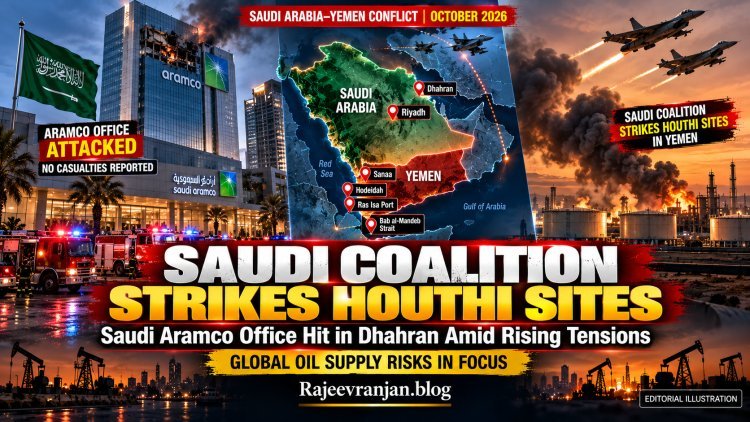
RIYADH, OCTOBER 14, 2026 — The conflict between Saudi Arabia and Yemen's Iran-aligned Houthi movement entered a dangerous new phase after a missile struck an administrative building at Saudi Aramco's headquarters complex in Dhahran, while Saudi-led coalition aircraft targeted Houthi-controlled fuel facilities and military-linked infrastructure across Yemen.
Saudi Arabia's Ministry of Energy confirmed on Wednesday that an attack had caused a limited fire in an administrative building at the state-owned oil company's complex in the kingdom's Eastern Province.
No deaths or injuries were reported in the Aramco incident, according to Saudi authorities.
A company source told Reuters that a ballistic missile struck an office tower at the Dhahran complex on Tuesday night, damaging its upper three floors.
The incident came amid an intensifying exchange of strikes between Saudi-backed forces and the Houthis, who have threatened further attacks on Saudi airports and energy installations.
Meanwhile, the Saudi-led military coalition carried out airstrikes against energy terminals, fuel-storage sites and other facilities in Houthi-controlled areas of Yemen.
The developments have heightened concerns about the potential expansion of the conflict and its consequences for international oil markets, maritime trade and regional stability.
What Happened at Saudi Aramco's Dhahran Headquarters?
The attack on Saudi Aramco's headquarters complex in Dhahran took place late on Tuesday, October 13.
According to Reuters, a ballistic missile struck an office tower within the complex, damaging the upper three floors.
Witnesses and sources familiar with the situation reported a fire in the building.
Saudi Arabia's Ministry of Energy subsequently confirmed that an administrative facility had been targeted.
The ministry described the resulting fire as limited and said authorities had responded to contain the situation.
It also confirmed that no casualties had been reported.
Dhahran is particularly important because it is home to Saudi Aramco's headquarters and major administrative and operational functions.
Aramco oversees an extensive network of oilfields, pipelines, refineries and export facilities.
An attack on its headquarters complex therefore carries significance beyond the immediate physical damage.
However, the available reports do not establish that the strike damaged crude-production facilities or caused a reduction in Saudi oil output.
That distinction is essential when assessing the potential economic consequences of the incident.
Saudi-Led Coalition Launches Airstrikes on Houthi Facilities
While Saudi authorities assessed the damage in Dhahran, coalition military operations continued across Yemen.
The Saudi-led coalition targeted several facilities in territory controlled by the Houthi movement.
According to Al Jazeera, the attacks included energy infrastructure around Yemen's capital, Sanaa, as well as facilities along the Red Sea coast.
One of the principal targets was the Yemeni Oil Company's al-Sabah central station in Sanaa.
Coalition forces issued an evacuation warning ahead of the operation, urging civilians to leave the area.
Al Jazeera correspondents subsequently reported hearing explosions in the capital.
Houthi-affiliated media said the coalition had struck an oil facility in the area.
Additional airstrikes were reported around the Ras Isa port and oil-storage facilities in Hodeidah province.
The coalition's spokesperson, Turki al-Maliki, said the operations were aimed at weakening Houthi military capabilities.
He maintained that precautions had been taken to reduce the risk of civilian harm.
Independent assessments of damage and possible casualties from all the targeted locations were not immediately available.
Why Were Oil Facilities Targeted in Yemen?
The targeting of fuel infrastructure reflects the growing importance of energy supplies in the conflict.
Fuel-storage and distribution facilities can support civilian transportation, electricity generation and essential services.
They may also have military value if used to supply armed forces or store military equipment.
The Saudi-led coalition has accused the Houthis of using certain facilities to support military operations.
Its latest strikes were presented as an effort to reduce the group's operational capabilities.
The Houthis, however, have condemned the attacks and warned that Saudi energy facilities could face further retaliation.
The legal status of any particular fuel facility depends on its actual use and whether it qualifies as a military objective under international humanitarian law.
Even when a legitimate military objective exists, attacking forces must follow rules concerning distinction, proportionality and precautions to minimise civilian harm.
The destruction of fuel infrastructure could also have significant humanitarian consequences in Yemen, where many communities already face severe economic and public-service difficulties.
Houthis Threaten Saudi Airports and Aramco Facilities
The latest military operations followed warnings from the Houthi movement that Saudi airports and energy infrastructure could be targeted.
On Tuesday, Houthi military spokesperson Yahya Saree issued an evacuation warning concerning several Saudi facilities.
The locations mentioned included Saudi Aramco sites and King Khalid International Airport in Riyadh.
The warning came after the Saudi-led coalition ordered civilians to evacuate a fuel installation in Sanaa before planned airstrikes.
Saree threatened a severe response if coalition attacks continued.
The Houthis describe their military actions as retaliation for Saudi Arabia's support of Yemen's internationally recognised government.
Saudi authorities, meanwhile, have condemned attacks against civilian aviation and economic infrastructure.
The competing threats have intensified fears of an expanding cycle of military retaliation.
Recent Riyadh Airport Attacks Add to Saudi Security Concerns
The Dhahran incident occurred just days after deadly attacks on Riyadh's King Khalid International Airport.
On October 10, an attack attributed to the Houthis killed 13 people and injured more than 300, according to subsequent reporting.
Another projectile struck the airport the following day, causing one additional death and 11 injuries.
The attacks disrupted aviation operations and prompted international concern about passenger safety.
The Houthis claimed responsibility for the October 10 attack.
The latest incidents demonstrate that the conflict increasingly threatens targets far from Yemen's immediate battlefronts.
Major airports, energy infrastructure and commercial facilities have become central to the regional security crisis.
For Saudi Arabia, protecting these locations is particularly important because international transportation and energy exports are essential components of its economy.
Saudi Arabia–Yemen Conflict: Latest Developments
| Development | Reported Status |
|---|---|
| October 13, 2026 | Saudi-led coalition launches airstrikes on Houthi-held facilities in Yemen |
| Sanaa | Fuel installation targeted following evacuation warning |
| Ras Isa and Hodeidah | Additional strikes reported on oil-related facilities |
| Dhahran, Saudi Arabia | Aramco administrative building attacked |
| Aramco Damage | Limited fire confirmed; upper-floor damage reported |
| Aramco Casualties | No deaths or injuries reported |
| Houthi Warning | Saudi airports and energy facilities threatened |
| October 14, 2026 | Saudi authorities confirm Dhahran incident |
| Oil Production Impact | No confirmed production disruption from this specific strike |
| Regional Situation | Military escalation continuing |
Sources: Reuters, Associated Press and Al Jazeera, October 13–14, 2026.
Why the Aramco Attack Matters to the Global Oil Market
Saudi Aramco is one of the world's most important oil producers.
The company plays a central role in the production, processing and export of crude oil.
Saudi Arabia's energy infrastructure is consequently of enormous importance to international markets.
An attack on an Aramco facility can trigger concerns about supply security, even when the immediate physical damage is limited.
This is because traders must consider not only existing production levels but also the possibility of additional attacks.
The Difference Between an Office Attack and an Oil-Production Disruption
The Dhahran incident involved an administrative building within Aramco's headquarters complex.
That does not automatically mean oil wells, refineries or export terminals were damaged.
The distinction matters because an attack on a crude-processing installation could directly reduce available supplies.
An attack on an administrative building may instead affect operations, security measures or market confidence without immediately changing production volumes.
Nevertheless, repeated attacks can increase insurance costs, security spending and uncertainty.
If the conflict expands to oilfields, pipelines, export terminals or major shipping routes, the economic consequences could become significantly more serious.
Saudi Oil Supply Has Already Faced Pressure
The wider conflict has previously affected Saudi Arabia's energy production.
In September, Reuters reported International Energy Agency figures showing that Saudi crude supply had fallen substantially in August following attacks on energy facilities.
The IEA estimated Saudi supply at approximately six million barrels per day during that period, the lowest level in more than three decades.
Those figures refer to earlier disruptions and should not be attributed to the latest Dhahran office attack.
They nevertheless illustrate why international energy markets are sensitive to threats against Saudi infrastructure.
Could the Conflict Push Oil Prices Higher?
The answer depends on whether military escalation creates additional disruptions to production and transportation.
There are three major risks.
Risk One: Additional Attacks on Energy Facilities
If refineries, processing centres or export terminals become targets, the amount of oil available for international markets could decline.
Actual supply losses would be more likely to exert upward pressure on prices than damage limited to administrative buildings.
Risk Two: Red Sea Shipping Disruptions
Yemen lies near the Bab al-Mandeb Strait, a strategically important maritime passage linking the Red Sea with the Gulf of Aden.
Commercial shipping through this region is essential to trade between Asia, Europe and the Middle East.
A prolonged security crisis could encourage shipping companies to use longer routes or increase insurance coverage.
Both developments could raise transportation costs.
Risk Three: Wider Regional Military Escalation
The Houthis are aligned with Iran, while Saudi Arabia is a major regional power with significant international security partnerships.
Further attacks could increase tensions between governments and armed groups already involved in the broader Middle East crisis.
Markets may respond to the possibility of escalation even before additional infrastructure is damaged.
However, a rise in global oil prices should not be presented as a confirmed consequence of the Dhahran incident without corresponding market data.
What Does the Saudi Aramco Attack Mean for India?
The developments have particular relevance for India because of the country's dependence on imported crude oil.
India imports much of the petroleum it consumes, making international energy prices an important economic factor.
Saudi Arabia is among India's significant energy suppliers.
Any prolonged disruption to Middle Eastern oil exports could affect the cost of crude purchases.
Impact on Petrol and Diesel Prices
If global crude prices rise for a sustained period, Indian refiners may face higher import costs.
However, domestic petrol and diesel prices are influenced by several factors, including taxes, currency movements, refinery margins and pricing decisions.
A single military incident does not necessarily result in an immediate increase at Indian fuel stations.
Impact on Inflation
Higher oil prices can increase transportation and production costs across the economy.
Businesses that depend on road freight, manufacturing and agricultural machinery may face additional expenses.
Some of these costs can eventually be passed on to consumers.
The extent of the impact depends on how long energy prices remain elevated.
Impact on the Indian Rupee
Higher crude import costs can increase demand for US dollars.
That may contribute to pressure on the rupee, particularly when combined with foreign investment outflows or broader global financial uncertainty.
However, exchange-rate movements depend on numerous factors and cannot be explained by oil prices alone.
Impact on Indian Workers in Saudi Arabia
Saudi Arabia is home to a substantial Indian expatriate community.
Escalating attacks on airports and important urban infrastructure can create concerns among residents and travellers.
Indian nationals should follow official security advisories and verify travel arrangements with airlines and relevant authorities.
For India, the most important issue is whether the conflict remains contained or begins to disrupt regional energy supplies and transportation on a larger scale.
Saudi Arabia's Strategic Challenge: Security or Negotiation?
The escalation presents a difficult challenge for Saudi Arabia.
The kingdom has invested heavily in defence systems and military infrastructure.
Nevertheless, repeated missile and drone attacks have demonstrated the difficulty of protecting widely dispersed civilian and industrial facilities.
Saudi Arabia must decide how to respond to attacks while avoiding an even broader conflict.
Military operations may weaken some Houthi capabilities, but they also risk prompting further retaliation.
Diplomatic negotiations could potentially reduce hostilities, although the parties remain divided over military and political objectives.
The Houthis continue to control significant territory in Yemen.
Saudi Arabia supports forces aligned with Yemen's internationally recognised government.
The conflict has also become entangled with wider regional tensions involving Iran and the United States.
Iran has offered mediation, according to Reuters, but it remains unclear whether such efforts can produce a breakthrough.
The competing military and diplomatic pressures make the coming days particularly important for regional stability.
What Happens Next? Four Developments to Watch
1. Saudi Aramco's operational assessment
Any official statement about the company's production, refining or export operations will be important for understanding the economic consequences of the attack.
2. Further Houthi missile and drone operations
Renewed strikes against Saudi cities, airports or energy infrastructure could increase regional instability.
3. Saudi-led coalition operations in Yemen
Additional airstrikes may intensify fighting and deepen humanitarian concerns, especially if fuel facilities and other essential infrastructure are damaged.
4. Diplomatic intervention
International efforts to reduce the conflict could become increasingly important as the risks to civilian safety and global energy security grow.
A Dangerous New Phase in the Saudi–Houthi Conflict
The missile strike on Saudi Aramco's Dhahran headquarters complex has brought renewed attention to the vulnerability of critical infrastructure during the Middle East conflict.
Although Saudi authorities reported no casualties and described the resulting fire as limited, the attack carries considerable symbolic and strategic significance.
At the same time, Saudi-led coalition strikes against Houthi-controlled facilities in Yemen demonstrate the continuing intensity of military operations.
With airports, energy installations and transportation routes increasingly exposed to attack, the consequences could extend far beyond the immediate battlefield.
For Saudi Arabia, the priority is protecting civilians and essential infrastructure.
For Yemen, renewed fighting threatens to worsen an already severe humanitarian crisis.
For the international economy, the greatest concern is whether military escalation will disrupt energy supplies and important shipping routes.
The Dhahran attack has not been confirmed to have reduced Saudi oil production, but it is another warning that a prolonged regional conflict could place global energy security under increasing pressure.