


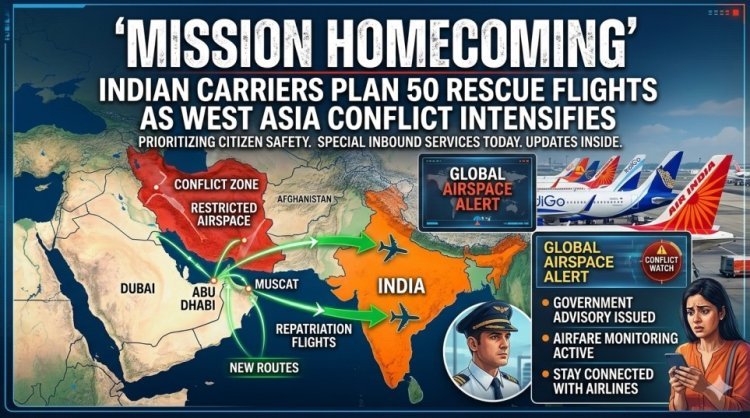
Mission Homecoming: Indian Carriers Plan 50 Rescue Flights as West Asia Conflict Intensifies
Amidst the rising Iran-Israel conflict, Indian carriers like Air India and IndiGo are operating 50 special inbound flights today to bring stranded citizens home. Get the latest on flight schedules, airfare monitoring, and government advisories.
 Rajeev

The geopolitical landscape in West Asia has shifted dramatically, leaving thousands of travelers navigating a complex web of airspace closures and flight cancellations. As the conflict involving Iran, Israel, and the U.S. enters a critical phase, the Government of India has stepped up its "citizen-first" approach.
On Monday, March 9, 2026, Indian carriers have coordinated a massive logistical effort to operate approximately 50 inbound flights from major hubs in West Asia, prioritizing the safe return of Indian nationals.
The Scale of the Operation
According to the Ministry of Civil Aviation (MoCA), the planned 50 flights are a mix of scheduled services and ad-hoc "rescue" runs. This follows a successful weekend where over 51 flights arrived on Saturday, bringing back 8,175 passengers.
Major Airlines Involved:
-
Air India & Air India Express: Slated to operate 24 scheduled flights to Jeddah and Muscat, plus 32 additional ad-hoc services from the UAE.
-
IndiGo: Repositioning aircraft to maintain connectivity while navigating rerouted flight paths.
-
SpiceJet & Akasa Air: Operating specialized relief runs from airports like Dubai and Fujairah.
Key Departure Hubs
The majority of these inbound flights are concentrated in the following "safe zones" where airspace remains partially functional:
-
UAE: Dubai, Abu Dhabi, Ras Al Khaimah, and Fujairah.
-
Oman: Muscat (serving as a critical transit point).
-
Saudi Arabia: Jeddah.
Government Vigilance on Airfares
A major concern during regional instability is the sudden surge in ticket prices. The Ministry has issued a stern directive to all domestic airlines to ensure that airfares remain reasonable.
"The Ministry of Civil Aviation is closely monitoring ticket prices to ensure there is no undue surge. Our primary goal is the safety and assisted return of our citizens, not commercial gain during a crisis," a government spokesperson stated.
Airspace Disruptions and Rerouting
The conflict, which escalated following strikes in late February, has forced pilots to adopt longer, more fuel-intensive flight paths to avoid the volatile skies over Iran and parts of the Levant. While airports like Dubai International have resumed limited operations, the situation remains "subject to operational feasibility."
What Travelers Should Do
If you or your loved ones are currently in the West Asia region, follow these essential steps:
-
Direct Contact: Do not rely solely on third-party apps. Stay in constant touch with your airline’s official helpdesk.
-
Register with Missions: Ensure you are registered with the local Indian Embassy or Consulate for emergency updates.
-
Check Advisories: Monitor the Delhi Airport (DIAL) and MoCA social media handles for real-time status of westbound international flights.
The Road Ahead
Beyond Monday’s 50 flights, Air India has already announced an additional 78 flights scheduled between March 10 and March 18 to clear the passenger backlog. With over 52,000 Indians already having returned since the start of March, the focus now shifts to stabilizing the "bridge" between the Gulf and India.