



Zelenskyy Says Ukraine Got No Warning as Russian Strikes Leave 5 Lakh Homes Without Power
Zelenskyy says Ukraine received no early missile warning as Russia attacks its power grid, killing four and leaving over 5 lakh households without electricity.
 Rajeev
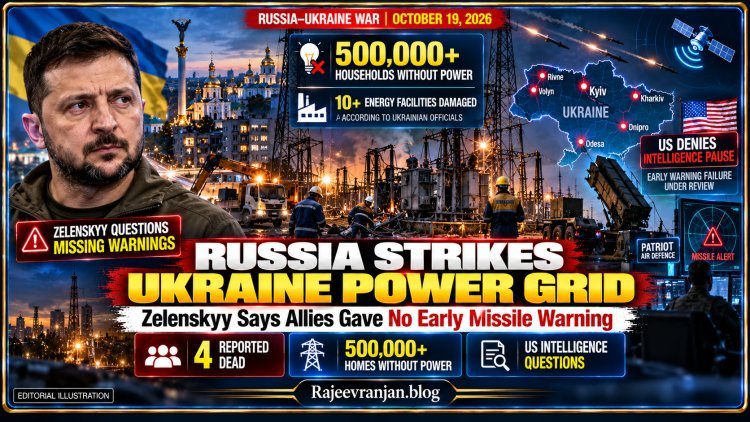

Ukraine's Power Grid Under Fire Again: Zelenskyy Questions Missing US Missile Warnings as Russia Intensifies Attacks
More than half a million households lose electricity after Russian missiles and drones strike energy facilities across Ukraine. Washington disputes suggestions that intelligence sharing has been suspended, exposing a growing disagreement between Kyiv and the Trump administration.
KYIV, OCTOBER 19, 2026 — For thousands of Ukrainian families, Monday began without electricity.
Across neighbourhoods in Kyiv and other regions, residents confronted another morning of damaged infrastructure, interrupted power supplies and emergency repair operations.
But alongside the destruction, a second crisis was unfolding—one involving Ukraine's relationship with its most important military partners.
President Volodymyr Zelenskyy said Ukraine had received no advance warning from its international partners before the first wave of Russian ballistic missiles struck overnight.
The allegation has raised fresh concerns about the reliability of intelligence cooperation between Kyiv and Washington at a particularly dangerous stage of the war.
Russia launched a major aerial assault involving 16 ballistic missiles and more than 200 drones, according to Ukrainian officials.
The strikes stretched across the country, affecting locations including Kyiv, Kharkiv, Dnipro, Odesa, Volyn and Rivne.
At least four people were killed, while attacks damaged energy infrastructure and forced authorities to introduce electricity restrictions.
More than 500,000 households lost power as Ukraine's energy system struggled to absorb another round of bombardment.
The developments come amid worsening disagreements between Zelenskyy and US President Donald Trump over military assistance, sanctions against Russia and efforts to negotiate an end to the war.
The Warning That Never Came
One of the most troubling developments was not simply the scale of the Russian attack.
It was the reported absence of intelligence that Ukrainian authorities have relied on for years.
American surveillance capabilities have helped Ukraine detect preparations for Russian ballistic missile launches.
Such intelligence can provide valuable additional time for air-defence personnel and emergency authorities to respond.
Ballistic missiles travel at extremely high speeds, leaving limited time between launch and impact.
Even a few minutes of advance warning can be important for civilians seeking shelter.
According to Zelenskyy, Ukraine did not receive the expected warning before the initial strikes.
In a statement on Telegram, he said Russia had launched another multi-wave ballistic missile attack without the usual advance notification from partners.
The Ukrainian president also criticised delays in the delivery of air-defence missiles and Washington's recent decisions to ease economic pressure on Moscow.
His remarks suggest mounting frustration with the support Ukraine is receiving as Russia continues targeting critical infrastructure.
However, Ukrainian Air Force spokesperson Yurii Ihnat clarified that Ukraine received no warning before the first missile wave but did receive information ahead of a subsequent strike.
That distinction is important because it indicates a failure affecting at least part of the warning process rather than confirming a complete absence of intelligence throughout the night.
Russia Launches One of Its Broadest Aerial Attacks in Months
According to Ukrainian officials, the overnight bombardment involved multiple weapons and targeted several regions.
Russia launched 16 ballistic missiles towards Kyiv and the surrounding area, while more than 200 drones were deployed across Ukraine.
Ukraine's Air Force reported intercepting 247 aerial threats, including four cruise missiles and 243 drones.
The interception figures refer to the broader mix of incoming weapons reported by the military and should not be interpreted as meaning that all ballistic missiles were successfully destroyed.
Despite Ukraine's defensive response, significant damage occurred.
Ukrainian authorities reported that the strikes killed two people in Kyiv and its surrounding region.
Two additional deaths were reported in Kryvyi Rih.
Residential buildings, transport facilities, commercial properties and energy installations were among the locations affected.
Russia's Defence Ministry acknowledged carrying out a large-scale strike but described its targets differently.
Moscow said its forces attacked defence-industry facilities, weapons-storage locations and a data centre.
Ukraine maintains that its energy sector was a principal target of the bombardment.
The competing descriptions underline the importance of distinguishing each side's military claims from independently verified damage assessments.
Ukraine Power Grid Attack: Latest Developments
| Key Detail | Reported Information |
|---|---|
| Attack Date | October 18–19, 2026 |
| Primary Target According to Ukraine | Energy infrastructure |
| Ballistic Missiles Reported | 16 |
| Drones Reported | More than 200 |
| Aerial Threats Intercepted | 247, according to Ukraine |
| Energy Facilities Damaged | More than 10 |
| Reported Deaths | At least 4 |
| Households Without Electricity | More than 500,000 |
| Major Areas Affected | Kyiv, Kharkiv, Dnipro, Odesa, Volyn and Rivne |
| Early Warning Before First Missile Wave | Not received, according to Ukraine |
| Warning Before Subsequent Attack | Received, according to Ukrainian Air Force |
| US Position | Denies suspending intelligence sharing |
| Electricity Supply | Rolling blackouts introduced |
| Situation | Emergency restoration operations continuing |
Figures reflect information reported on October 19, 2026, and may change as damage assessments continue.
More Than 5 Lakh Households Lose Electricity
The immediate consequence of the attack was widespread disruption to Ukraine's electricity network.
More than half a million households were affected by power outages.
Ukrainian authorities reported damage to more than 10 energy facilities.
Emergency repair crews began working to restore services, while electricity providers introduced rolling blackouts to manage pressure on the network.
Ukraine's energy sector has faced repeated strikes throughout the war.
Power stations, substations and transmission infrastructure have been particularly vulnerable to missile and drone attacks.
The latest assault further complicates efforts to maintain a stable electricity supply as colder weather approaches.
Why Damage to Power Infrastructure Is So Serious
Electricity is essential to almost every aspect of modern urban life.
When energy infrastructure is damaged, the consequences extend beyond household lighting.
Hospitals may need backup generators to operate medical equipment.
Water-treatment and pumping facilities can experience interruptions.
Schools may struggle to remain open.
Public transportation systems can face delays or temporary shutdowns.
Telecommunications networks and businesses may also be affected.
For families with young children, older people and individuals requiring electrically powered medical equipment, prolonged outages can present particularly serious difficulties.
More Than 2,000 Energy Attacks Since July
Ukrainian Prime Minister Sergii Koretskyi said Russian forces had struck the country's energy infrastructure more than 2,000 times since mid-July.
He described the sustained campaign as an attempt to exhaust Ukraine's population and undermine the country's ability to function.
The prime minister also reported damage to transportation infrastructure, residential properties, commercial facilities and pharmaceutical warehouses.
According to his figures, Ukrainian businesses have suffered approximately $7.7 billion in wartime damage so far this year.
These figures were provided by Ukrainian officials and have not all been independently audited.
Nevertheless, they illustrate the economic and humanitarian pressures created by repeated infrastructure attacks.
Did the United States Stop Sharing Intelligence With Ukraine?
This is now one of the most important questions surrounding the attack.
Zelenskyy has repeatedly expressed concern that Ukraine is not receiving the intelligence information it previously relied upon.
The Ukrainian president has also complained about delays affecting deliveries of air-defence equipment.
However, Washington disputes suggestions that it has suspended intelligence cooperation.
Marco Rubio Denies an Intelligence-Sharing Pause
US Secretary of State Marco Rubio rejected claims that Washington had halted intelligence sharing with Ukraine.
Speaking during a visit to Uzbekistan, Rubio said the United States had not paused its intelligence-sharing arrangements.
He also acknowledged reports of a technical problem involving the early-warning system.
According to Rubio, a software-related issue had occurred during a recent incident, and US European Command was examining the matter.
The explanation raises further questions about whether the missed warnings were caused by technical difficulties, operational problems or changes in communication procedures.
There is not yet sufficient public evidence to establish the precise cause.
The verified distinction is that Ukraine says it did not receive an expected warning, while the United States denies deliberately suspending intelligence sharing.
It would therefore be inaccurate to report as established fact that Washington intentionally withheld the warning.
Why US Intelligence Is Critical for Ukraine's Air Defence
Ukraine operates several types of air-defence systems.
These include domestically developed capabilities and equipment supplied by Western partners.
American-made Patriot missile systems are particularly important for defending against certain ballistic missile threats.
However, an effective defence depends on more than the launchers themselves.
It also requires surveillance information, radar coverage, functioning communication networks and sufficient interceptor missiles.
American intelligence can help Ukrainian authorities identify incoming threats before their own systems detect them.
This additional warning time can improve the coordination of defensive responses.
Ukraine's military has relied on such cooperation throughout the war.
Any interruption—whether technical, operational or political—can therefore create serious difficulties.
The controversy is especially significant because Ukraine has also reported shortages of Patriot interceptor missiles.
According to Reuters, Ukrainian authorities say some promised supplies have been delayed at the US Defence Department level.
Zelenskyy has criticised the difference between political commitments made by partners and their practical implementation.
The US government has not publicly provided a comprehensive explanation confirming that all the delays identified by Kyiv were deliberate policy decisions.
Trump–Zelenskyy Disagreement Adds to Ukraine's Difficulties
The latest attacks occurred during a period of increasingly strained relations between Kyiv and Washington.
President Donald Trump has pursued negotiations intended to end the Russia–Ukraine war.
He has also argued that additional sanctions against Moscow could complicate diplomatic efforts.
Ukraine, meanwhile, maintains that reducing economic pressure on Russia while attacks continue could weaken its negotiating position.
The disagreement has intensified because of Washington's recent decisions concerning Russian energy trade.
The Trump administration has temporarily eased certain sanctions and pursued arrangements involving Russian diesel supplies.
Kyiv has criticised these moves, arguing that Moscow should face stronger economic pressure rather than additional opportunities to generate revenue.
The Energy Ceasefire Dispute
Trump has also urged restraint in attacks against energy infrastructure.
But Ukraine says Russia has continued striking its electricity network despite discussions about limiting such attacks.
Kyiv argues that any arrangement concerning energy infrastructure must be respected by both sides.
The latest missile and drone bombardment has reinforced Ukrainian concerns about whether Russia is prepared to honour such commitments.
Washington maintains that negotiations remain necessary to bring the conflict to an end.
The central disagreement concerns strategy: the Trump administration emphasises maintaining diplomatic options, while Ukraine argues that military assistance and pressure on Russia are essential to achieving a sustainable peace.
The competing positions have become increasingly difficult to reconcile as attacks continue.
Starlink Restrictions Create Another Security Concern
Ukraine's concerns extend beyond missile warnings and ammunition deliveries.
The country has also raised questions about restrictions affecting military use of satellite communications technology.
Starlink, operated by SpaceX, has played an important role in Ukrainian communications during the war.
Military versions of satellite connectivity have supported a range of operational activities.
Recent restrictions affecting some services have reportedly complicated Ukrainian drone operations.
Ukrainian officials have raised concerns about whether these limitations are affecting the effectiveness of their military systems.
Washington has disputed suggestions that it is deliberately undermining Ukraine's defence capabilities.
The situation illustrates Ukraine's dependence on international technology providers and military partners.
Satellite connectivity, intelligence information and air-defence equipment have become essential elements of modern warfare.
When any part of that support becomes uncertain, the operational consequences can extend across multiple areas of defence.
Winter Is Approaching: Why Russia's Power Grid Attacks Matter
The timing of the latest bombardment is particularly significant.
Ukraine is approaching another winter during a war that has already placed enormous pressure on its civilian infrastructure.
Electricity is essential for heating, water supplies and emergency services during freezing conditions.
When major energy installations are damaged, repair teams may require considerable time to replace equipment and restore normal operations.
Some components, including high-voltage transformers, can be difficult to replace quickly.
The consequences may become more severe if attacks continue during periods of extreme cold.
The Human Cost of Repeated Blackouts
For people living in Kyiv and other Ukrainian cities, electricity interruptions have become an increasingly familiar part of wartime life.
Residents may need to plan around scheduled blackouts.
Businesses must arrange backup electricity supplies.
Families may have to charge phones and essential equipment whenever power becomes available.
Medical facilities require contingency arrangements to maintain treatment during disruptions.
Repeated outages can also create psychological stress, particularly when accompanied by nighttime air alerts and missile strikes.
The latest attack highlights why protecting and repairing civilian energy infrastructure remains a central humanitarian priority.
Could the Latest Attacks Affect Peace Negotiations?
The renewed strikes have complicated an already difficult diplomatic environment.
Ukraine wants guarantees that any peace agreement will protect its sovereignty and prevent further Russian aggression.
Russia continues to make territorial and security demands that Kyiv rejects.
The United States is attempting to encourage negotiations, but its relationship with Ukraine has become increasingly strained.
The absence of expected missile warnings adds another issue to those discussions.
For Kyiv, dependable military cooperation remains essential while the conflict continues.
For Washington, diplomatic engagement with Moscow remains a central part of its approach.
These priorities are not necessarily incompatible, but tensions have increased over how they should be balanced.
The outcome may depend on whether the United States can reassure Ukraine about intelligence cooperation and air-defence supplies while continuing its diplomatic efforts.
Russia's military operations will also influence whether any proposed ceasefire can gain credibility.
For now, there is no verified agreement that has brought the attacks on Ukraine's energy infrastructure to an end.
What Happens Next?
The immediate priority for Ukraine is restoring electricity and repairing damaged infrastructure.
Emergency teams are working to assess damage and bring affected facilities back into operation.
But several unresolved questions could influence what happens next.
Will Washington explain the missing warnings?
US and Ukrainian officials may need to establish whether technical failures or other communication problems caused the disruption.
Will Patriot missile deliveries improve?
Ukraine continues to seek additional interceptors to defend against ballistic missile attacks.
Will Russia intensify its winter energy campaign?
Further attacks could cause increasingly serious disruptions as temperatures fall.
Can the United States and Ukraine repair their relationship?
Maintaining cooperation will be important for both military operations and any future diplomatic settlement.
Can an energy ceasefire become credible?
Any agreement to stop attacks on power infrastructure would require clear commitments and effective implementation.
Conclusion: Ukraine Faces Two Crises at Once
Russia's latest assault has once again demonstrated the vulnerability of Ukraine's electricity infrastructure.
More than half a million households have been affected, essential facilities have been damaged and civilians have lost their lives.
But the attack has also exposed a second challenge.
Ukraine's ability to defend itself depends partly on the reliability of international intelligence sharing and the timely delivery of military equipment.
Zelenskyy's warning about missing information raises serious questions that Washington and Kyiv have yet to fully resolve.
The United States denies suspending intelligence cooperation, while American officials acknowledge that technical problems have affected the warning system.
As winter approaches, these disagreements carry consequences far beyond diplomatic relations.
For Ukrainian civilians, reliable early warnings and functioning air defences can make the difference between reaching safety and facing an incoming missile without adequate preparation.
The latest Russian strikes have damaged Ukraine's power grid. The dispute over missing missile warnings threatens something equally important: confidence in the international partnerships that help Ukraine defend itself.