


Caller Name Display From November 1: New DoT Rules for Jio, Airtel, Vi and BSNL
India mandates CNAP caller name display from November 1, 2026. Learn how Jio, Airtel, Vi and BSNL users can identify unknown callers without Truecaller.
 Rajeev

Goodbye, Unknown Caller? India's New CNAP Rule Will Show Registered Names on Incoming Calls From November 1
A new government directive could change the way Indians answer their phones. But will it eliminate spam calls, replace Truecaller or expose your personal information? Here's what the rules actually say.
NEW DELHI, OCTOBER 15, 2026 — Imagine receiving a phone call from an unfamiliar mobile number.
Today, your smartphone might show only ten digits, leaving you wondering whether the caller is a delivery executive, an old acquaintance, a customer-service representative or a potential scammer.
From November 1, that experience could change for millions of mobile subscribers across India.
The Department of Telecommunications (DoT) has directed telecom operators to introduce a nationwide caller-identification service that displays a caller's registered name alongside their phone number.
Known as Calling Name Presentation (CNAP), the service will initially cover mobile networks using 4G and higher-generation technologies.
The directive, issued on October 13, requires licensed telecom operators to introduce the service across their service areas from November 1, 2026.
For customers of Reliance Jio, Bharti Airtel, Vodafone Idea and BSNL, the development could make it easier to recognise unknown callers without depending exclusively on applications such as Truecaller.
Unlike conventional caller-identification applications, CNAP will obtain caller-name information from telecom operators' subscriber records.
The government hopes this will give mobile users more reliable information when deciding whether to answer an unfamiliar call.
However, experts caution that displaying a registered name does not automatically establish that a caller is trustworthy.
The system is intended to improve identification, not eliminate every form of telecom fraud.
What Exactly Has the Government Announced?
The Department of Telecommunications issued Circular No. 01/Licensing Policy/2026 on October 13.
Under the directive, telecom service providers must introduce CNAP on eligible mobile networks from November 1.
The government has already conducted trials of the technology through telecom operators.
The latest circular moves the service toward nationwide implementation.
Importantly, the directive does not require subscribers to submit separate requests to activate CNAP.
It instructs operators to provide the service automatically.
The initial requirement applies to 4G and newer mobile networks.
The department has not yet established the same rollout schedule for 2G, 3G or traditional fixed-line telephone networks.
These technologies will be considered separately following further examination.
The November 1 deadline is an official implementation requirement, but it does not guarantee that every mobile device will display names correctly from the first day.
Actual performance may depend on network compatibility, device support and successful implementation by telecom operators.
CNAP Explained: How Will Your Phone Identify Unknown Callers?
Calling Name Presentation is designed to make incoming calls more transparent.
When someone calls another person, the telecom network will identify the phone number and retrieve the caller's name from the relevant subscriber database.
The recipient's phone will then display the number and corresponding name.
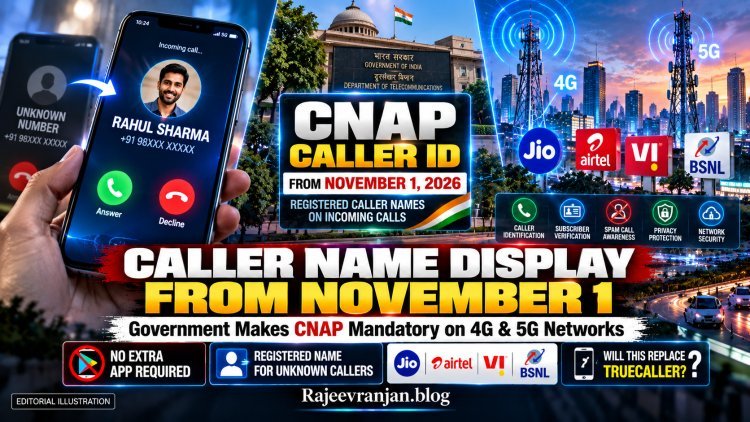
For example, consider a fictional subscriber named Rahul Sharma.
Rahul purchased his SIM card using valid identity documents, and his telecom operator recorded his name as Rahul Sharma.
When Rahul calls an unfamiliar number on a supported network, the recipient may see:
???? Rahul Sharma
+91 98XXX XXXXX
Incoming Call
The recipient would no longer have to rely solely on the phone number to decide whether to answer.
However, if the recipient has already saved Rahul's number as "Rahul Office", that saved contact name will take priority.
This is an important distinction.
CNAP is primarily intended to provide registered name information for numbers that are not saved in the recipient's contact list.
For international calls, the rules specify that unsaved numbers should display "International Call", rather than following the same registered-name presentation used for domestic calls.
CNAP Rules: What Changes From November 1?
| Feature | New CNAP Requirement |
|---|---|
| Starting Date | November 1, 2026 |
| Service Name | Calling Name Presentation |
| Full Form | CNAP |
| Government Department | Department of Telecommunications |
| Eligible Networks | 4G and higher-generation networks |
| Caller Information | Phone number and registered caller name |
| Saved Contacts | Your saved contact name takes priority |
| Unknown Domestic Numbers | Name from telecom subscriber records |
| International Calls | "International Call" displayed for unsaved numbers |
| Separate Activation Request | Not required |
| Third-Party App | Not required for the network-based service |
| Business Caller Names | Verified registered business names may be used |
| 2G and 3G | Rollout to be considered separately |
| Privacy Exception | Existing authorised CLIR facilities remain protected |
| Complaint Mechanism | Operators must provide grievance redressal |
Source: Department of Telecommunications, Circular No. 01/Licensing Policy/2026, dated October 13, 2026.
Will CNAP Replace Truecaller in India?
This is likely to become one of the biggest questions surrounding the new service.
Truecaller and similar applications have become popular in India because they help users identify unknown numbers.
However, the government's CNAP system operates differently.
How Truecaller Works
Third-party caller-identification applications use combinations of user-contributed information, databases, community reports and other signals to identify callers.
Depending on the application, users may also receive spam warnings and call-blocking features.
Some services offer additional functionality beyond simply identifying an incoming number.
How CNAP Works
CNAP uses telecom operators' subscriber records to retrieve a name associated with a mobile number.
The service is integrated into the telecommunications network rather than operating solely through a separate caller-identification application.
It is designed to display registered identity information during incoming calls.
CNAP vs Truecaller: Key Differences
| Feature | CNAP | Truecaller |
|---|---|---|
| Operated By | Telecom service providers | Private technology company |
| Name Source | Operator subscriber records | Multiple information sources |
| Separate App Required | No | Generally yes |
| Designed for Caller Identification | Yes | Yes |
| Community Spam Reports | Not specified as a CNAP feature | Available |
| Spam Blocking Tools | Not automatically included in CNAP | Available |
| Name Display for Unsaved Numbers | Yes, on supported networks | Yes, through supported app features |
| Accuracy | Depends on subscriber records and implementation | Depends on available identification data |
Could CNAP Reduce Dependence on Truecaller?
Potentially.
Users who mainly want to know the name associated with an unknown Indian mobile number may find CNAP sufficient.
However, those who use additional services such as community spam reporting, call blocking and business information may still find third-party applications useful.
The government has not announced a ban on Truecaller or other caller-identification applications.
CNAP introduces a network-based identification option; it does not automatically make existing applications obsolete.
Why India Is Introducing Caller Name Display
India has faced persistent problems involving unsolicited commercial calls, fraudulent calls and attempts to impersonate trusted organisations.
Scammers sometimes claim to represent banks, courier companies, police departments or government agencies.
These calls may be used to obtain sensitive information or persuade victims to transfer money.
Caller identification can provide an additional signal when evaluating unfamiliar calls.
For example, a recipient may become suspicious if someone claiming to represent a bank calls from a number displaying an unrelated personal name.
That inconsistency could encourage the recipient to verify the call independently.
However, identification systems have limitations.
A fraudster could use a SIM registered under an accomplice's name or a business connection that does not clearly reveal the caller's intentions.
Similarly, a displayed name matching a familiar organisation should not be considered definitive proof that the call is genuine.
CNAP may improve transparency, but it is not a guarantee against fraud.
The government has introduced the service as part of efforts to give telecom users more information about incoming calls.
What Happens If You Have Saved a Contact Under a Different Name?
This is one of the most useful details in the new rules.
Suppose you have saved your father's phone number as:
"Papa ❤️"
His telecom registration might contain his full legal name.
Under the DoT's directive, your saved contact name will take priority.
The phone should therefore continue displaying "Papa ❤️", rather than automatically replacing it with the name in the telecom database.
The same principle applies to numbers saved as:
- Mom
- Office Manager
- School Teacher
- Family Doctor
- Customer Support
For numbers not saved in your contacts, CNAP will attempt to display the registered caller identity.
This approach is intended to preserve users' existing contact-list experience while adding identification information for unfamiliar numbers.
What Name Will Appear If Your SIM Card Is Registered to Someone Else?
This is an important question, particularly in households where mobile connections may be registered under a family member's name.
CNAP uses the subscriber identity recorded by the originating telecom operator.
Therefore, if the subscriber database contains another person's name, that name may appear when the number calls someone who has not saved it.
For example, if a mobile number is registered under a parent's name but regularly used by another family member, CNAP may display the registered subscriber's name.
The government directive does not say that CNAP will identify the person physically holding the phone.
It relies on telecom subscription records.
Users concerned about incorrect names should contact their telecom provider through official customer-support channels.
Operators are required to establish mechanisms for receiving and resolving CNAP-related grievances.
Subscribers should avoid sharing identity documents through unsolicited messages or unofficial links claiming to offer CNAP updates.
Will Everyone's KYC Name Become Public?
The rollout raises legitimate questions about personal privacy.
Under the new system, the registered name associated with an eligible domestic calling number can be displayed to the recipient of an incoming call.
This means users should understand that an unfamiliar recipient may see the caller identity recorded in the telecom subscriber database.
However, the directive includes safeguards governing the handling of this information.
Telecom operators must implement a security-focused system designed to prevent the retrieved caller-name information from being retained through the CNAP query-response mechanism after a call is completed.
The circular also specifies that subscribers who have an authorised Calling Line Identification Restriction (CLIR) facility activated will not have their calling-name identity displayed through CNAP.
This is a defined exception and should not be confused with a general opt-out option available to every subscriber.
The directive does not establish that all consumers can freely hide their names through an ordinary phone setting.
Telecom operators must also provide complaint-handling mechanisms for users who encounter errors or other problems.
Businesses Can Display Verified Brand Names
The new system includes a provision that could be particularly useful for legitimate businesses.
A company using business or bulk telephone connections may be permitted to display a verified business name rather than the individual name ordinarily associated with the connection.
However, the business cannot simply choose any name it likes.
The DoT requires the preferred name to be supported by a registered trademark or a trade name registered through the GST system.
The telecom operator must verify the business identity before approving the preferred name.
For example, a registered business could potentially display its verified commercial identity when calling customers, subject to the operator's implementation and approval.
This could help customers distinguish legitimate business communications from unfamiliar personal numbers.
It may also create difficulties for callers attempting to impersonate well-known companies.
Nevertheless, even a verified displayed name should not be treated as an absolute guarantee that a call is safe.
Customers should continue using official communication channels when handling financial or sensitive transactions.
What Will Happen to 2G Users and Basic Phones?
The initial November 1 directive does not cover every telephone technology.
The DoT has specifically instructed operators to introduce CNAP on wireless networks using 4G and higher-generation technologies.
The introduction of the service on 2G and 3G networks will be examined separately.
Traditional public switched telephone networks are also outside the immediate rollout requirement.
This means some basic-phone users may not receive the same caller-name display functionality when the new service begins.
The government has not confirmed a nationwide implementation deadline for these older networks.
For consumers, the practical availability of CNAP may therefore depend on both their telecom network and device capabilities.
Do Jio, Airtel, Vi and BSNL Users Need to Activate CNAP?
According to the government directive, users do not need to submit a separate request for the service.
Telecom operators have been instructed to provide caller-name presentation automatically on supported networks.
What Mobile Users Should Know
1. No separate application is required. CNAP is designed as a telecom-network service.
2. No special registration request is required. Eligible users are to receive the feature through their telecom providers.
3. Saved contact names remain important. Names already stored on your phone take priority.
4. Incorrect caller names can be reported. Telecom operators must provide complaint-handling mechanisms.
5. Older networks are not covered by the initial mandate. Separate decisions will be required for 2G and 3G.
Users should also be cautious about messages claiming that CNAP activation requires payment, an OTP or installation of an unfamiliar APK file.
The official directive does not establish any requirement for subscribers to pay a third-party activation agent.
Could CNAP Help Prevent Digital Arrest and Bank Fraud Scams?
Caller identification may offer some practical benefits, particularly when criminals make unsolicited calls claiming to represent official organisations.
For instance, a fraudster might call someone and claim to be a police officer investigating a bank account.
If the displayed name bears no relationship to the claimed organisation, that could raise suspicion.
Similarly, someone pretending to represent a courier service or financial institution may become easier to question.
However, scammers can exploit stolen identities, compromised communications or misleading subscriber registrations.
Consequently, CNAP should be treated as one security measure rather than a complete defence.
Important Safety Advice
Never share OTPs, UPI PINs, passwords or banking credentials merely because a caller's name appears genuine.
If someone claims to represent a bank, police department or government agency, end the conversation and contact the organisation through independently verified channels.
If you suspect financial cyber fraud in India, use the national cybercrime reporting helpline 1930 or the official cybercrime reporting portal.
Caller identification can help users make decisions, but safe verification habits remain essential.
What Challenges Could Telecom Companies Face?
The proposed nationwide implementation is technically significant.
Telecom operators must maintain subscriber-name databases and allow caller-name information to be retrieved efficiently when calls move between networks.
For example, when an Airtel subscriber calls a Jio subscriber, the receiving network may need to obtain the name from the originating operator's database.
The system must work quickly enough to avoid creating unnecessary call delays.
It must also protect subscriber information and handle cases where records are incorrect.
The DoT's circular specifically requires operators to maintain adequate database, network and connectivity infrastructure.
Telecom companies must also preserve service quality and implement security protections.
Large-scale implementation may therefore involve software upgrades, database integration, interoperability testing and customer-support arrangements.
The success of the rollout will ultimately depend on how consistently these requirements are implemented across different networks and devices.
Why This Is a Significant Step for Digital India
India's digital economy increasingly depends on mobile connectivity.
Phones are used for banking, business transactions, education, healthcare, government services and everyday communication.
This makes telephone networks an important part of the country's digital trust infrastructure.
A system that provides additional information about unknown callers could make routine communication more transparent.
It may particularly benefit people who are unfamiliar with caller-identification applications or prefer not to install additional software.
At the same time, the policy introduces a balance between transparency and privacy.
The government and telecom operators will need to ensure that subscriber information is accurate, complaints are addressed and data-protection safeguards are properly implemented.
The effectiveness of CNAP should be judged by its actual performance after launch, not simply by the date on which it becomes mandatory.
A New Era for Caller Identification in India
India's decision to introduce Calling Name Presentation from November 1, 2026, represents an important change in how incoming calls will be identified.
Instead of showing only an unfamiliar phone number, supported mobile networks will provide a registered caller name for eligible domestic calls.
The system could reduce uncertainty when answering unknown calls and give consumers additional information when evaluating suspicious communications.
It may also reduce dependence on third-party caller-identification applications for basic name recognition.
However, CNAP will not automatically eliminate spam calls, impersonation or financial fraud.
Its success will depend on accurate subscriber records, reliable telecom infrastructure, privacy safeguards and effective complaint resolution.
The biggest change may be simple but meaningful: before answering an unknown call, millions of Indians could soon know whose name is registered against the number.