


India-US Trade Deal: MEA Responds to White House Fact Sheet Revisions, Cites "Shared Understanding"
MEA clarifies that White House fact sheet revisions reflect the "shared understanding" between India and the US. Discover how the joint statement remains the primary framework for the interim trade deal.
 Rajeev

New Delhi: The Ministry of External Affairs (MEA) has officially clarified the recent turbulence regarding the documentation of the India-US interim trade deal. Speaking at a weekly media briefing on February 12, 2026, MEA Spokesperson Randhir Jaiswal stated that the recent amendments made by the White House to its fact sheet are consistent with the "shared understandings" established in the original joint statement.
The response comes after the White House issued a revised version of its trade framework fact sheet on February 11, softening several key assertions that had previously caused concern in New Delhi.
The Joint Statement: The "Ultimate Framework"
Addressing queries about the contradictions between the initial US release and the Indian version, Jaiswal emphasized that the Joint Statement issued on February 7, 2026, remains the definitive foundation of the agreement.
"India and the US had agreed to a joint statement on the framework for an interim agreement on reciprocal and mutually beneficial trade... The joint statement is the framework and remains the basis of our mutual understanding in this matter," Jaiswal told reporters.
The MEA’s position is that any edits made by the US side were essentially "aligning" their internal documents with the actual negotiated text of the leaders' agreement.
Key Revisions in the White House Fact Sheet
The controversy began when the White House’s initial "fact sheet" appeared to go beyond the agreed-upon terms. Following diplomatic feedback and internal reviews, several high-stakes edits were made:
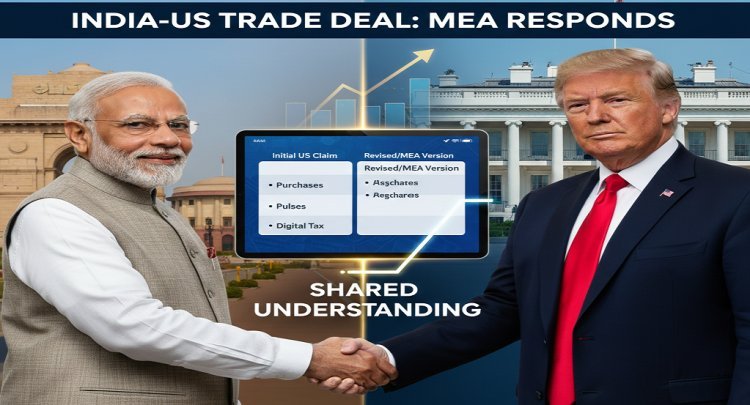
| Topic | Initial US Claim | Revised/MEA Version |
| Purchases | India "will purchase" $500B in goods. | India "intends" to purchase $500B. |
| Agricultural Products | Included "certain pulses" in tariff cuts. | References to "pulses" have been removed. |
| Digital Trade | India "will remove" digital service taxes. | Claim removed; India committed to negotiating rules. |
| Energy & Tech | Definitive commitment to $500B spend. | Focus on "intent" and 5-year timeline. |
Why the Changes Matter
The revisions are seen as a win for Indian negotiators, particularly regarding sensitive sectors:
-
Agriculture: The removal of "pulses" protects domestic farmers from a sudden influx of American produce, a major "red line" for New Delhi.
-
Sovereignty in Tech: By changing "will remove digital service taxes" to "negotiating rules," India retains its policy space. It is noted that India had already phased out its 6% equalization levy on digital advertising services as of April 2025.
-
Financial Commitments: The shift from "will buy" to "intends to buy" clarifies that the $500 billion figure for energy, ICT, and coal is a target based on market conditions, not a legally binding guarantee.
What’s Next for the Deal?
The MEA has confirmed that both nations are now moving toward operationalizing the framework. The interim agreement is seen as a precursor to a comprehensive Bilateral Trade Agreement (BTA).
The deal, which notably lowered US tariffs on Indian goods like textiles and leather from 50% to 18%, is expected to generate significant employment in India's labor-intensive sectors while providing the US preferential access to India's market of 1.4 billion people.