


"Not Heard From Anyone Except You": Lavrov Counters US Claim on India Oil Deal
Russian FM Sergei Lavrov dismisses US claims that India is halting Russian oil imports, stating he has "not heard" this from New Delhi. Read about the latest diplomatic standoff here.
 Rajeev
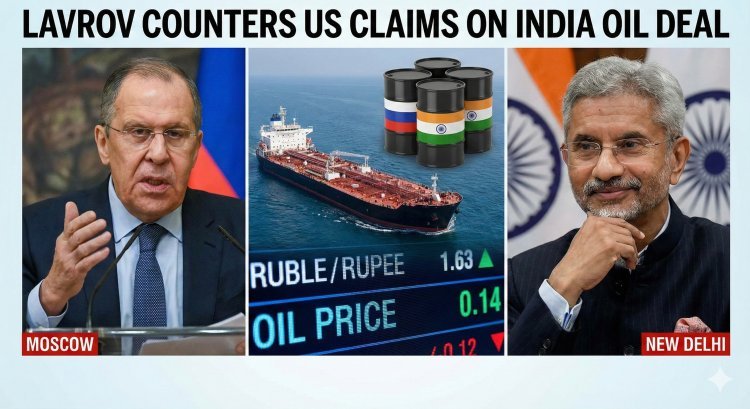

MOSCOW/NEW DELHI — In a sharp rebuttal to Western narratives, Russian Foreign Minister Sergei Lavrov has dismissed assertions made by United States officials suggesting that India is moving away from Russian oil imports due to sanctions. Lavrov termed the reports as disconnected from the reality of the bilateral dialogue between Moscow and New Delhi.
The statement comes amidst a fresh wave of diplomatic pressure from Washington, aimed at tightening the G7 price cap on Russian crude oil and discouraging major buyers like India and China from fueling Moscow’s economy.
The Controversy: What the US Claimed
The diplomatic exchange was triggered after senior US officials recently suggested that the "knots" of sanctions were tightening, making it increasingly difficult for India to procure Russian oil. US representatives hinted that Indian refiners were beginning to shun Russian Sokol crude due to payment hurdles and the risk of secondary sanctions.
The narrative from Washington posited that the strategic energy partnership between India and Russia was fraying under the weight of financial restrictions.
Lavrov’s Rebuttal: "No Signal from New Delhi"
Speaking at a press briefing, Sergei Lavrov addressed these claims directly when questioned by reporters. He emphasized that the Indian government has not communicated any intention to stop or reduce the purchase of Russian hydrocarbons.
"I have not heard about it from anyone except you [the media/US officials]," Lavrov remarked.
He went on to clarify the nature of the relationship, stating, "We have honest, respectful, and mutually beneficial relations with India. If there are issues, we discuss them directly. We do not communicate through American press releases."
Lavrov’s comments highlight Moscow’s stance that the energy trade is driven by market pragmatism and mutual national interest, rather than third-party geopolitical pressure.
The Payment Mechanism Hurdles
While Lavrov dismissed the idea of a policy shift, he acknowledged the technical challenges inherent in the trade. The issue of payment mechanisms—specifically the conversion of Indian Rupees and the use of the UAE Dirham or Chinese Yuan—has been a friction point.
-
The Price Cap: The G7 has imposed a $60-per-barrel price cap on Russian oil.
-
Tanker Sanctions: The US has recently sanctioned specific tankers and shipping companies moving Russian oil above this cap.
-
Currency Issues: Russia has accumulated billions in Indian Rupees that it struggles to use, leading to negotiations on payment in third-party currencies.
However, Lavrov insisted that these are "working issues" that technical teams from both nations are resolving, rather than a strategic pivot by India away from Russia.
India’s Stance: "Energy Security First"
The Indian Ministry of External Affairs (MEA), led by Dr. S. Jaishankar, has consistently maintained that India’s oil procurement is guided solely by "energy security" and the interests of the Indian consumer.
Despite Western pressure, India rose to become the world’s top importer of Russian seaborne crude in 2024 and 2025, taking advantage of deep discounts. Indian officials have previously stated that they will buy oil from "wherever it is cheapest," refusing to buckle to moral pressure regarding the conflict in Ukraine.