


India-US Critical Minerals Deal: Ambassador Sergio Gor Reveals Strategic Breakthrough
US Ambassador Sergio Gor confirms India and the US are nearing a landmark Critical Minerals deal. Learn how this partnership secures the global clean energy supply chain.
 Rajeev
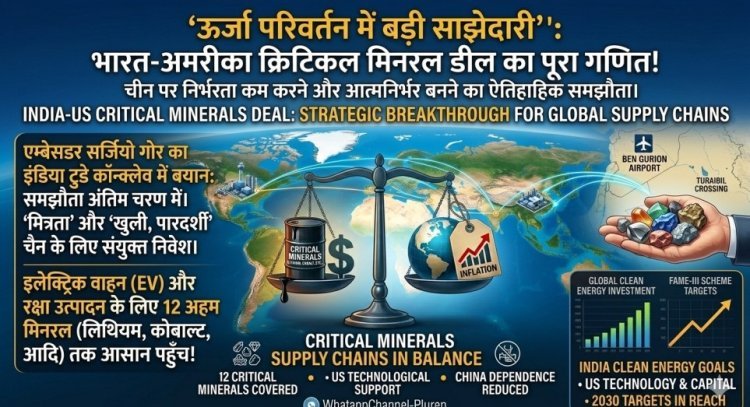

In a move that could redefine the global technology and clean energy landscape, United States Ambassador to India, Sergio Gor, has confirmed that Washington and New Delhi are on the verge of signing a comprehensive Critical Minerals Agreement.
Speaking at the prestigious India Today Conclave, Ambassador Gor highlighted that the partnership is entering its final stages, signaling a massive shift in how the two democratic giants intend to secure their technological futures.
Why Critical Minerals Matter
Critical minerals, including lithium, cobalt, nickel, and rare earth elements, are the "new oil" of the 21st century. They are indispensable for the production of electric vehicle (EV) batteries, semiconductors, defense equipment, and renewable energy infrastructure.
Currently, the global supply chain for these materials is heavily concentrated in a few regions, leading to significant vulnerabilities. Ambassador Gor emphasized that this new deal is designed to create a "resilient and transparent" supply chain that reduces dependency on volatile or monopolistic markets.
The Strategic "China-Plus-One" Strategy
While not explicitly mentioning rivals, the undertone of the Ambassador’s speech was clear: India and the US are building an alternative to the current dominance of Chinese processing and mining. By combining US capital and technology with India’s massive industrial potential and labor force, the two nations aim to lead the Energy Transition.
Key Pillars of the Upcoming Deal
Ambassador Gor outlined several areas where the cooperation will focus:
-
Investment in Mining: Joint ventures to explore and mine minerals in third-party countries (friend-shoring).
-
Processing Technology: The US will share advanced technology for refining raw minerals into usable components for high-tech manufacturing.
-
Recycling Innovation: Establishing a circular economy where minerals from old electronics and batteries are recovered and reused.
A "New Chapter" in Bilateral Ties
Ambassador Gor lauded the current state of India-US relations, describing them as being at an "all-time high." He noted that the minerals deal is part of a broader framework of cooperation that includes space exploration (iCET), artificial intelligence, and defense co-production.
"We are not just looking at a trade agreement; we are looking at a decades-long partnership that ensures security for our citizens and prosperity for our industries," the Ambassador remarked.
What This Means for Indian Industry
For Indian manufacturers, this deal could mean easier access to the raw materials needed for the FAME-III scheme and the country’s ambitious goal of 30% EV penetration by 2030. It also opens doors for Indian startups in the deep-tech and material science sectors to collaborate with Silicon Valley.