


Naval Might: USS George H.W. Bush Joins the Fray! Why America Sent a Third Carrier to the Middle East
The USS George H.W. Bush has entered the Middle East, marking a massive escalation in US naval presence. Explore the firepower of this Supercarrier and what it means for regional stability.
 Rajeev
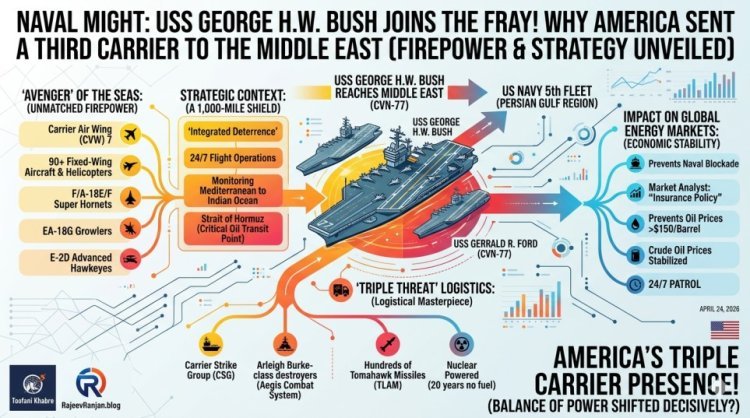

Iron Rain in the Gulf: USS George H.W. Bush Arrives in the Middle East—Decoding the Firepower of America's Third Carrier
CENTCOM HQ (Defense Desk - April 24, 2026): In a move that has sent shockwaves through global capitals, the USS George H.W. Bush (CVN-77) has officially entered the Middle East region. This arrival marks a historic moment in modern naval warfare: for the first time in decades, the United States has stationed three nuclear-powered aircraft carriers simultaneously in the waters surrounding the Arabian Peninsula.
Joining the USS Gerald R. Ford and the USS Abraham Lincoln, the "Bush" brings an unparalleled level of aerial supremacy to the 5th Fleet’s area of operations. But why has the Pentagon chosen this moment to triple its naval footprint?
1. The "Avenger" of the Seas: Unmatched Firepower
The USS George H.W. Bush is the final ship of the legendary Nimitz-class. It is not just a ship; it is a four-and-a-half-acre floating sovereign territory of the United States.
-
The Air Wing: The carrier houses Carrier Air Wing (CVW) 7, capable of launching up to 90 fixed-wing aircraft and helicopters. This includes the lethal F/A-18E/F Super Hornets, EA-18G Growlers for electronic warfare, and E-2D Advanced Hawkeyes for early warning.
-
Speed and Endurance: Powered by two nuclear reactors, she can operate for over 20 years without refueling, reaching speeds in excess of 30 knots (approx. 56 km/h).
-
Defensive Shield: To protect itself from missile swarms, the carrier is equipped with RIM-162 Evolved Sea Sparrow Missiles (ESSM) and the Phalanx CIWS, a radar-guided Gatling gun that shreds incoming threats.
2. Strategic Context: A 1,000-Mile Shield
The arrival of a third carrier is a clear signal of "Integrated Deterrence." As tensions rise in the Strait of Hormuz and across the Red Sea, the U.S. Navy now has the capability to conduct 24/7 flight operations without fatigue.
By positioning the USS George H.W. Bush, the U.S. can effectively monitor and control maritime traffic from the Mediterranean all the way to the Indian Ocean. This creates a "Steel Curtain" that discourages any regional actor from attempting a full-scale naval blockade.
3. The "Triple Threat" Logistics
Operating three carriers in one theater is a logistical masterpiece.
-
Carrier Strike Group (CSG): The Bush is accompanied by a flotilla of destroyers and cruisers, including Arleigh Burke-class destroyers equipped with the Aegis Combat System.
-
Tomahawk Capability: Collectively, this strike group carries hundreds of Tomahawk Land Attack Missiles (TLAM), capable of striking targets deep inland with pinpoint accuracy.
4. Impact on Global Energy Markets
The presence of the USS George H.W. Bush is directly tied to economic stability. With the Strait of Hormuz being the world's most critical oil transit point, this naval deployment acts as a massive insurance policy for global oil tankers. Market analysts suggest that without this presence, crude oil prices could have surged past $150 per barrel due to "war premiums."
Diplomacy through Strength
The U.S. Navy’s motto for the CVN-77 is "Freedom at Work." As the USS George H.W. Bush begins its patrol, the message to the world is undeniable: the U.S. is prepared to maintain maritime freedom at any cost. Whether this leads to a de-escalation or further provocation remains to be seen, but for now, the balance of power in the Middle East has shifted decisively toward the sea.