


UNIFIL Under Fire: Are Indian Peacekeepers in Danger Amidst Lebanon’s Escalating War?
As hostilities intensify between Israel and Hezbollah, UNIFIL peacekeepers, including hundreds of Indian soldiers, face grave security threats. Explore the latest updates on the safety of the UN mission in South Lebanon.
 Rajeev
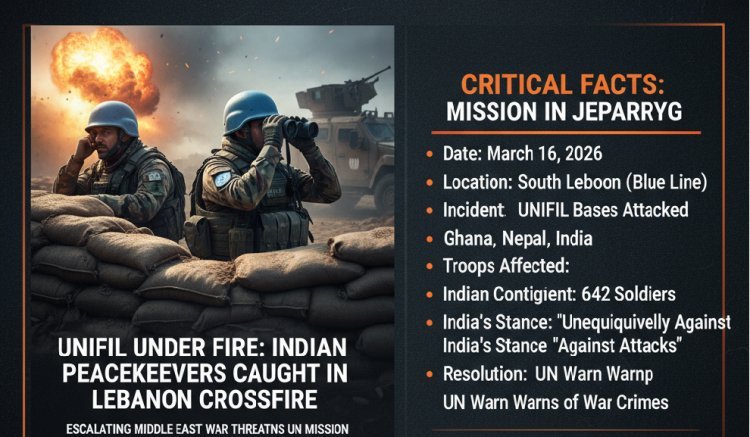

UNIFIL Under Fire: The Growing Threat to Peacekeepers in Southern Lebanon
The "Blue Line"—the volatile border separating Israel and Lebanon—has transformed into one of the world’s most dangerous combat zones. As the conflict between Israel and Hezbollah escalates following the regional fallout of the Iran-US standoff, the United Nations Interim Force in Lebanon (UNIFIL) finds itself caught in the crossfire, with peacekeepers increasingly becoming targets.
The Escalating Security Crisis
Since the surge in hostilities on March 2, 2026, UNIFIL positions have been struck multiple times. Recent reports confirm that UNIFIL bases, including those housing contingents from Ghana and Nepal, have sustained damage from heavy machine-gun fire and artillery.
On March 14, 2026, a UN peacekeeper was injured when a position near Meiss ej Jebel was hit, sparking a fire. The United Nations has reported three separate incidents on March 15 alone, where peacekeepers were fired upon while patrolling areas in Yatar, Dayr Kifa, and Qallawiyah. The proximity of these strikes—some as close as five meters—highlights the extreme risk faced by the 7,500-strong force.
India’s Crucial Role and Standing
India remains one of the largest contributors to the UN mission. As of early 2026, 642 Indian peacekeepers are deployed in South Lebanon, serving as the fourth-largest contingent in the force.
The Indian government has maintained a firm stance. On March 11, India joined 30 other troop-contributing nations in a joint statement expressing "deep alarm" at the escalation. India's Permanent Representative to the UN, Ambassador Parvathaneni Harish, stated unequivocally: "We are unequivocally against any attacks on UN Peacekeepers for which there can be no justification." Indian soldiers continue to execute their mandate despite the volatile conditions, focusing on maintaining stability and assisting local communities trapped in the conflict.
The Future of the Mission
The safety of these personnel is now a central concern for the UN Security Council. While the current mandate for UNIFIL was renewed until the end of 2026, the intensifying violence has raised difficult questions about the mission's viability. The UN has reminded all actors—state and non-state—that targeting peacekeepers constitutes a grave violation of international humanitarian law and may amount to a war crime.
However, as the conflict expands, the "buffer" role of UNIFIL is being stretched to its limits. With hundreds of thousands of civilians displaced and heavy shelling becoming the new normal, the peacekeepers are operating in an environment where the cessation of hostilities mandated by Resolution 1701 is effectively non-existent.
A Moral and Legal Imperative
The world is watching as brave men and women from countries like India, Italy, Indonesia, and Spain face mounting threats while performing their duty to protect civilians. Ensuring the safety of UNIFIL personnel is not just a diplomatic obligation but a fundamental requirement for maintaining what little remains of the international rules-based order in the region.