


Israeli Unity Talks Fail: Netanyahu and Eisenkot Divided
Netanyahu and Gadi Eisenkot fail to agree on an Israeli unity government. Explore the political differences and what happens before December 6.
 Rajeev
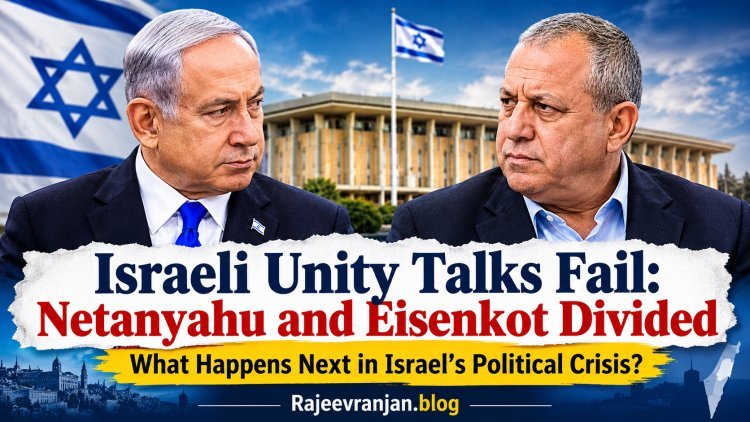

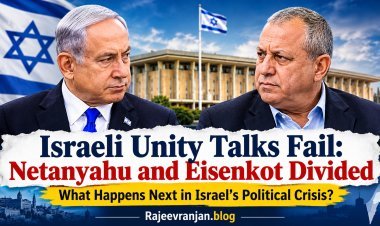
Israel's latest attempt to break its political deadlock has ended without an agreement. Prime Minister Benjamin Netanyahu and opposition leader Gadi Eisenkot met on Sunday, November 29, to explore the possibility of forming a national unity government. After around two hours of discussions, however, the two leaders remained divided over key political issues.
The meeting had attracted considerable attention because Netanyahu had made an unexpected offer: he was willing to let Eisenkot serve as prime minister first under a rotating leadership arrangement. But the proposal was not enough to bring the rival camps together. Israeli media reports now say that no further meetings between their negotiating teams are planned.
For Israel, this is more than another disagreement between politicians. The country is approaching an important deadline to form a government, and the failure of these discussions leaves its political future uncertain.
An Unexpected Offer From Netanyahu
Netanyahu's proposal came at a particularly sensitive moment. Following the October 27 parliamentary elections, neither of the main political blocs secured enough support to govern independently.
Eisenkot, who leads the Yashar party, was given the responsibility of trying to form the next government. His political objective has been to build a coalition capable of replacing Netanyahu, Israel's longest-serving prime minister.
On Saturday night, Netanyahu publicly offered a different arrangement. He said Eisenkot could take the first turn as prime minister, while he would initially serve as alternate prime minister.
It was a notable change in position from a leader who had previously resisted similar power-sharing proposals.
Eisenkot agreed to meet Netanyahu to examine whether the offer represented a genuine opportunity for political cooperation. The meeting took place at the Kirya military headquarters in Tel Aviv and began with a security briefing.
According to the joint statement released by Likud and Yashar, the discussion was businesslike, with both sides attempting to overcome their substantial differences.
But the positive language did not translate into a political agreement.
Why the Two Leaders Could Not Agree
The disagreement was not simply about who would occupy the prime minister's office. The timing and conditions of the proposed arrangement also became important obstacles.
According to reports cited by The Times of Israel, Netanyahu wanted to remain in office for an unspecified period before the proposed rotation took effect. One reported consideration was the possibility of a future security operation involving Iran.
Eisenkot reportedly rejected this condition.
There is also a wider political problem. Eisenkot has built his campaign around replacing Netanyahu, and several of his political partners have strongly opposed joining a government under the outgoing prime minister.
A unity agreement could therefore create serious divisions within Eisenkot's own camp.
Following Sunday's meeting, reports indicated that Eisenkot remained committed to his existing political partners. He was also understood to have left open the possibility of Likud joining a government later, provided it accepted the coalition's principles.
For now, however, the two sides have failed to find a formula acceptable to both.
The Numbers Behind Israel's Political Deadlock
The difficulty becomes easier to understand when looking at the parliamentary numbers.
Israel's parliament, known as the Knesset, has 120 seats. A government generally needs support from at least 61 lawmakers to command a majority.
According to Reuters, Netanyahu's political bloc has 53 seats, while Eisenkot's four-party bloc has 48. Neither side can govern comfortably without additional political support.
Eisenkot has already secured agreements with Avigdor Liberman's Yisrael Beiteinu and Yair Golan's Democrats. He is also negotiating with Naftali Bennett's Beyachad party.
But even with these partners, he needs additional support.
This is where the negotiations become complicated. Arab-led political parties could provide important parliamentary backing, but their involvement remains controversial among several Jewish political parties.
Ultra-Orthodox parties are another possible source of support. However, disagreements over military conscription have made negotiations with them difficult.
The result is a political puzzle in which almost every possible coalition arrangement comes with significant compromises.
The Military Service Question Adds Another Obstacle
One of the most sensitive issues in the negotiations concerns military service for ultra-Orthodox Jewish communities, commonly known as Haredim.
For years, exemptions for many ultra-Orthodox students studying in religious institutions have been a source of political disagreement in Israel.
Several parties in Eisenkot's camp want a clearer framework requiring broader military participation. Ultra-Orthodox parties, meanwhile, have resisted arrangements that would significantly change existing exemptions.
Naftali Bennett's party has reportedly demanded progress on a military conscription framework before finalising its agreement with Eisenkot.
This creates another challenge for the opposition leader. He needs enough parliamentary support to form a government, but the parties capable of providing that support do not necessarily agree on major policy questions.
December 6 Could Decide Israel's Political Direction
Eisenkot is working against a deadline. President Isaac Herzog gave him the mandate to form a government, with the initial period ending on December 6.
Eisenkot has indicated that he intends to complete the process by that date rather than rely on a possible 14-day extension.
The failure of the Netanyahu meeting means that attention is now shifting towards negotiations with the remaining potential coalition partners.
Netanyahu, meanwhile, has not disappeared from the political picture. Although his bloc does not currently have enough seats to govern independently, Likud remains an influential parliamentary force.
If Eisenkot fails to secure the necessary support, the next steps will depend on Israel's constitutional process and the President's decisions. Another attempt at coalition negotiations or fresh elections could become possible.
Why This Matters Beyond Israel
For international observers, the political developments are important because Israel is dealing with major security and diplomatic challenges.
Its relationship with Iran, the wider Middle East security situation and its ongoing international partnerships all make political stability particularly significant.
India also has reasons to follow these developments closely. New Delhi and Tel Aviv cooperate in defence, technology, agriculture, water management and other strategic sectors.
A change in government does not automatically mean a change in foreign policy. Much will depend on the priorities of the incoming leadership and the agreements reached between its coalition partners.
For now, the immediate question is whether Eisenkot can assemble a government before the deadline.
Sunday's meeting offered an opportunity for Israel's rival political camps to find common ground. That opportunity has so far produced no agreement.
As December 6 approaches, the pressure is increasing. Israel's next government may depend less on the promises made by individual leaders and more on their ability to reach compromises with political partners who do not always share the same priorities.