



Gold vs Antimatter: 1 Gram Price, Red Diamonds & World's Costliest Materials
Gold vs antimatter: Discover the price of 1 gram, why antimatter is so costly, how rare red diamonds compare, and which materials are truly most valuable.
 Rajeev
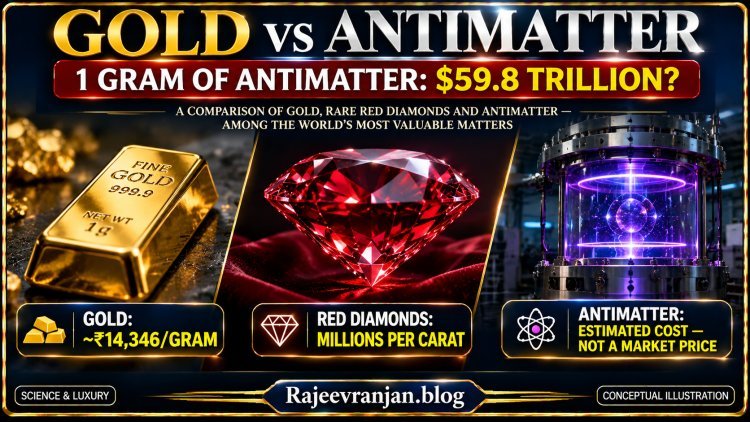

Gold Is Expensive. Antimatter Is Almost Priceless. Here's Why the World's Rarest Materials Defy Imagination
Imagine holding one gram of gold, one gram of a natural red diamond and one gram of antimatter. They have the same mass, but their economic and scientific significance could hardly be more different.
SCIENCE & LUXURY | NOVEMBER 6, 2026
A gram of gold is small enough to rest on your fingertip.
It can be bought from a jeweller, stored in a safe or passed down through generations.
For centuries, this remarkable metal has represented wealth, power and financial security.
Now imagine something dramatically more expensive.
A natural red diamond weighing the same amount could be worth millions of dollars.
Then comes antimatter—a substance so difficult to produce and contain that scientists work with quantities far smaller than anything visible to the human eye.
Popular articles often claim that one gram of antimatter costs approximately $62.5 trillion.
That would make it vastly more expensive than gold.
But here is the detail that changes the entire comparison.
Nobody is selling antimatter by the gram.
The enormous numbers associated with it are theoretical or historical production-cost estimates, not prices established through commercial transactions.
This distinction makes the story more interesting than a simple ranking of expensive objects.
Because the world's most costly materials are expensive for completely different reasons.
Gold is valuable because people trust it.
Red diamonds are valuable because nature produces so few exceptional examples.
Antimatter is extraordinarily costly because making and storing it pushes modern science to its limits.
How Much Does One Gram of Gold Cost in India?
Gold is the most familiar starting point.
As of November 6, 2026, indicative Indian retail quotations for 24-karat gold range from approximately ₹14,000 to ₹15,000 per gram, depending on the pricing source.
The figures vary between dealers, platforms and cities.
For example, Goodreturns quoted approximately ₹14,346 per gram for 24-karat gold, while Paytm's gold-rate tracker displayed approximately ₹14,829 per gram.
These are indicative rates rather than a single universal transaction price.
The final price of jewellery may also include taxes, making charges and other expenses.
Gold's value is influenced by international demand, central-bank activity, currency movements and investor expectations.
Unlike many extremely rare substances, gold has a large and established global market.
People can buy, sell, store and exchange it relatively easily.
That makes gold unusual: it combines physical scarcity with global liquidity.
Its price is high, but its usefulness as a financial asset comes partly from its accessibility.
Gold vs Antimatter vs Red Diamonds: The Price Comparison
Before examining the science, consider how dramatically these materials differ.
| Material | Illustrative Value | Important Clarification |
|---|---|---|
| 24K Gold | Approximately ₹14,000–₹15,000 per gram | Market-linked indicative price |
| Natural Red Diamond | Exceptional examples can reach millions of dollars per gram | Auction-dependent; no uniform rate |
| Antimatter | Often quoted at $62.5 trillion per gram | Historical estimate, not a selling price |
| Californium-252 | Often described as costing millions of dollars per gram | Specialised radioactive isotope; not an ordinary retail commodity |
| Platinum | Market-dependent | Precious metal traded commercially |
| Rhodium | Market-dependent | Rare industrial precious metal with volatile prices |
These values are not directly comparable. Some represent actual market quotations, others reflect exceptional auction results, and antimatter's figures concern laboratory production rather than commercial supply.
A scientifically accurate comparison must preserve those distinctions.
Antimatter: The Substance That Challenges Our Understanding of the Universe
Antimatter sounds like something invented for a science-fiction film.
But it is real.
Every ordinary particle has a corresponding antiparticle with the same mass and certain opposite properties.
For example, the electron has an antiparticle called the positron.
A proton has an antiproton.
When a particle encounters its corresponding antiparticle, they can annihilate, converting their mass into other forms of energy.
This process makes antimatter fascinating to physicists.
It also makes storing antimatter extraordinarily difficult.
Why Can't Scientists Simply Put Antimatter in a Container?
A normal container is made of matter.
If antimatter touches its walls, annihilation can occur.
Scientists therefore use sophisticated electromagnetic traps and extremely high vacuum conditions to isolate antiparticles.
CERN, the European Organization for Nuclear Research, operates specialised facilities to produce and study antimatter.
But the quantities involved are astonishingly small.
According to CERN, even running its Antimatter Factory continuously for an entire year would produce only a minuscule quantity of antiprotons.
The organisation explains that present technology is nowhere close to manufacturing useful quantities of antimatter on a gram scale.
This is why comparisons involving a full gram are hypothetical.
Does One Gram of Antimatter Really Cost $62.5 Trillion?
The figure of $62.5 trillion per gram is widely repeated in discussions about expensive substances.
However, it should not be treated as a current commercial price.
The number is commonly traced to historical estimates of the cost of producing antimatter using particle accelerators.
It is not a quote from a functioning antimatter marketplace.
In fact, more recent CERN educational material illustrates just how uncertain these cost comparisons can be.
A 2025 CERN lecture estimated that producing one gram of antiprotons by extrapolating existing production processes could involve costs measured in thousands of trillions of Swiss francs, even before all operational expenses were considered.
That estimate is not an actual project budget or transaction price.
It demonstrates the enormous difficulty of scaling laboratory production.
CERN has also explained that, with existing production methods, manufacturing a gram of antimatter would require an unimaginably long period.
Why the Estimates Differ
The answer depends on what is being calculated.
Are researchers estimating electricity consumption?
Are they including construction costs?
What about specialised equipment, staffing, cooling and particle losses?
And how would a laboratory contain an entire gram after production?
Different assumptions produce radically different numbers.
The most accurate conclusion is that antimatter is among the most difficult and costly substances to produce, but it has no meaningful established price per gram.
What Would Happen if One Gram of Antimatter Met Ordinary Matter?
One reason antimatter attracts public attention is its extraordinary energy density.
When antimatter annihilates with an equal amount of matter, the combined mass can be converted into energy and other particles.
However, that does not mean antimatter offers an easy new source of electricity.
Producing antimatter requires enormous amounts of energy.
Storing it is extremely challenging.
Capturing and using the energy released through annihilation would introduce additional technical difficulties.
CERN emphasises that current antimatter production quantities are far too small to serve as a practical energy source.
Its scientific importance lies primarily in understanding fundamental physics.
Researchers study antimatter to investigate questions including why the observable universe contains so much more matter than antimatter.
That mystery remains one of the deepest questions in modern physics.
Red Diamonds: When Nature Creates Something Almost Impossible to Find
Antimatter is extraordinarily difficult to manufacture.
Natural red diamonds are extraordinary for a different reason.
They are exceptionally rare geological creations.
Most people are familiar with colourless diamonds.
Fancy-coloured diamonds can appear yellow, blue, green, pink or other shades.
But diamonds with a predominantly natural red colour are among the rarest.
Research published by the Gemological Institute of America in 2025 examined more than one million fancy-colour diamonds submitted for laboratory services.
Only approximately 0.07% had predominantly red hues.
Those graded specifically as Fancy red represented roughly 0.04% of the fancy-colour stones examined.
That is an extraordinarily small proportion.
Why Are Red Diamonds Red?
Their colour is associated with changes in the diamond's crystal structure.
Unlike diamonds whose colour comes mainly from particular chemical impurities, natural red diamonds can develop their appearance through structural deformation and related optical effects.
These changes influence how the crystal absorbs and transmits light.
The result can be an intensely valuable gemstone.
But rarity alone does not determine price.
Colour quality, size, clarity, treatment history, grading and provenance also matter.
How Expensive Can a Red Diamond Become?
A remarkable example is the Argyle Phoenix.
This natural Fancy red diamond weighs 1.56 carats.
In 2024, it sold for approximately $4.2 million at auction.
That works out to roughly $2.7 million per carat.
Since one carat equals 0.2 grams, the transaction corresponds to approximately $13.5 million per gram when expressed as a weight-based comparison.
This does not mean a buyer could purchase a full gram of comparable red diamond material at that rate.
Diamonds are individual gemstones, and their prices do not scale evenly with weight.
A larger, rarer or more desirable stone may command a substantially different price.
The Argyle Phoenix was exceptional enough to set auction records for a Fancy red diamond at the time of its sale.
What About the Moussaieff Red?
Another famous example is the Moussaieff Red Diamond.
Weighing 5.11 carats, it is among the best-known large natural red diamonds.
Its unusual size and colour make it especially important in the world of rare gemstones.
However, publicly quoted valuations of famous diamonds should not be confused with verified recent selling prices.
The true market value of an individual exceptional stone depends on what a willing buyer would pay in an actual transaction.
Californium-252: The Radioactive Material Most People Have Never Heard Of
Gold and diamonds are familiar luxury materials.
Californium-252 belongs to a completely different category.
It is a radioactive isotope produced in specialised nuclear facilities.
Its unusual properties make it useful as a neutron source.
Applications include certain scientific measurements, industrial analysis and specialised research.
Producing it requires complex nuclear processes.
Its availability is extremely limited.
This has led to widespread claims that a gram could cost millions of dollars.
However, there is no ordinary consumer market where buyers can simply purchase gram quantities.
The isotope is regulated, hazardous and supplied for specialised purposes.
For that reason, internet rankings that assign it a simple fixed price per gram can be misleading.
Californium-252 is valuable because of its scientific and industrial applications—not because it can be displayed like jewellery.
Why Gold Still Has an Advantage Over These Rare Materials
Here is where the comparison becomes surprising.
Antimatter may be vastly more expensive to produce than gold.
Exceptional red diamonds may command much higher prices per gram.
Yet gold remains one of the world's most important stores of wealth.
Why?
Because value depends on more than rarity.
Gold Has a Global Market
Gold is bought and sold internationally.
Its prices are widely published.
Investors can compare quotations and access regulated markets.
Gold Is Relatively Easy to Store
Gold does not require a particle accelerator, electromagnetic containment system or specialised nuclear facility.
Properly stored gold can remain physically stable for extremely long periods.
Gold Has Recognised Financial Uses
Central banks hold gold reserves.
Individuals purchase gold jewellery, coins and bars.
Financial markets also offer gold-linked investment products.
Gold Can Be Resold
A person who owns gold can generally find buyers.
The same cannot be said of antimatter.
A hypothetical scientific valuation means little if the substance cannot be produced in useful quantities, stored easily or traded.
A material can be extraordinarily costly to create without being a practical investment.
What Actually Makes Something Expensive?
The comparison reveals five important factors.
Scarcity: How difficult is the material to find or produce?
Demand: Who wants it, and for what purpose?
Production cost: How much technology, energy and labour are required?
Utility: Does the material have scientific, industrial, decorative or financial applications?
Market accessibility: Can it legally and practically be bought and sold?
Gold performs strongly across several of these dimensions.
Red diamonds derive much of their value from rarity, beauty and collector demand.
Antimatter's extreme production difficulty makes it scientifically extraordinary, but not commercially investable.
Californium-252 is valuable because of specialised uses and highly constrained production.
These differences explain why a ranking of expensive materials should never rely on one number alone.
Can Scientists Make Antimatter More Affordable?
Researchers continue improving methods for creating, trapping and studying antimatter.
At CERN, experiments involving antihydrogen and antiprotons help physicists test fundamental properties of the universe.
Better containment and more efficient experimental techniques may allow researchers to study antimatter with increasing precision.
But scientific progress does not mean gram-scale production is approaching commercial reality.
Even substantial improvements would leave an enormous gap between current laboratory quantities and a full gram.
The practical applications of antimatter therefore remain limited.
Its greatest present value is scientific knowledge.
Frequently Asked Questions
Is antimatter the world's most expensive substance?
It is often described that way because of its extraordinary production difficulty. However, it has no established commercial price per gram, so the claim is best understood as a comparison of hypothetical production costs.
Is one gram of antimatter worth $62.5 trillion?
That figure is a widely repeated historical estimate, not a current transaction price or a verified market quotation.
Is antimatter more expensive than gold?
Based on production-cost estimates, antimatter is vastly more costly to produce. However, gold and antimatter do not have comparable commercial markets.
Which is more expensive: gold or a natural red diamond?
Exceptional natural red diamonds can command dramatically higher prices per unit of weight than gold.
Can ordinary people buy antimatter?
No practical retail market exists for antimatter.
Are red diamonds rarer than ordinary diamonds?
Yes. Natural Fancy red diamonds are exceptionally rare, as documented by the Gemological Institute of America.
Is gold still a good investment?
Gold has established financial markets, but its price can rise or fall. Whether it suits an investor depends on financial goals, risk tolerance and portfolio needs.
Final Verdict: The Most Expensive Material Is Not Necessarily the Most Valuable Investment
Gold, red diamonds and antimatter illustrate three dramatically different kinds of value.
Gold represents economic trust, practical ownership and global liquidity.
Red diamonds represent geological rarity and extraordinary collector demand.
Antimatter represents the limits of scientific production and some of the deepest mysteries of the universe.
A gram of gold can be purchased and stored.
A gram of exceptional natural red diamond material would be extraordinarily difficult to acquire.
A gram of antimatter remains beyond present practical production capabilities.
And that leads to the most important conclusion.
Antimatter may be the ultimate example of extreme production cost, but gold remains far more useful as an accessible store of wealth.
The distinction reminds us that the world's most fascinating substances are not necessarily valuable for the same reasons.
Some are prized because people want to own them.
Others are important because they help scientists understand the universe.
And sometimes, the most extraordinary material is one that humanity can barely produce at all.