


DMK Backs Revised Delimitation Bill: Stalin Calls Protection of Tamil Nadu's Lok Sabha Share a Major Victory
DMK backs the revised Delimitation Bill after the Centre addresses Tamil Nadu's seat-share concerns. Stalin calls it a victory ahead of Parliament's session.
 Rajeev

DMK Backs Revised Delimitation Bill: Stalin Calls Protection of Tamil Nadu's Lok Sabha Share a Major Victory
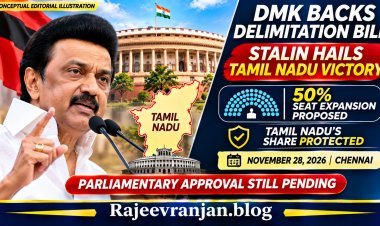
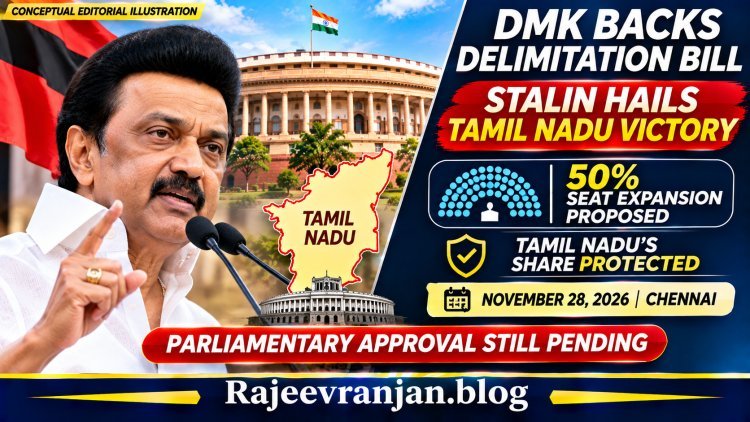
The DMK has formally announced its support for the Centre's revised delimitation legislation, with party president M. K. Stalin describing the proposed safeguards for Tamil Nadu's parliamentary representation as a major political achievement. The decision, taken on November 28, 2026, marks a significant shift ahead of Parliament's special sitting beginning November 30.
CHENNAI | November 28, 2026
A major political obstacle to the Centre's proposed parliamentary delimitation reforms appears to have eased after the Dravida Munnetra Kazhagam formally decided to support the revised legislation.
The decision was announced following a meeting of DMK Members of Parliament chaired by party president M. K. Stalin at Anna Arivalayam in Chennai on Saturday.
The party adopted a resolution supporting the revised delimitation framework while reiterating its commitment to protecting Tamil Nadu's political representation.
Stalin described the development as a victory for the state's longstanding demands concerning fair delimitation.
The announcement follows the Union Cabinet's approval of revised legislation on November 27, linking the expansion of parliamentary seats with the implementation of women's reservation.
The DMK's decision could strengthen the government's chances of securing the parliamentary support needed for constitutional changes.
However, the proposed legislation still requires approval by Parliament.
Why Has the DMK Decided to Support the Delimitation Bill?
The DMK's support rests primarily on two conditions.
First, Tamil Nadu's existing proportional share of Lok Sabha seats must not decline.
Second, the relative distribution of parliamentary representation among states must remain protected for another 25 years.
The party had previously opposed proposals that could allow states with higher population growth to gain a larger share of parliamentary representation.
Southern states have argued that population-based redistribution could disadvantage regions that have successfully implemented family-planning programmes.
The revised proposal reportedly provides for a uniform 50% increase in parliamentary seats across states while preserving their existing proportional representation until 2051.
For the DMK, that provision addresses its central concern: Tamil Nadu should not lose relative political influence simply because its population has grown more slowly than that of some other states.
Stalin said the party's principal demands had been incorporated into the revised legislation.
He presented the outcome as the result of a sustained political campaign rather than a retreat from the DMK's earlier position.
Tamil Nadu's 7.18% Lok Sabha Share at the Centre of the Debate
Tamil Nadu currently has 39 elected Lok Sabha constituencies.
That represents approximately 7.18% of the existing 543 elected constituencies.
The DMK has repeatedly argued that this proportion must be protected.
Senior party leader and MP A. Raja said the revised arrangement could increase Tamil Nadu's share marginally to approximately 7.21%.
He maintained that the proposal would preserve the state's relative representation rather than reduce it.
The two percentages are significant because the debate concerns more than the absolute number of seats.
A state could gain additional constituencies while still losing influence if other states received a substantially larger increase.
The DMK's objective has been to prevent that outcome.
Under the proposed uniform expansion, Tamil Nadu would gain additional seats without suffering the relative reduction the party had feared.
However, the precise final allocation must be checked against the enacted legislation and subsequent delimitation arrangements.
What Did Stalin Say After the Meeting?
Addressing party parliamentarians, Stalin argued that the DMK had anticipated the political consequences of population-based delimitation.
He referred to the party's efforts to build opposition to any arrangement that could disadvantage southern states.
Stalin also recalled the Tamil Nadu Assembly's February 2024 resolution calling for the protection of existing interstate parliamentary representation.
According to the DMK leader, the revised proposal demonstrates that sustained political pressure can influence the terms of national legislation.
He urged party MPs to explain the DMK's position clearly during Parliament's upcoming sitting.
The party's argument is that supporting a revised framework with constitutional safeguards is different from accepting an unrestricted population-based redistribution.
Stalin's description of the development as a victory is a political assessment made by the DMK, not an independently established conclusion about every consequence of the proposed reform.
What Does the Revised Delimitation Proposal Include?
The revised legislative package seeks to expand parliamentary representation and create a pathway for implementing women's reservation.
The principal features reported so far include:
-
A proposed 50% increase in Lok Sabha seats across states.
-
Protection of existing interstate representation proportions until 2051.
-
Expansion of seats in state legislative assemblies.
-
Implementation of 33% reservation for women through the revised delimitation framework.
The Union Cabinet approved the Constitution (One Hundred and Thirty-Second Amendment) Bill, 2026, and the Delimitation (Second) Bill, 2026, on November 27, according to contemporary parliamentary reporting.
The proposals follow an earlier legislative attempt in April 2026 that failed to secure the required majority.
The current package represents another effort to obtain sufficient political agreement for the reforms.
However, Cabinet approval is not equivalent to parliamentary enactment.
Why Women's Reservation Is Linked to Delimitation
The Nari Shakti Vandan Adhiniyam, enacted through the Constitution (106th Amendment) Act, 2023, established a framework for reserving one-third of seats for women in the Lok Sabha and specified state legislatures.
Its implementation was linked to a subsequent census and delimitation exercise.
The Centre's revised proposals seek to advance implementation while expanding the number of elected representatives.
Supporters argue that the approach could create additional opportunities for women to enter Parliament without substantially reducing the number of constituencies available to other candidates.
Critics, however, have questioned whether women's reservation should depend on a wider reorganisation of parliamentary representation.
The debate therefore involves two distinct questions: when women's reservation should begin and how parliamentary seats should be redistributed.
The DMK's latest decision concerns the safeguards included in the revised delimitation arrangement.
DMK's Decision Creates New Political Divisions
The announcement has also exposed differences between political parties that previously opposed the Centre's delimitation plans.
Congress leaders have questioned the DMK's decision to support the revised legislation.
Congress MP Shashi Tharoor expressed disappointment, arguing that proportional expansion may not address every concern about the broader political implications.
DMK MP Dayanidhi Maran rejected criticism from Congress and defended his party's approach as consistent with the demand for fair delimitation.
The disagreement comes amid changing political alliances in Tamil Nadu following the state's 2026 Assembly election.
The DMK's position could become important in Parliament because constitutional amendments require more than a simple majority.
The government must obtain sufficient support in both Houses to advance the proposed changes.
Whether other opposition parties follow the DMK's position remains uncertain.
What Happens When Parliament Meets on November 30?
Parliament's special sitting begins on Monday, November 30.
The government is expected to introduce the revised delimitation legislation as part of its effort to implement women's reservation.
The DMK has announced its support, but party representatives have also indicated that procedural concerns and possible amendments may still be raised.
The final legislative text, voting outcome and implementation timetable will determine the practical consequences.
For Tamil Nadu, the central issue remains the protection of its political representation.
For India, the debate concerns the future size of Parliament, the balance of representation among states and the implementation of women's reservation.
As of November 28, 2026, the DMK has formally backed the revised proposal, but the legislation has not yet become law.
The party's decision is an important political development. Whether it produces the outcome Stalin has welcomed will depend on Parliament's approval and the final delimitation framework.