


Lok Sabha Seats May Rise to 815: How Much Will 272 Additional MPs Cost Taxpayers?
Lok Sabha seats could rise from 543 to around 815. Explore the estimated cost of 272 additional MPs, including salaries, allowances and development funds.
 Rajeev

Lok Sabha Seats May Rise to 815: How Much Will 272 Additional MPs Cost Taxpayers?
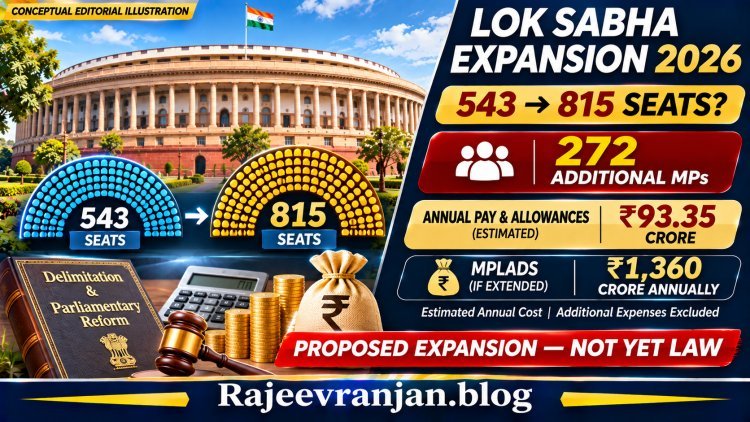
India's proposed Lok Sabha expansion could add approximately 272 elected Members of Parliament, increasing annual expenditure on their salaries, constituency allowances and office expenses by an estimated ₹93.35 crore. The figure excludes housing, travel and other facilities. With the Union Cabinet approving a revised delimitation proposal on November 27, 2026, the financial implications of parliamentary expansion have become an important public-policy question.
NEW DELHI | November 27, 2026
India is preparing for a potentially significant change in the size of its Parliament.
The Union Cabinet has approved a revised legislative proposal linking the expansion of the Lok Sabha with the implementation of women's reservation.
The proposal envisages increasing parliamentary seats by approximately 50%, while maintaining states' existing proportional representation until 2051.
The development comes ahead of Parliament's scheduled sitting beginning November 30.
While much of the political debate concerns women's reservation and the distribution of seats among states, another question deserves attention.
How much additional money would the government need to spend if hundreds of new MPs entered Parliament?
The answer involves more than salaries. Additional representatives would require allowances, offices, staff support, travel facilities and potentially government accommodation.
Lok Sabha Expansion: From 543 to Approximately 815 Seats
India currently has 543 elected Lok Sabha constituencies.
The earlier 2026 constitutional amendment proposed increasing the House's maximum strength from 550 to 850 members.
That ceiling included up to 815 representatives from states and 35 from Union Territories.
The revised November proposal reportedly envisages increasing seats across states by approximately 50%, while protecting their existing proportional share.
However, the precise constituency allocation must be confirmed from the revised legislation.
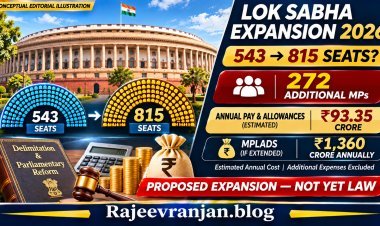
If the number of elected constituencies rises from 543 to 815, India would have 272 additional MPs.
Some reports calculate an increase of 270 by using 545 as the starting figure.
For a like-for-like comparison of currently elected constituencies, however, 543 is the appropriate baseline.
The proposed expansion has not yet become law. Parliament must approve the necessary legislation before the additional seats can be created.
How Much Salary Does an MP Receive in 2026?
The official parliamentary information booklet specifies that an MP receives a basic salary of ₹1.24 lakh per month.
Members are also entitled to a constituency allowance of ₹87,000 and an office expense allowance of ₹75,000 per month.
The office allowance includes provision for stationery, postage and secretarial assistance.
Together, these three components amount to ₹2.86 lakh per month.
Over twelve months, they total ₹34.32 lakh per MP.
It is important to distinguish salary from allowances.
The entire ₹2.86 lakh should not be described as personal take-home salary. The constituency and office allowances support parliamentary and administrative responsibilities.
MPs also receive a daily allowance of ₹2,500 for eligible periods of parliamentary or committee duty.
How Much Would 272 Additional MPs Cost Annually?
Using the existing salary and allowance structure, the calculation is straightforward.
| Expense | Estimated amount |
|---|---|
| Additional elected MPs | 272 |
| Monthly salary and specified allowances per MP | ₹2,86,000 |
| Monthly expenditure for 272 MPs | ₹7.78 crore |
| Annual expenditure for 272 MPs | ₹93.35 crore |
This is an illustrative calculation based on current entitlements.
It assumes all 272 additional positions are filled throughout the year and that the applicable rates remain unchanged.
The estimated ₹93.35 crore is not an officially announced government budget for Lok Sabha expansion.
It also excludes other facilities and administrative expenditure.
Daily Allowances Would Add Another Expense
MPs are entitled to daily allowances when they satisfy the applicable duty and attendance conditions.
At the current rate of ₹2,500 per eligible day, the additional cost would depend on parliamentary sittings and committee responsibilities.
For example, if 272 additional MPs each qualified for 60 daily allowances during a year, the total would be:
272 × 60 × ₹2,500 = ₹4.08 crore.
The example is not a prediction of actual expenditure.
The final amount would depend on the number of eligible days and the applicable parliamentary rules.
Housing, Travel and Administrative Expenses
Parliamentary expansion would also create demand for additional accommodation and administrative support.
MPs are eligible for residential facilities in Delhi, subject to the relevant rules and availability.
Other facilities include travel, communications and certain utilities.
Additional constituency representatives could also increase requirements for parliamentary offices, security arrangements and staff support.
However, not every parliamentary operating expense would rise proportionately with the number of MPs.
Some costs relate to shared infrastructure and existing institutional arrangements.
A reliable estimate of additional housing and administrative expenditure would require detailed government planning and budget documents.
MPLADS Could Add ₹1,360 Crore in Annual Development Entitlements
Another important financial consideration is the Members of Parliament Local Area Development Scheme, commonly called MPLADS.
Under the existing framework, each eligible MP has an annual entitlement of ₹5 crore for recommending approved local development works.
If 272 additional elected constituencies received equivalent annual entitlements, the corresponding provision would be:
272 × ₹5 crore = ₹1,360 crore annually.
However, this money is not paid to MPs as salary or personal income.
It is intended for approved public-development projects, such as community infrastructure.
Actual expenditure and fund releases are governed by scheme rules.
Therefore, MPLADS should be treated as a separate potential public-budget commitment, not added to MPs' personal compensation.
Will More MPs Make Parliament More Effective?
Supporters of expanding the Lok Sabha argue that additional representatives could improve the relationship between citizens and elected lawmakers.
Smaller constituencies may allow MPs to focus on fewer voters and local issues.
The proposed expansion is also connected with the implementation of 33% reservation for women.
However, increasing the number of MPs introduces institutional challenges.
PRS Legislative Research has highlighted how a substantially larger Lok Sabha could alter the relationship between the two Houses of Parliament.
It could also affect opportunities for individual members to participate in debates and parliamentary proceedings.
A larger House does not automatically guarantee better representation or more effective lawmaking.
Those outcomes depend on institutional rules, political participation and parliamentary functioning.
Has the Lok Sabha Expansion Been Finalised?
No.
The Union Cabinet's reported approval represents an important step in the legislative process.
The proposed constitutional changes must still secure the required parliamentary majorities.
The earlier Constitution (131st Amendment) Bill, introduced in April 2026, failed to obtain the necessary support.
A revised proposal will therefore require fresh parliamentary consideration.
The eventual number of seats, implementation timetable and administrative expenses cannot be treated as final until the required legislation is passed and the relevant arrangements are announced.
What Would the Expansion Mean for Taxpayers?
The proposed enlargement of the Lok Sabha is a major democratic and financial decision.
Based on current pay rates, 272 additional MPs would require approximately ₹93.35 crore annually for basic salaries and the two principal monthly allowances.
Eligible daily allowances, housing, travel and administrative facilities would increase expenditure further.
If existing MPLADS entitlements were extended to all additional constituencies, the associated annual development allocation could reach ₹1,360 crore.
These figures serve different purposes and should not be confused.
The central question is not simply how much a larger Parliament would cost, but whether additional representation would deliver sufficient public value to justify the expenditure.
That assessment will depend on the final legislation, official budget estimates and the effectiveness of parliamentary institutions after any expansion.