


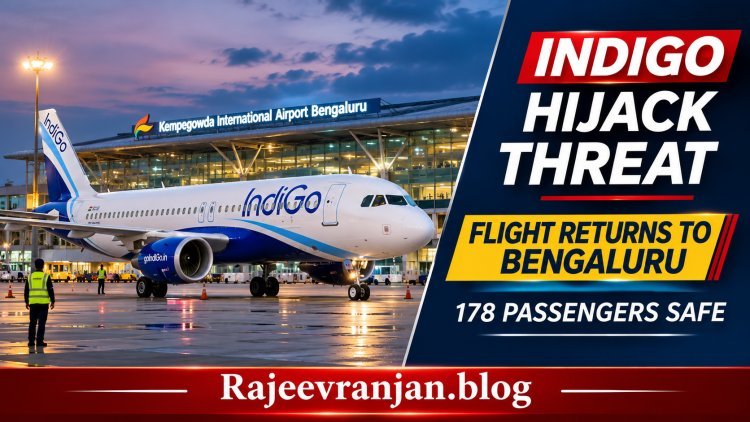
IndiGo Flight Hijack Threat: Bengaluru-Lucknow Plane With 178 Passengers Makes Emergency Return After Note Found in Toilet
IndiGo flight 6E-451 returned to Bengaluru after a hijack threat note was found onboard. All 178 passengers were safe as authorities investigated the scare.
 Rajeev

IndiGo Flight Hijack Threat: Bengaluru-Lucknow Plane With 178 Passengers Makes Emergency Return After Note Found in Toilet
A handwritten message threatening to hijack IndiGo flight 6E-451 triggered a full emergency at Bengaluru's Kempegowda International Airport on November 7, 2026. The aircraft returned safely, all 178 passengers were deboarded, and subsequent security checks found nothing suspicious. Investigators are now trying to establish who left the note.
BENGALURU | November 7, 2026
What began as a routine Saturday evening flight from Bengaluru to Lucknow turned into a major security operation after a passenger discovered a handwritten note threatening to hijack the aircraft.
IndiGo flight 6E-451, carrying 178 passengers, had departed Kempegowda International Airport at approximately 5:50 PM on November 7, 2026.
About half an hour after takeoff, according to a report by The Times of India citing police sources, a passenger entering the aircraft's lavatory noticed a threatening message written on a piece of paper.
The note warned that the aircraft would be hijacked at 6:30 PM and threatened consequences if the warning was ignored.
The passenger alerted the cabin crew, who immediately informed the pilots.
The flight crew contacted Air Traffic Control and decided to return to Bengaluru as a precaution.
A full emergency was declared at the airport, and security personnel prepared to inspect the aircraft after landing.
The flight returned safely, and all 178 passengers were deboarded. There was no confirmed hijacking.
What Happened on IndiGo Flight 6E-451?
The incident unfolded during the early evening, as the aircraft was travelling from Karnataka's capital to Lucknow in Uttar Pradesh.
According to NDTV and The Times of India, the flight departed Bengaluru at 5:50 PM.
The security scare began when a passenger discovered a handwritten message inside a toilet.
The wording reportedly threatened a hijacking at 6:30 PM.
Although the note did not establish that an actual hijacking was underway, its contents were serious enough to require an immediate response from the flight crew.
After receiving the information, the pilots contacted Air Traffic Control and initiated the aircraft's return.
The decision meant the aircraft would land at its departure airport rather than continue towards Lucknow.
The flight returned to Kempegowda International Airport, where aviation security personnel took responsibility for the aircraft and its passengers.
According to reporting carried by The Hindu, the aircraft had remained airborne for approximately 51 minutes before returning.
The sequence highlights the distinction between receiving a security threat and an actual unlawful takeover of an aircraft.
In this case, the available evidence supports a reported hijack threat—not a completed or attempted physical seizure of the plane.
What Did the Hijack Threat Note Say?
The handwritten message discovered in the aircraft lavatory was central to the incident.
According to The Times of India, the note stated:
"This plane is going to get hijacked exactly at 6.30."
It also warned that ignoring the message would have consequences.
The note's reference to a specific time contributed to the urgency of the security response.
However, the existence of a threatening message is not proof that a person had the means or intention to carry out a hijacking.
Investigators must establish who wrote the message, how it was placed inside the aircraft and whether it represented a genuine threat or a deliberate attempt to cause disruption.
At the time of the reports reviewed, authorities had not publicly identified the person responsible.
Full Emergency Declared at Bengaluru Airport
Following the pilots' decision to return, a full emergency was declared at Kempegowda International Airport.
An airport emergency declaration allows relevant personnel to coordinate their response to a potentially serious aviation incident.
It does not necessarily mean that an aircraft has suffered a technical failure or that passengers are facing an immediate physical attack.
In this case, the declaration was connected to the security threat reported onboard.
After landing, the aircraft was moved to an isolated area for inspection.
Security teams carried out anti-sabotage checks to determine whether any suspicious object or dangerous material was present.
Reports indicated that personnel from the Central Industrial Security Force, airport security services and other relevant agencies participated in the response.
The aircraft and passenger baggage were examined as part of the security operation.
All passengers were safely taken off the plane.
The Economic Times reported that the authorities initiated an investigation into the source of the threatening message.
Were All 178 Passengers Safe?
Yes. Reports from NDTV and The Times of India confirmed that all 178 passengers were safely deboarded after the aircraft returned to Bengaluru.
No injuries were reported in the sources reviewed.
The flight's unexpected return caused disruption, but the available reporting did not indicate that the aircraft had been physically seized or that a hijacker had taken control of the cockpit.
The distinction is important because descriptions such as "flight hijacked" could give readers an inaccurate impression of what occurred.
The aircraft returned because of a reported threat.
The fact that passengers were safely deboarded does not diminish the seriousness of the security alert, but it establishes the outcome of the immediate flight emergency.
What Did IndiGo Say About the Security Incident?
IndiGo confirmed that a security threat had been reported onboard flight 6E-451, operating between Bengaluru and Lucknow on November 7.
In its statement, the airline explained that the relevant authorities were informed promptly and the pilots decided to return to Bengaluru in accordance with established procedures.
The airline also expressed regret for the disruption experienced by passengers.
According to its statement, IndiGo arranged refreshments and provided regular updates while passengers awaited further information.
The company emphasized that passenger, crew and aircraft safety remained its priority.
IndiGo said the flight would resume its journey after receiving the necessary security clearances.
The statement was reported by The Economic Times, NDTV and Mint.
Was the Hijack Threat Real or a Hoax?
Security checks reportedly found no suspicious material onboard the aircraft.
The Times of India reported that the inspection lasted approximately 90 minutes and that authorities subsequently treated the threat as a hoax.
Mint also reported that the security checks had been completed and the threat was declared a hoax.
However, describing the message as a hoax does not mean investigators have established who wrote it or why.
A threat can be assessed as non-credible following security checks while the investigation into its origin continues.
The available reports did not identify a suspect or establish a motive.
There was also no verified public finding that the message was linked to an organized hijacking attempt or terrorist organization.
Did the IndiGo Flight Resume Its Journey to Lucknow?
Late-night reports provided slightly different accounts of the flight's onward status.
The Times of India reported at approximately 11:05 PM that the aircraft had resumed its journey to Lucknow after receiving security clearance.
Mint subsequently carried a similar update.
However, NDTV's report, updated at 11:45 PM, stated that the aircraft was expected to depart again after the necessary clearances.
These accounts may reflect differences in when information was obtained or updated.
The exact time of the onward departure and arrival in Lucknow requires confirmation from flight-tracking records or an updated airline statement.
The important verified development is that passengers were safely deboarded in Bengaluru and security checks were completed before any further operation of the aircraft.
Why Aviation Authorities Take Hijack Threats Seriously
Even when a threat appears to be written on an ordinary piece of paper, flight crews cannot safely assume that it is harmless.
An aircraft travelling at cruising altitude presents different operational challenges from a vehicle on the ground.
The flight crew must consider passenger safety, aircraft operations, airport readiness and available security information.
Returning to the departure airport can allow the aircraft to land at a familiar location where appropriate response arrangements are available.
In a suspected security incident, the immediate objective is to reduce uncertainty and place passengers and crew in a controlled environment.
This helps explain why IndiGo's pilots returned to Bengaluru instead of continuing towards Lucknow.
The decision also demonstrates why passengers should report suspicious notes or behaviour to cabin crew rather than attempting to investigate matters themselves.
Aviation security responses are designed to prioritize safety while authorities determine whether a threat is credible.
How Do Airports Respond to Aircraft Security Threats?
The response to a suspected hijacking or other serious security alert depends on the circumstances and the assessment made by aviation authorities.
However, several broad principles are relevant.
Communication Between Crew and Air Traffic Control
The cabin crew reports the concern to the pilots, who coordinate with Air Traffic Control.
Controllers can then assist with arrangements for the aircraft's return or diversion.
Emergency Readiness at the Airport
Relevant airport personnel are informed of the situation.
Emergency services may be placed on standby, depending on the assessed threat.
Aircraft Isolation and Inspection
Following landing, authorities may direct the aircraft to a designated area away from routine passenger operations.
Security teams can then conduct appropriate inspections.
Passenger Assistance
Passengers may need to disembark, undergo additional checks or wait for further information.
The airline is responsible for communicating operational arrangements and providing assistance in accordance with applicable requirements.
These are general principles of aviation security management, not a claim that every possible procedure was used during the Bengaluru incident.
Who Left the Threatening Note?
Identifying the person responsible remains a central question.
NDTV reported that police questioned passengers as part of their investigation.
Authorities were examining whether the note may have been placed in the lavatory by someone onboard.
However, that possibility had not been established as a conclusion in the reports reviewed.
The identity of the writer, the circumstances in which the note was left and the intended purpose of the message remain unresolved.
Investigators may need to examine available evidence and passenger accounts before determining responsibility.
It would be premature to identify a suspect or attribute a motive without confirmation from the investigating authorities.
What Passengers Can Learn From the Bengaluru Incident
The incident provides a practical example of how a passenger's observation can become the starting point for an aviation security response.
A person noticed a suspicious message and informed the cabin crew.
The information was passed to the pilots, who contacted the relevant authorities.
The aircraft returned safely, and security personnel carried out checks.
For travellers, the most useful lesson is to report suspicious messages or objects promptly and follow instructions from trained airline personnel.
Passengers should avoid spreading unverified claims during an unfolding incident, particularly when the information could create confusion among relatives or other travellers.
Those affected by a diversion should also retain their booking details and monitor official airline communications for updated departure arrangements.
What Happens Next in the Investigation?
The immediate emergency ended without a confirmed hijacking, but the investigation into the threatening message remains important.
Authorities still need to establish who wrote the note and why it was placed inside the aircraft.
Any decision about legal action will depend on the evidence collected and the applicable law.
The incident also illustrates the operational disruption that can follow even a threat later assessed as a hoax.
A single handwritten message forced a domestic flight to return, brought security teams into action and interrupted the journeys of 178 passengers.
For IndiGo and aviation authorities, the immediate priority was the safe handling of the reported threat.
For investigators, the remaining task is to establish accountability.
As of late November 7, 2026, the confirmed outcome is that IndiGo flight 6E-451 returned safely to Bengaluru, all passengers were deboarded without reported injuries, and subsequent security checks found nothing suspicious.
The investigation into the origin of the hijack threat remains the principal unresolved issue.