


Iran War: Italy Says Drone Used in Deadly Kuwait Attack Was Made in Iran; Tehran Denies Responsibility
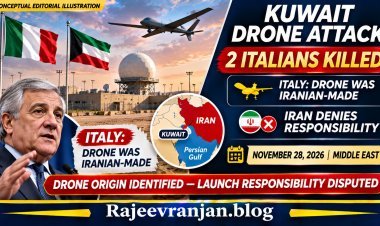
Italy says a drone used in Kuwait's deadly November 26 attack was made in Iran. Two Italian technicians died, but Tehran denies launching the strike.
 Rajeev

Iran War: Italy Says Drone Used in Deadly Kuwait Attack Was Made in Iran; Tehran Denies Responsibility
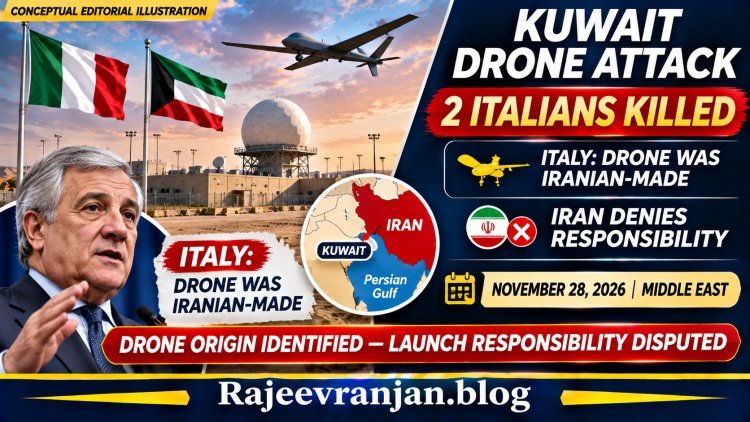
Italy says the drone involved in a November 26 attack that killed two Italian technicians at a military facility in Kuwait was manufactured in Iran. Foreign Minister Antonio Tajani cited findings from Kuwaiti investigations, while Tehran denied conducting the attack. The incident has intensified diplomatic concerns as military tensions continue across the Gulf region.
ROME / KUWAIT CITY | November 28, 2026
The deaths of two Italian civilian technicians in a drone attack in Kuwait have become the focus of a growing diplomatic dispute involving Italy, Kuwait and Iran.
Italian Foreign Minister Antonio Tajani said Kuwaiti investigations had established that the drone used in Thursday's deadly attack was manufactured in Iran.
The findings were highlighted in international reporting on Saturday, November 28.
However, Tehran has denied launching the drone or carrying out the operation.
The distinction matters because identifying a weapon's manufacturing origin does not necessarily identify the military force or organisation responsible for using it.
The incident occurred on November 26 at a Kuwaiti military facility where two Italian technicians were maintaining equipment associated with an air-defence system.
Both men died following an explosion.
A Kuwaiti military officer and a Pakistani national were also injured.
Kuwait has accused Iran of responsibility, while Iranian officials have rejected the allegation.
What Happened in the Kuwait Drone Attack?
The attack struck a site associated with Kuwait's military air-defence infrastructure.
According to an official statement issued by Italy's Ministry of Foreign Affairs on November 26, the two Italian nationals were working for Rheinmetall Italia.
Their assignment involved maintaining the detection antennas of the Skyguard air-defence system operated by the Kuwaiti Armed Forces.
The explosion killed both technicians.
Italy's Foreign Ministry confirmed their deaths and said its embassy in Kuwait was maintaining contact with local authorities and assisting their families.
The ministry did not independently publish a complete technical account of the drone's flight path or launch location.
Kuwaiti officials said their air-defence systems had intercepted several drones.
According to the Associated Press, Kuwait's Defence Ministry attributed the deaths and injuries to falling debris from intercepted drones.
The precise sequence of the explosion remains an important part of the investigation.
Italy Says Drone Was Manufactured in Iran
The latest development concerns the drone's origin.
Foreign Minister Tajani said investigations conducted by Kuwaiti authorities indicated that the aircraft involved in the deadly strike was made in Iran.
His comments strengthen Italy's publicly stated concerns about the attack.
However, the available reporting does not establish that Italy has independently demonstrated where the drone was launched.
That distinction is particularly important in the Middle East, where Iranian-designed and Iranian-manufactured unmanned aircraft have been associated with several armed groups.
Determining responsibility for an individual attack requires evidence beyond the identification of a weapon's manufacturer.
Investigators would need to establish who controlled the drone, where it originated and how the operation was organised.
Tajani also acknowledged Tehran's denial and its stated willingness to participate in an inquiry involving Italy and Kuwait.
The central confirmed development is Italy's attribution of the drone's manufacturing origin, not an independently established identification of its operators.
Iran Denies Carrying Out the Attack
Iran has rejected accusations that its armed forces conducted the operation.
According to Reuters, Iranian military spokesperson Abolfazl Shekarchi denied that Iranian forces had attacked the Kuwaiti facility.
Iran's embassy in Rome also rejected allegations of an Iranian drone strike.
Iranian Foreign Minister Abbas Araghchi subsequently spoke with Tajani and expressed condolences over the deaths.
During that conversation, Araghchi denied Iranian involvement.
Iran's denials stand in direct contrast to the accusations made by Kuwaiti authorities.
Neither position should be presented as the final outcome of an independent investigation.
The dispute illustrates the difficulty of establishing responsibility for drone attacks during an active regional conflict.
Even when the country of manufacture can be identified, the chain of control may remain unclear.
Who Were the Two Italian Victims?
The two men were civilian technicians employed by Rheinmetall Italia, part of German defence group Rheinmetall.
They were involved in maintaining equipment used by Kuwait's Skyguard air-defence system.
Skyguard systems are designed to support air-defence operations through target detection and related equipment.
The technicians were not reported to have been participating in an offensive military operation.
Their deaths have drawn particular attention because they demonstrate how civilians working on defence-related infrastructure can become exposed to danger during regional hostilities.
Italy's Foreign Ministry confirmed that diplomatic personnel were working with Kuwaiti authorities to obtain information and support the victims' families.
Kuwait's foreign minister, Sheikh Jarrah Jaber Al-Ahmad Al-Sabah, also contacted Tajani to express solidarity following the deaths.
The Italian government has continued monitoring developments through its embassy.
Why the Attack Matters for Gulf Security
The incident occurred amid continuing military confrontation involving Iran, the United States and Israel.
Kuwait is an important Gulf state with longstanding security relationships with Western countries.
It also hosts American military facilities.
Recent hostilities have increased concerns about the vulnerability of military installations, commercial infrastructure and international shipping.
On November 26, Kuwait reported intercepting drones it attributed to Iran.
The Associated Press reported that Kuwait had previously announced attacks during November, including an incident on November 17.
The renewed activity has raised questions about the effectiveness of air-defence systems against relatively small unmanned aircraft.
Drones can present difficult challenges because of their size, flight characteristics and the possibility of simultaneous attacks.
Even intercepted drones can create risks when debris falls near populated or operational areas.
The deaths in Kuwait underline that an interception does not necessarily eliminate every danger on the ground.
Could the Incident Increase Tensions Between Italy and Iran?
The attack has created a serious diplomatic issue for Rome.
Italy has condemned the deaths and sought explanations, while Iran continues to deny responsibility.
The incident is particularly sensitive because the victims were Italian civilians working under a defence-related contract in a country affected by regional hostilities.
Italy must now balance demands for accountability with the need to establish the facts.
Any diplomatic response will depend partly on what investigators can demonstrate about the drone's operators.
Iran's willingness to participate in an inquiry could provide an opportunity for further investigation.
However, participation alone would not resolve the competing allegations.
The central question remains whether evidence can establish responsibility in a manner that withstands independent scrutiny.
What Remains Unknown?
Several important questions have not been conclusively answered in the publicly available evidence.
The exact launch location remains unverified.
The identity of the person, organisation or military unit controlling the drone has not been independently established.
Detailed forensic findings identifying the aircraft's model and components have not been made available in the sources reviewed.
There are also unresolved questions about the precise sequence of interception, falling debris and the fatal explosion.
As of November 28, 2026, Italy says the drone was manufactured in Iran, Kuwait blames Iran for the attack, and Tehran denies responsibility.
The deaths of the two Italian technicians are confirmed.
Determining who launched the aircraft remains the most consequential unanswered question.
As the investigation continues, the incident highlights the increasing risks faced by civilian specialists, military personnel and communities in the Gulf during the wider Middle East conflict.