



Türkiye Inducts KIZILELMA Unmanned Fighter Jets: Erdoğan Hails Historic Milestone as Baykar Claims World First
Türkiye inducts three Bayraktar KIZILELMA unmanned fighter jets as Erdoğan celebrates a milestone. Explore Baykar's world-first claim, capabilities and limits.
 Rajeev
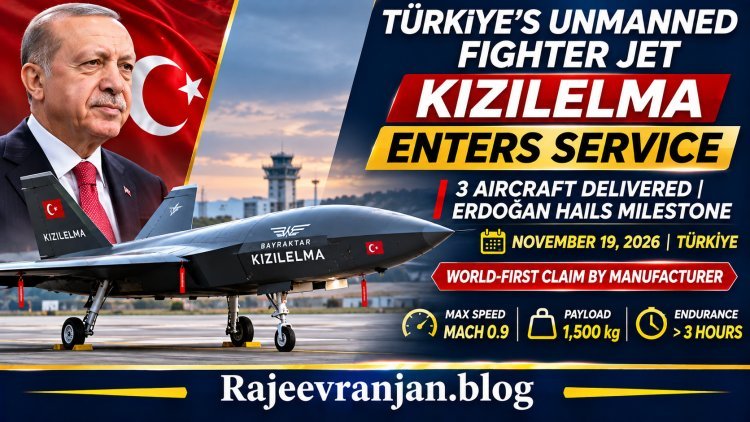

Türkiye Inducts KIZILELMA Unmanned Fighter Jets: Erdoğan Hails Historic Milestone as Baykar Claims World First
Türkiye has taken a significant step in military aviation with the induction of its first three Bayraktar KIZILELMA unmanned fighter jets. President Recep Tayyip Erdoğan celebrated the November 19, 2026, delivery as a landmark achievement, while manufacturer Baykar described it as the first time an unmanned fighter jet had entered military service anywhere in the world. The announcement represents a technological milestone, although important questions remain about the aircraft's operational capabilities.
ANKARA / ISTANBUL | November 21, 2026
For decades, fighter aircraft have been associated with pilots operating sophisticated machines at extraordinary speeds, making split-second decisions in dangerous environments.
Türkiye is pursuing a different vision of military aviation.
On November 19, Turkish defence manufacturer Baykar announced the delivery of three Bayraktar KIZILELMA unmanned fighter jets to the country's security forces.
The aircraft entered the military inventory after completing acceptance tests, marking a major development in Türkiye's expanding domestic defence industry.
President Recep Tayyip Erdoğan welcomed the announcement and described it as the realization of a long-term national ambition.
Baykar went further, presenting the induction as a world-first achievement in the history of unmanned fighter aircraft.
The announcement has attracted attention because KIZILELMA differs from conventional military drones.
Rather than functioning primarily as a slow-moving surveillance platform or strike aircraft, it is designed as a jet-powered combat aircraft capable of carrying weapons, engaging aerial targets and operating alongside piloted fighters.
However, the distinction between accepting an aircraft into military inventory and establishing its full combat readiness remains important.
Independent defence reporting confirms the delivery of three aircraft, but the precise missions they are ready to perform have not been publicly established.
What Did Erdoğan Announce About KIZILELMA?
Erdoğan confirmed that the Bayraktar KIZILELMA had entered the Turkish Armed Forces' inventory after years of development.
In a message published on Türkiye's NSosyal platform, he described the achievement as a moment of national pride.
The official Turkish presidency's Directorate of Communications reproduced his remarks on November 19.
Erdoğan expressed confidence in the aircraft's future contribution to the country's military capabilities.
His statement emphasised the work of Turkish engineers and the importance of developing indigenous defence technology.
The announcement forms part of Türkiye's wider effort to strengthen its domestic aerospace industry and reduce dependence on imported military equipment.
An important distinction concerns the world-first claim.
The manufacturer, Baykar, explicitly described KIZILELMA as the first unmanned fighter jet inducted into military service.
Erdoğan celebrated the aircraft's induction, but reporting should not conflate his statement with independent verification of every technological claim made by the manufacturer.
Has Türkiye Really Become the First Country to Use Unmanned Combat Aircraft?
The answer depends on what is meant by an unmanned combat aircraft.
If the expression refers to any remotely piloted aircraft capable of carrying weapons, Türkiye is not the first.
The United States used armed MQ-1 Predator drones during military operations beginning in 2001.
Other countries subsequently developed and operated armed unmanned aircraft.
Türkiye itself has considerable experience operating combat drones, including the Bayraktar TB2 and Akıncı.
Consequently, describing KIZILELMA as the world's first armed drone would be incorrect.
The more specific claim concerns its classification as an unmanned fighter jet.
Unlike traditional propeller-driven combat drones, KIZILELMA uses jet propulsion and is intended for missions that can include air-to-air engagements.
Baykar argues that the aircraft's induction represents the first operational entry into service of this particular category.
Defence publication Janes reported the November 19 delivery and documented the manufacturer's claim.
However, independent reporting has cautioned that defining a global first requires consistent criteria and that the aircraft's full operational status remains unclear.
The verified milestone is the delivery of three jet-powered KIZILELMA aircraft to Türkiye's military inventory. The broader world-first claim should remain attributed to Baykar.
What Makes the Bayraktar KIZILELMA Different?
KIZILELMA represents an attempt to extend unmanned aviation beyond traditional reconnaissance and strike missions.
The aircraft is designed around several capabilities associated with modern fighter aviation.
It uses a turbofan engine rather than the propeller propulsion commonly found on many long-endurance military drones.
Its design also incorporates features intended to reduce radar detectability.
An internal weapons bay allows certain weapons to be carried within the aircraft rather than externally.
This configuration can reduce the radar signature associated with externally mounted equipment.
KIZILELMA is also designed to operate alongside piloted aircraft.
Such cooperation could eventually allow unmanned fighters to undertake selected high-risk assignments while crewed aircraft provide command, coordination or additional combat capabilities.
The concept is often described as manned-unmanned teaming.
However, the aircraft's advertised design features should not be confused with independently demonstrated performance under combat conditions.
Testing can establish that particular systems function in controlled environments.
Real-world operational effectiveness depends on additional factors, including electronic warfare, communications resilience, maintenance and crew training.
KIZILELMA Specifications: Speed, Payload and Endurance
According to technical information reported by Janes and Anadolu Agency, the aircraft has the following advertised characteristics.
| Specification | Reported capability |
|---|---|
| Aircraft type | Jet-powered unmanned combat aircraft |
| Length | 14.5 metres |
| Wingspan | 10 metres |
| Height | 3.5 metres |
| Maximum take-off weight | 8,500 kg |
| Maximum speed | Mach 0.9 |
| Cruise speed | Mach 0.6 |
| Payload capacity | 1,500 kg |
| Endurance | More than three hours |
| Service ceiling | 40,000 feet |
| Advertised mission radius | 500 nautical miles |
| Propulsion | Turbofan engine |
These figures describe the aircraft's reported technical specifications.
They should not be interpreted as independently verified performance in every operational configuration.
For example, endurance and mission radius can vary according to payload, flight conditions and mission requirements.
The aircraft's maximum advertised speed also remains below the speed of sound.
Therefore, KIZILELMA should not be described as a supersonic fighter simply because it uses jet propulsion.
From First Flight to Military Induction: The KIZILELMA Development Timeline
KIZILELMA's entry into military inventory follows several years of development and testing.
Baykar publicly unveiled the project's conceptual design in July 2021.
Production work on the prototype began in March 2022.
On December 14, 2022, KIZILELMA completed its maiden flight at Çorlu in northwestern Türkiye.
The aircraft subsequently underwent further testing involving formation flying, weapons integration and autonomous coordination.
In April 2023, KIZILELMA flew in close formation with Baykar's Akıncı drone.
The aircraft also appeared alongside piloted Turkish military aircraft during public demonstrations.
Further milestones followed in 2025.
In October, Baykar conducted weapons tests involving the TOLUN and TEBER-82 munitions.
On November 29, 2025, the company reported a successful engagement against a jet-powered aerial target using a GÖKDOĞAN air-to-air missile.
Additional testing in 2026 included autonomous formation flying with piloted aircraft and weapons-release trials involving the aircraft's internal weapons bay.
By November 19, 2026, Baykar reported that the programme had completed approximately 600 test and training sorties.
The first three aircraft were then delivered following acceptance testing.
The chronology demonstrates substantial progress from prototype development to military inventory.
It does not, however, reveal whether the delivered aircraft have achieved full operational capability.
Why the Air-to-Air Missile Test Matters
One of KIZILELMA's most closely watched milestones occurred in November 2025.
Baykar reported that the aircraft successfully engaged a jet-powered aerial target using a Turkish-made GÖKDOĞAN missile.
The company said the test involved target detection through an ASELSAN MURAD radar system.
The development was significant because conventional armed drones have generally been used for reconnaissance and strikes against targets on the ground.
Air-to-air combat introduces different technical challenges.
Aircraft must detect, track and engage moving aerial targets while maintaining reliable communications and flight control.
An unmanned aircraft performing such tasks could eventually support new approaches to air defence and offensive missions.
Nevertheless, a successful missile test against a designated target is not equivalent to demonstrating sustained effectiveness against opposing fighter aircraft in combat.
The test supports Baykar's claims about particular capabilities, while leaving broader operational performance unproven.
Why Türkiye Is Investing in Unmanned Fighter Technology
Türkiye has developed a substantial domestic military drone industry.
Baykar's Bayraktar TB2 became internationally prominent through its use in several conflicts, including Ukraine following Russia's full-scale invasion in 2022.
The company also manufactures the larger Akıncı unmanned combat aircraft.
These programmes helped establish Turkish companies as competitors in the international drone market.
KIZILELMA represents a move towards more complex aircraft designed for additional combat roles.
For Ankara, indigenous development offers potential advantages in technology ownership, manufacturing capabilities and long-term supply security.
Domestic production may also reduce dependence on foreign suppliers for some systems.
However, the extent of technological independence depends on the origin of engines, electronic components and other subsystems.
Producing an aircraft domestically does not necessarily mean every component is manufactured within the country.
The broader significance is that Türkiye is attempting to move from conventional armed drones into the more demanding field of unmanned fighter aviation.
What Could KIZILELMA Mean for Future Military Operations?
Unmanned fighter aircraft could eventually change how air forces assign dangerous missions.
A combat aircraft without an onboard pilot removes the immediate risk of losing that pilot if the platform is destroyed.
It may also permit different operational choices because some limitations associated with human endurance no longer apply.
Future unmanned fighters could potentially support surveillance, electronic warfare, strikes against surface targets and cooperation with piloted jets.
However, these possibilities require reliable command systems and extensive testing.
Military planners must also consider communications interruptions, electronic interference, identification of targets and the risks of unintended engagements.
An unmanned aircraft is not necessarily fully autonomous.
Some systems operate through remote human control, while others perform selected tasks automatically.
The precise division between human decisions and automated functions is particularly important when weapons are involved.
KIZILELMA's advertised capabilities suggest opportunities for future military operations, but the November delivery announcement does not establish how the Turkish Armed Forces will employ it.
Why Independent Analysts Are Cautious About the Announcement
The delivery of three aircraft is an important manufacturing and procurement milestone.
But military inventory and operational readiness are not identical concepts.
After accepting new aircraft, armed forces may still need to complete personnel training, develop maintenance systems, establish operating procedures and integrate equipment with existing units.
Independent reporting by Turkish Minute highlighted these uncertainties.
The report quoted Ryan Gingeras, a Türkiye specialist at the US Naval Postgraduate School, who described the development as potentially significant while pointing to the small number of delivered aircraft and unanswered operational questions.
Neither Baykar's announcement nor Erdoğan's official message clearly identified the receiving unit or detailed its initial mission responsibilities.
Janes also reported that Baykar did not identify the end user when asked.
Those limitations do not invalidate the aircraft's induction.
They simply mean that the evidence supports a narrower conclusion than claims that Türkiye already possesses a fully deployed fleet of unmanned fighters.
What Does Türkiye's Achievement Mean for India?
For India, the development is relevant to broader changes in military aviation.
The Indian defence sector is also pursuing indigenous unmanned systems and technologies intended to support future air operations.
International progress in unmanned fighter aircraft highlights several important areas of technological competition.
These include jet propulsion, advanced sensors, secure communications, autonomous flight control and integration with existing combat aircraft.
For Indian policymakers and defence manufacturers, KIZILELMA provides an example of how a domestic aerospace company can move from established drone products towards more sophisticated unmanned platforms.
However, it would be premature to conclude that the Turkish aircraft has surpassed India's existing or planned aviation capabilities based solely on its delivery.
Such comparisons require detailed information about mission requirements, technical performance and operational readiness.
The broader lesson is that unmanned systems are becoming increasingly important to the future of military aviation.
A Milestone for Türkiye, With Important Questions Still Open
The induction of three Bayraktar KIZILELMA aircraft marks a significant moment for Türkiye's defence industry.
The programme has progressed from its first flight in December 2022 to military inventory in November 2026.
Its development includes reported achievements in formation flying, weapons integration and air-to-air missile testing.
President Erdoğan has celebrated the delivery as the fulfilment of a longstanding ambition.
Manufacturer Baykar describes the achievement as the world's first induction of an unmanned fighter jet.
That claim is narrower than saying Türkiye was the first country to operate armed drones, which is historically incorrect.
The immediate facts establish that three aircraft have been delivered after acceptance testing.
Their operational deployment, readiness for specific combat missions and future production scale remain to be confirmed.
KIZILELMA's arrival is a meaningful development in unmanned military aviation. Whether it becomes a transformative combat platform will depend on how effectively it performs beyond the testing environment.