


Middle East on the Brink: IRGC Spokesman Ali Mohammad Naini Killed in US-Israeli Strike
Iran's IRGC spokesperson Ali Mohammad Naini has been killed in a joint US-Israeli strike. Explore the latest updates on the 2026 Iran War and the regional impact.
 Rajeev

Middle East Crisis: IRGC Spokesman Ali Mohammad Naini Killed Amidst Spiraling Tensions
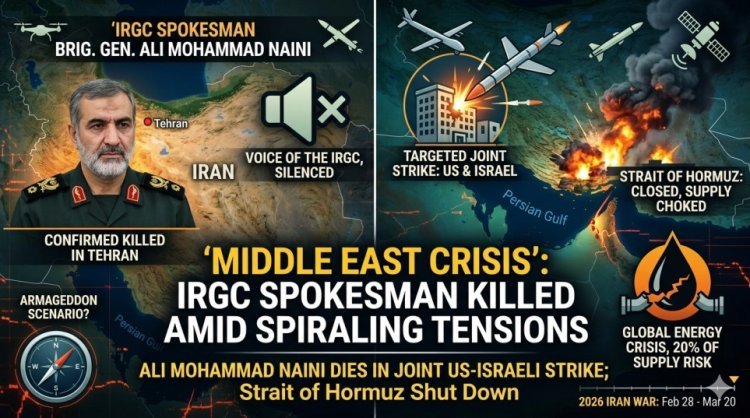
TEHRAN / JERUSALEM — The Middle East has entered its most perilous phase in decades. In a pre-dawn operation on Friday, March 20, 2026, the Islamic Revolutionary Guard Corps (IRGC) confirmed that its high-profile spokesperson, Brigadier General Ali Mohammad Naini, was killed in a targeted joint strike by United States and Israeli forces in Tehran.
The death of Naini, often described as the "voice of the IRGC," marks a significant "decapitation" strike against Iran’s propaganda and communication apparatus. It follows a series of high-level assassinations that have shaken the Iranian leadership since the conflict ignited on February 28.
The Final Defiance of Ali Mohammad Naini
Just hours before his death, General Naini had issued a scathing and defiant warning to Washington and Tel Aviv. Responding to claims that Iran's naval capabilities had been crippled, Naini mocked the US administration, daring them to "send their ships into the Persian Gulf if they dare."
He also insisted that Iran’s missile industry remained "perfect," claiming that production continued unabated despite three weeks of heavy bombardment. His assassination is being viewed by analysts as a direct response to his role in coordinating the regime's messaging to its regional proxies.
A Leadership Under Fire
The 2026 Iran War has seen an unprecedented rate of leadership loss for the Islamic Republic. Since the killing of the former Supreme Leader on February 28, the "Operation Roaring Lion" campaign has eliminated:
-
Esmaeil Khatib: Minister of Intelligence (Killed Thursday).
-
Ali Larijani: Senior Security Chief (Killed earlier this week).
-
Gholamreza Soleimani: Head of the Basij Force.
Despite these losses, Iranian Foreign Minister Abbas Araghchi maintains that the nation's political infrastructure is "solid" and capable of functioning effectively even under extreme wartime conditions.
Global Economic Shockwaves: Energy at Risk
The conflict is no longer contained within borders. It has evolved into a global energy crisis.
-
Strait of Hormuz: Iran’s closure of this vital waterway has choked nearly 20% of the world's oil supply, sending prices to record highs.
-
Attacks on Refineries: Drone strikes have hit the Mina Al-Ahmadi refinery in Kuwait and major gas facilities in Qatar, leading to "force majeure" declarations on LNG contracts to Europe and Asia.
-
Supply Chain Disruption: Analysts warn that repairs to damaged gas infrastructure could take 3 to 5 years, costing the global economy tens of billions of dollars.
The Humanitarian and Regional Toll
The human cost of the three-week-old war is staggering. Reports suggest over 6,000 military personnel and hundreds of civilians have been killed across the region. Countries like Jordan, Kuwait, and the UAE have found themselves caught in the crossfire, intercepting drones and missiles daily.
The UN Security Council has held emergency sessions, with Secretary-General António Guterres pleading for diplomacy to "prevail over the law of force" before the conflict spirals beyond the point of no return.
What Comes Next?
The killing of Ali Mohammad Naini is a psychological blow to the IRGC, but the war shows no signs of cooling. With Israel striking as far north as the Caspian Sea and Iran retaliating against Gulf energy hubs, the "Armageddon scenario" many feared is unfolding in real-time.