


Double Chokepoint Crisis: Why the Red Sea Threat is the New Nightmare for India's Oil Imports
As the Strait of Hormuz remains effectively closed, tensions in the Red Sea are threatening India’s last oil lifeline. Discover how $100+ oil and rerouted ships are impacting the Indian economy.
 Rajeev

The Double Chokepoint Nightmare: Why India’s Oil Lifeline is Under Unprecedented Threat
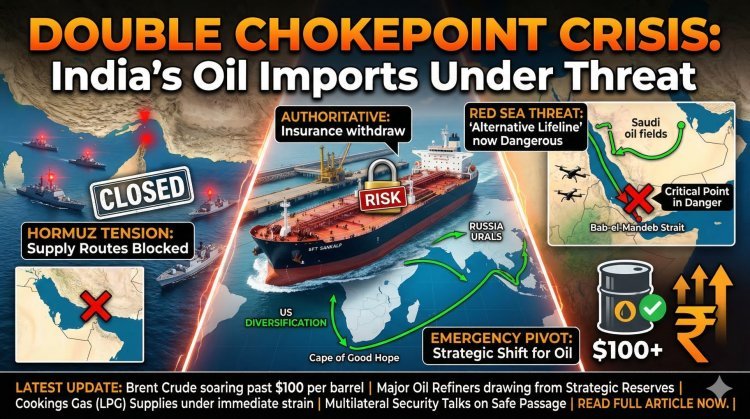
NEW DELHI | March 18, 2026: For weeks, the world’s attention has been fixed on the Strait of Hormuz, where a 95% collapse in traffic has sent Brent Crude soaring past $100 per barrel. However, the crisis is far from over. As India and other Asian giants attempted to bypass the Persian Gulf by utilizing Saudi Arabia’s East-West pipeline to the Red Sea, a new threat has emerged: the "Alternative Lifeline" is now in the crosshairs.
1. From Hormuz to the Red Sea: The Crisis Spreads
When the Strait of Hormuz was effectively blocked on March 2, India pivoted to the Red Sea ports (like Yanbu in Saudi Arabia) to maintain its flow of Middle Eastern crude. But as of mid-March 2026, the Red Sea has become a high-risk zone:
-
Increased Drone Attacks: Regional actors have escalated strikes on commercial tankers near the Bab-el-Mandeb Strait.
-
Insurance Collapse: Maritime insurers have begun withdrawing "War Risk" coverage for the entire region. Without insurance, tankers are effectively "ghost ships," unable to enter international ports.
-
Route Paralysis: Even the Red Sea terminals, which have a capacity of 7 million barrels per day, are currently operating at less than half that volume due to security fears.
2. The "India Factor": A Vulnerable Giant
India is particularly exposed to this double-chokepoint crisis.
-
The 88% Dependency: India imports nearly 88% of its crude oil. Before the conflict, roughly half of these imports transited through Hormuz.
-
The Cost of "The Long Way": With both the Gulf and the Red Sea threatened, shipping companies are opting for the Cape of Good Hope detour. This adds 15–20 days to the journey, drastically increasing freight costs and tying up working capital.
-
Economic Impact: Analysts estimate that for every $10 rise in oil prices, India’s GDP growth could be shaved by 0.2%, while inflation could rise by a similar margin.
3. India’s Strategic Counter-Moves
Despite the "Nightmare Scenario," the Indian government and refiners are not sitting idle. The Ministry of Petroleum & Natural Gas has activated an Emergency Pivot:
-
The Russia Shift: India has ramped up purchases of Russian Urals crude, which travels through safer eastern routes. Currently, over 120 million barrels of Russian oil are "on the water" destined for Asian hubs.
-
Strategic Reserves: India is drawing from its Strategic Petroleum Reserves (SPR), which, combined with refinery stocks, provide a buffer of roughly 74 days.
-
Supplier Diversification: New contracts are being signed with the United States, Brazil, and West African nations to reduce reliance on the Middle East "war zones."
4. What Lies Ahead for Consumers?
While the government has kept retail petrol and diesel prices relatively stable by absorbing margins through OMCs, the pressure is building. LPG (Cooking Gas) supplies are under the most immediate strain, as 90% of India’s LPG imports traditionally pass through Hormuz.
The "Oil Lifeline" is currently under a strategic blockade that is as much about insurance and risk perception as it is about physical missiles. For India, the coming weeks will be a test of its "Aatmanirbhar" energy resilience and its ability to secure safe passage in a fractured global order.