


Digital Kranti: Puducherry Launches India’s First CBDC-Based Digital Food Currency Pilot
"India launches CBDC-based Digital Food Currency pilot in Puducherry under PMGKAY. Learn how the programmable digital rupee is making food subsidy delivery transparent, efficient, and leak-proof."
 Rajeev
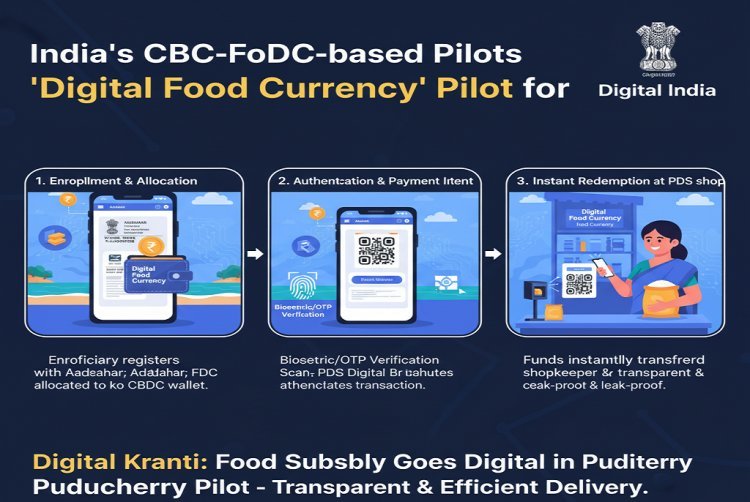

In a landmark move that promises to revolutionize India’s food security architecture, the Government of India has officially launched a Central Bank Digital Currency (CBDC)-based Digital Food Currency pilot project in the Union Territory of Puducherry. Inaugurated on February 26, 2026, by Union Minister for Consumer Affairs, Food and Public Distribution, Shri Pralhad Joshi, this initiative marks a bold step toward a fully transparent, leakage-free, and technology-driven Public Distribution System (PDS).
What is the Digital Food Currency Pilot?
The pilot, operating under the Pradhan Mantri Garib Kalyan Anna Yojana (PMGKAY), seeks to integrate the Reserve Bank of India’s (RBI) digital rupee (e₹) into the Direct Benefit Transfer (DBT) framework.
Unlike traditional bank transfers, where subsidy funds are credited to general bank accounts, the CBDC-based model credits programmable digital currency tokens directly into the beneficiaries' CBDC wallets.
Key Features of the System:
-
Programmability: These digital tokens are "purpose-bound," meaning they can be redeemed exclusively for the purchase of entitled foodgrains at authorized Fair Price Shops (FPS) or merchant outlets.
-
Traceability: Since the currency is issued by the RBI in a digital format, every transaction is secure, real-time, and fully traceable, eliminating the possibility of fund diversion.
-
Direct Empowerment: By removing intermediaries and bypassing conventional bank account friction, the system ensures that entitlements reach the intended beneficiaries instantly.
Why This Shift Matters for PDS
The implementation of Digital Food Currency addresses several persistent challenges in the national food security ecosystem:
-
Eliminating Leakages: The programmable nature of the e-rupee ensures that funds allocated for food cannot be misused for non-essential purposes.
-
Overcoming Operational Hurdles: The system is designed to mitigate common issues faced in PDS, such as biometric authentication failures and e-POS (electronic Point of Sale) device connectivity problems.
-
Real-Time Accountability: With the integration of the Public Financial Management System (PFMS) and Canara Bank as the banking partner, the government can monitor subsidy utilization in real-time.
Scaling the "Digital India" Vision
Union Minister Pralhad Joshi highlighted that this pilot is not an isolated experiment but part of a broader vision of "Every Grain, Every Rupee, Every Entitlement." Following successful initial trials in Ahmedabad (Gujarat) and the current rollout in Puducherry, the government has announced a phased expansion plan:
-
Next Phase: The initiative will soon be rolled out in Chandigarh and Dadra and Nagar Haveli.
-
Nationwide Outlook: After a deep analysis of outcomes from these pilots, the Ministry plans to expand the CBDC-based distribution model across the country.
This reform complements existing pillars of digital welfare, such as the One Nation One Ration Card (ONORC) scheme, Aadhaar-enabled authentication, and the use of automated grain dispensing machines (Grain ATMs), which have already significantly modernized India's welfare delivery.
The launch of the CBDC-based food subsidy model in Puducherry signifies a pivotal transition in governance. By harnessing cutting-edge financial technology, India is moving toward a system where the integrity of welfare delivery is guaranteed by code and transparency. As this model matures, it is set to redefine the global standards for food security programs, empowering over 80 crore beneficiaries with a secure, sovereign digital asset.