


Indian Officer Hospitalised After Projectile Attack on Liberia-Flagged Tanker Near Strait of Hormuz; All Crew Safe
Liberia-flagged tanker MT NAVIG8 MESSI was hit near Hormuz on November 18. All three Indian seafarers are safe; one was taken to hospital for evaluation.
 Rajeev

Indian Officer Hospitalised After Projectile Attack on Liberia-Flagged Tanker Near Strait of Hormuz; All Crew Safe
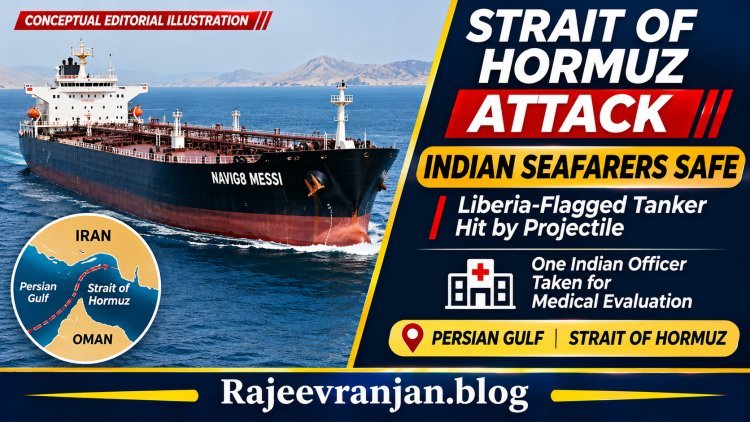
A Liberia-flagged crude oil tanker carrying three Indian seafarers was targeted in a projectile attack in the Persian Gulf on November 18, 2026. Union Minister Sarbananda Sonowal confirmed that all crew members were safe, although one Indian officer was taken to hospital for medical evaluation. The incident has renewed concerns about the safety of commercial shipping near the Strait of Hormuz.
NEW DELHI / PERSIAN GULF | November 18, 2026
A fresh attack on a commercial oil tanker near the Strait of Hormuz has brought the safety of Indian seafarers into focus once again.
The Liberia-flagged crude oil tanker MT NAVIG8 MESSI, carrying three Indian nationals, was targeted by a projectile while approaching the strategically important waterway on Wednesday, November 18.
Union Minister for Ports, Shipping and Waterways Sarbananda Sonowal confirmed the incident through a statement on social media platform X.
According to the minister, all three Indian seafarers and the vessel's remaining crew members were safe and accounted for.
One Indian officer was transferred to a hospital for first-aid treatment and medical evaluation.
No serious injuries were reported.
The Indian government is maintaining contact with the ship management company and monitoring arrangements for the crew's safety, medical care and general welfare.
The incident comes amid repeated attacks involving commercial vessels in and around the Persian Gulf.
Only two days earlier, another tanker carrying Indian crew members was struck in the Strait of Hormuz, leaving one Indian national missing and two others requiring hospital treatment.
The latest attack highlights an increasingly important concern: the exposure of civilian maritime workers to military dangers in one of the world's most strategically significant shipping corridors.
What Happened to MT NAVIG8 MESSI?
The incident occurred while the crude oil tanker was approaching the Strait of Hormuz from the Persian Gulf.
According to information released by Shipping Minister Sarbananda Sonowal, the Liberia-flagged vessel came under a projectile attack on November 18.
The ship was carrying three Indian seafarers.
The minister confirmed that everyone aboard was accounted for and that no serious injuries had been reported.
One Indian officer was nevertheless taken to hospital for medical assessment.
The publicly available statement does not identify the exact type of projectile involved.
It also does not establish who launched it or whether the tanker sustained significant structural damage.
These details are important because incidents involving commercial vessels can have different causes and consequences.
Some attacks involve drones or missiles, while others may involve different weapons or explosive devices.
Until the responsible authorities publish more information, the incident should be described as a projectile attack rather than attributed to a particular weapon or armed group.
The tanker was approaching the Strait of Hormuz when targeted. The available reporting does not establish that it had already entered the strait.
Indian Officer Taken to Hospital: What Is Known About His Condition?
The most reassuring development is that all three Indian nationals aboard MT NAVIG8 MESSI have been reported safe.
However, the transfer of one Indian officer to hospital requires careful reporting.
Minister Sonowal said the officer was moved for first-aid treatment and medical evaluation.
He did not identify the officer publicly in the reporting reviewed.
Nor did he provide a specific medical diagnosis or describe the nature of any injury.
The distinction matters.
A medical assessment after a maritime attack can be necessary even when serious injuries have not been reported.
The available information does not justify describing the officer as critically injured or claiming that his condition has deteriorated.
Likewise, it would be premature to declare him discharged without a subsequent official update.
The government's latest statement confirms the officer's transfer for evaluation and the safety of the crew.
Further medical details should be published only after confirmation from the shipping authorities, the vessel's management or another authorized source.
Sarbananda Sonowal Confirms Government Is Monitoring the Situation
Following the incident, the Ministry of Ports, Shipping and Waterways moved to reassure the public about the safety of Indian personnel.
Sonowal stated that the government was monitoring developments and remained in contact with the company responsible for managing the vessel.
The communication is intended to help authorities follow the crew's condition and coordinate assistance where necessary.
For seafarers working aboard internationally registered ships, such coordination is particularly important.
A vessel may be registered in one country, operated by a company in another and staffed by personnel from several nationalities.
This arrangement is common in international merchant shipping.
It also means that responding to an emergency may involve multiple authorities, including the flag state, ship operator, coastal state and the governments of affected crew members.
In the case of MT NAVIG8 MESSI, the ship's Liberian registration does not diminish India's interest in the safety of its nationals.
The immediate priority is ensuring that the crew remains safe and that the officer receiving medical attention obtains appropriate care.
Another Attack Follows November 16 Incident Involving 24 Indian Seafarers
The November 18 attack occurred only two days after a more serious incident involving the Panama-flagged LPG tanker MT TARA GAS.
On November 16, the vessel, carrying 24 Indian seafarers, was struck in a missile attack in the Strait of Hormuz.
The incident triggered emergency assistance involving Indian and Omani authorities.
According to reporting based on India's Ministry of External Affairs statement, 21 Indian crew members were safely evacuated to Khasab in Oman.
Two injured Indian nationals were admitted to hospital.
One Indian seafarer remained missing at the time of the latest reporting reviewed.
The Indian Embassy in Oman was coordinating with Omani authorities regarding search-and-rescue operations.
The Ministry of External Affairs also acknowledged the assistance provided by Oman during the emergency response.
The circumstances involving MT TARA GAS were separate from the attack on MT NAVIG8 MESSI.
The casualty figures and rescue information should therefore not be combined.
Nevertheless, the two incidents demonstrate the repeated dangers confronting civilian crews navigating the region.
Earlier Tanker Incidents Raise Concerns About Indian Crew Safety
The latest attacks are part of a broader pattern of maritime incidents reported during November.
On November 11, the Saudi Arabia-flagged oil tanker NCC FAJR, carrying three Indian seafarers, was involved in a suspected attack while transiting the Strait of Hormuz.
Sonowal subsequently confirmed that the Indian nationals and the remaining crew were safe.
Another incident involved the Liberia-flagged tanker MT DOMINICA PROSPERITY, which was struck by a projectile near the United Arab Emirates.
The ship carried 22 crew members, including 19 Indians.
According to the minister's November 12 statement, the UAE Coast Guard safely evacuated everyone aboard.
No injuries were reported in that incident.
In a separate November 10 attack on another Liberia-flagged tanker carrying six Indian seafarers, four crew members were injured, including one Indian national who reportedly sustained minor injuries.
These cases illustrate why each vessel and incident must be identified precisely.
Different attacks have involved different ships, crew sizes and medical outcomes.
Treating them as one event could mislead readers and create unnecessary confusion for affected families.
Why Is the Strait of Hormuz So Important?
The Strait of Hormuz is a narrow maritime passage connecting the Persian Gulf with the Gulf of Oman and the Arabian Sea.
It lies between Iran and Oman.
The waterway provides an essential route for commercial shipping, particularly vessels transporting oil and liquefied natural gas from Gulf producers to international markets.
Countries including Saudi Arabia, Iraq, Kuwait, Qatar and the United Arab Emirates depend heavily on maritime access through or near the region.
The strait is therefore important not only for regional trade but also for global energy security.
According to the US Energy Information Administration, approximately 20.9 million barrels of oil per day passed through the strait during the first half of 2025.
That represented roughly one-fifth of global petroleum liquids consumption at the time.
However, the 2026 conflict has substantially disrupted shipping volumes.
The historical figures should not be mistaken for current daily traffic.
The strategic importance remains: when shipping through Hormuz becomes dangerous, the consequences can extend to international energy prices, transport costs and supply chains.
India's Maritime Workforce Faces Growing Risks
Indian nationals form an important part of the international shipping workforce.
They serve in roles ranging from deck officers and marine engineers to technical specialists and other crew positions.
Their work supports commercial transportation across international waters.
When ships face projectile attacks, fires or other security incidents, the consequences are immediate for the people onboard.
Civilian seafarers may be working hundreds or thousands of kilometres from their families, often in areas where emergency assistance depends on maritime authorities and nearby coastal states.
For families in India, confirmation that a crew member is safe becomes especially important during periods of regional instability.
The November 18 incident demonstrates why communication between the government, ship operators and maritime authorities must remain reliable.
It also raises longer-term questions about how shipping companies assess security risks before assigning crews to voyages through conflict-affected waters.
India Has Already Issued Special Safety Instructions for Seafarers
India's maritime administration has issued formal guidance concerning the dangers facing Indian seafarers in the Gulf.
In Circular 36 of 2026, dated July 15, the Directorate General of Maritime Administration directed vessels operating in the Persian Gulf, Strait of Hormuz and adjoining waters to maintain heightened security vigilance.
Shipmasters were instructed to monitor navigational warnings, security updates and applicable ship-security procedures.
The circular also directed shipowners, ship managers and registered recruitment and placement companies to avoid deploying Indian seafarers on vessels undertaking voyages through the Strait of Hormuz until further orders.
These measures were introduced because of the heightened risks associated with attacks on merchant vessels and the wider regional conflict.
The circular demonstrates that the dangers facing commercial crews had already become a matter of official concern before the November incidents.
For current operations, companies and seafarers must check whether subsequent instructions have amended or replaced the July advisory.
Why Attacks on Commercial Vessels Matter Beyond the Immediate Incident
Commercial shipping depends on predictable access to international waterways.
When projectiles strike merchant vessels, the consequences can extend beyond the damage to an individual ship.
Crew members may require evacuation or medical treatment.
Shipping companies may face delays, additional security expenses or changes to planned routes.
Insurers may adjust coverage conditions and premiums for voyages through high-risk areas.
Cargo deliveries can also be affected.
The risks become particularly significant when attacks occur repeatedly in a narrow shipping corridor.
For India, which imports substantial quantities of crude oil, instability around the Persian Gulf can create uncertainty for energy supplies and transportation costs.
However, an individual tanker attack does not automatically establish that Indian fuel prices will rise.
Any wider economic impact depends on market conditions, the duration of disruptions and the ability of shipping operators to maintain supply.
The immediate human consequences remain the priority.
Who Was Responsible for the November 18 Projectile Attack?
The available information does not establish responsibility for the attack on MT NAVIG8 MESSI.
Although the incident occurred against the backdrop of heightened tensions involving Iran and other regional actors, its location alone does not prove who carried it out.
There has been no independently established identification of the weapon, launching platform or responsible organization in the reporting reviewed.
This distinction is essential.
A projectile attack is an identifiable type of incident, but responsibility requires evidence.
Such evidence may come from maritime security reporting, vessel records, official investigations or verified statements from the parties involved.
Until then, attributing the November 18 attack to a particular country or armed group would be premature.
What Happens Next?
The immediate priority is the continued safety of the crew of MT NAVIG8 MESSI.
Indian authorities are expected to maintain communication with the vessel's management while monitoring the officer receiving medical evaluation.
Further information may clarify the ship's condition, its onward voyage and the circumstances of the attack.
Maritime security authorities may also provide additional information about the projectile and the location of the incident.
For Indian seafarers and their families, the most reliable updates will come from official government communications and authorized ship-management representatives.
The wider challenge remains the protection of civilian shipping in the Persian Gulf.
Repeated incidents involving vessels carrying Indian nationals demonstrate the importance of effective security precautions, coordinated emergency assistance and efforts to prevent commercial shipping from becoming a target of regional hostilities.
Indian Seafarers Safe, but Maritime Security Concerns Remain
The November 18 attack on MT NAVIG8 MESSI ended without any reported serious injuries among the crew.
All three Indian nationals were confirmed safe, although one officer required hospital evaluation.
The government's response has focused on monitoring the situation and maintaining contact with the ship operator.
The incident follows other serious attacks, including the November 16 strike on MT TARA GAS, in which Indian seafarers were injured and another was reported missing.
Together, these developments illustrate the dangers confronting civilian maritime workers in conflict-affected waters.
As of the latest reporting on November 18, 2026, the crew of MT NAVIG8 MESSI is safe, but responsibility for the projectile attack and the vessel's full operational status remain unconfirmed.
For India, the incident reinforces the need to protect its seafarers while supporting the safety of international commercial navigation.