


Spain Election 2026: Voter Turnout Surges in Snap Poll
Spain's snap election sees voter turnout reach 68.1% by 6 pm. Discover why Sánchez, the People's Party and Vox are fighting for power.
 Rajeev
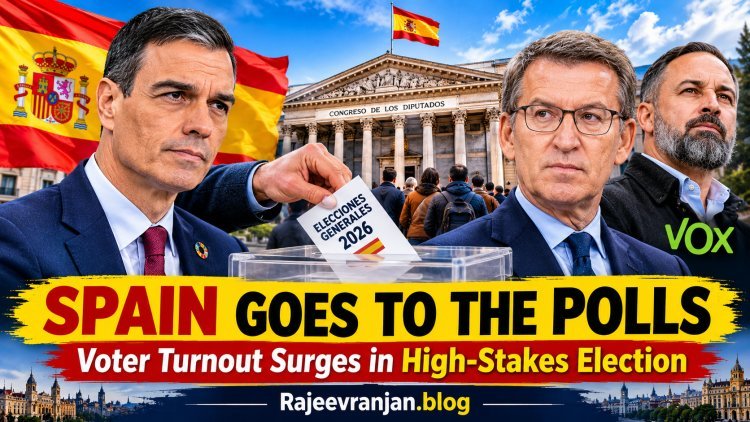

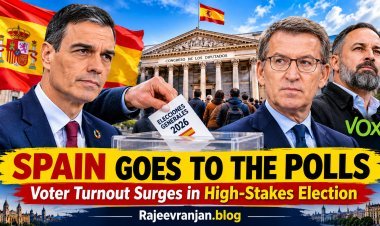
Spain Heads to the Polls in High-Stakes Snap Election as Voter Turnout Surges
Spain's political future is being decided at the ballot box on Sunday, November 29, as millions of voters take part in a closely watched snap general election. Early participation figures have already drawn attention, with turnout significantly higher than during the previous parliamentary election in 2023.
By 6 pm local time, 68.1% of eligible voters had cast their ballots, according to preliminary figures from Spain's Interior Ministry. At the same point during the July 2023 election, participation stood at 53.1%. The increase suggests unusually strong public interest in an election that could reshape Spain's political direction.
The contest is particularly important for Socialist Prime Minister Pedro Sánchez, who is seeking another term after eight years in power. His main challenger, conservative People's Party leader Alberto Núñez Feijóo, is hoping to take advantage of growing dissatisfaction with the government. The far-right Vox party could also emerge as a decisive force in determining who governs the country.
With housing costs, immigration, corruption and the cost of living dominating the campaign, this election has become about much more than choosing a new prime minister.
A Record-Breaking Day at the Ballot Box
Voting began at 9 am across Spain, with nearly 38.6 million registered voters eligible to participate.
The early turnout figures suggest that the election has generated considerable public engagement. At 2 pm, participation had already reached 45.74%, compared with 40.48% at the same time in 2023.
The momentum continued into the evening. By 6 pm, turnout had climbed to 68.1%, a substantial increase over the previous general election.
For Sánchez, higher participation could offer an opportunity. His political camp is hoping that voters who are concerned about the possibility of a conservative government supported by the far right will turn out in large numbers.
However, high turnout does not automatically favour one political party. It can benefit either side depending on which groups of voters are more motivated to participate.
That is why political observers are watching the final figures closely rather than treating the early numbers as an indication of who will win.
Why Did Pedro Sánchez Call an Early Election?
Sánchez called the snap election eight months ahead of schedule after his government struggled to secure parliamentary support for important housing measures.
Spain has been facing a serious housing affordability problem, particularly in major cities such as Madrid and Barcelona. Rising rents, limited affordable housing and increasing pressure on ordinary households have become major political concerns.
Public anger intensified following the eviction of an elderly woman, 87-year-old Maricarmen Abascal, from her Madrid home. The incident attracted national attention and became a symbol of the difficulties faced by people struggling with housing costs.
The government had attempted to introduce measures aimed at addressing the housing crisis, but political disagreements prevented key proposals from moving forward.
Calling an early election was Sánchez's attempt to seek a fresh mandate and resolve the parliamentary deadlock.
But the decision has also created a major political risk for the Socialist leader. Rather than strengthening his position, the election could open the door to a change in government.
Conservatives and Vox See an Opportunity
The main opposition challenge comes from the People's Party, known as PP, led by Alberto Núñez Feijóo.
Pre-election opinion polls generally placed the conservatives ahead of Sánchez's Socialist Workers' Party, or PSOE. However, winning the largest number of seats may not be enough to form a government.
Spain's Congress of Deputies has 350 seats, and an absolute majority requires 176.
The PP is widely expected to need parliamentary support from Vox, led by Santiago Abascal, to reach that threshold.
Vox has become one of the most influential forces on Spain's political right. Its campaign has focused heavily on stricter immigration controls, national identity and reversing several progressive policies introduced under Sánchez's government.
If the conservative and far-right parties secure enough seats together, Spain could see a significant shift in its political direction.
Such an outcome would also be politically important for Europe, where far-right movements have been gaining influence in several countries.
Housing, Immigration and Corruption Shape the Campaign
Three major issues have dominated discussions during the election campaign.
Housing is perhaps the most immediate concern for many Spanish households. Young people in particular face difficulties finding affordable accommodation, while rising rents have placed pressure on working families and pensioners.
Immigration has also become a defining political issue. Sánchez's government has generally supported a more inclusive immigration approach, arguing that migration contributes to economic growth and helps address labour shortages.
Vox has taken a sharply different position, demanding tougher border controls and restrictions on immigration.
The disagreement has turned immigration into one of the most divisive subjects in the campaign.
Corruption allegations have created another challenge for Sánchez. Investigations involving people in his political circle and family members have provided ammunition for opposition parties. Sánchez has denied wrongdoing and has argued that some of the accusations are politically motivated.
For voters, the choice is therefore not simply between left and right. It is also about economic security, public accountability and the future direction of Spanish society.
What Happens After the Polls Close?
Polling stations across mainland Spain and the Balearic Islands are scheduled to close at 8 pm local time. The Canary Islands follow a different timetable because of their time zone.
Preliminary counting is expected to begin after voting concludes, with the first results providing an indication of the balance of power in parliament.
However, the final political picture may take longer to emerge.
Even if the PP wins the largest number of seats, negotiations with other parties will be necessary before a government can be formed. Spain's fragmented parliamentary system gives smaller regional and national parties considerable influence.
Sánchez could also remain politically relevant if the Socialist-led bloc performs better than opinion polls have predicted.
The election's outcome will therefore depend not only on which party receives the most votes but also on which political alliances can command parliamentary support.
Why the Spanish Election Matters Beyond Europe
The outcome is worth watching from an international perspective because Spain plays an important role in European Union politics, trade and diplomacy.
A change in government could influence Spain's approach to immigration, European economic policy and relations with other international partners.
For India, Spain is an important European partner in areas such as trade, infrastructure, renewable energy, defence and tourism.
A new administration would not automatically change these relationships, but its economic and foreign policy priorities could influence future cooperation.
The election also reflects a wider political question facing several democracies: how governments respond when housing affordability, migration, economic pressure and public dissatisfaction become central issues.
For now, Spain's voters have the final say.
The unusually high turnout shows that the country is paying close attention to this election. Whether that participation translates into a fresh mandate for Sánchez or a breakthrough for the conservative and far-right opposition will become clearer as the votes are counted.
One thing is already evident: Spain's political landscape is entering an important moment, and the consequences could extend well beyond its borders.