


A New Era of Governance: PM Modi Inaugurates 'Seva Teerth' and 'Kartavya Bhavan' at Central Vista
PM Narendra Modi inaugurates Seva Teerth and Kartavya Bhavan 1 & 2 at Central Vista. Discover the features of India's new PMO and Common Central Secretariat.
 Rajeev
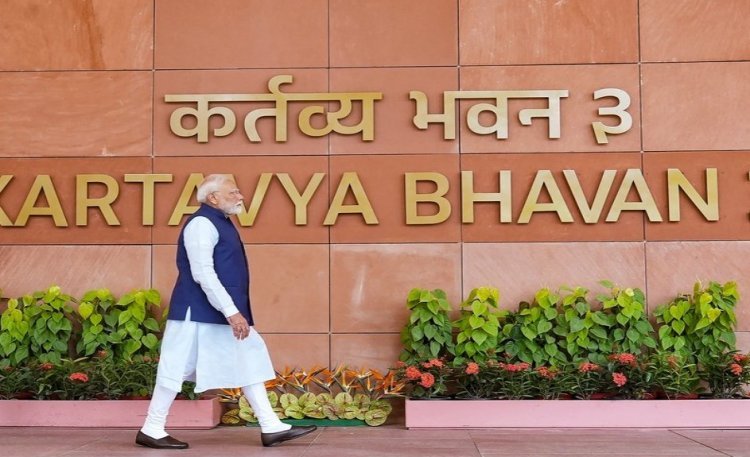

New Delhi | February 13, 2026: In a historic move that reshapes India's administrative landscape, Prime Minister Narendra Modi today inaugurated the Seva Teerth complex and Kartavya Bhavan-1 & 2 as part of the ambitious Central Vista Redevelopment Project.
The inauguration coincides with the 95th anniversary of the formal opening of New Delhi as India's capital in 1931, symbolizing a definitive shift from colonial-era infrastructure to a modern, indigenous, and efficient seat of power.
Seva Teerth: The New Seat of the Prime Minister’s Office (PMO)
Moving away from the colonial-era South Block, the Prime Minister’s Office has officially transitioned to the newly named Seva Teerth. The name reflects the government's "Seva-led" (service-led) governance model.
-
Motto: The building features the motto "Nagrik Devo Bhava" (Citizen is akin to God), inscribed prominently in Devanagari.
-
Consolidation: For the first time, the PMO, the National Security Council Secretariat (NSCS), and the Cabinet Secretariat are housed under one roof, ending decades of administrative fragmentation.
-
Efficiency: Located less than a kilometer from the former office, the complex is designed to reduce logistical delays and enhance inter-departmental synergy.
Kartavya Bhavan-1 & 2: A Unified Secretariat
Alongside the PMO, PM Modi inaugurated Kartavya Bhavan-1 and 2, the first major buildings of the Common Central Secretariat (CCS). These structures will now house several high-profile ministries that were previously scattered across Delhi in aging buildings like Shastri Bhavan and Nirman Bhavan.
Ministries Moving to Kartavya Bhavan:
The new complexes will accommodate over 10 key ministries, including:
-
Ministry of Finance & Ministry of Defence
-
Ministry of Health & Family Welfare
-
Ministry of Education & Ministry of Culture
-
Ministry of Agriculture & Farmers Welfare
-
Ministry of Law & Justice
Key Features of the New Infrastructure
Designed to meet the demands of the 21st century, these "future-ready" buildings prioritize sustainability and digital integration.
-
Sustainable Design: The complexes are built to 4-Star GRIHA standards, featuring solar energy systems, water conservation mechanisms, and advanced waste management.
-
Digital Integration: The offices are fully paperless-ready, equipped with high-speed secure networks and smart access control.
-
Citizen-Centric: Dedicated zones for public interface and centralized reception areas aim to make government interaction smoother for the general public.
-
Security: State-of-the-art surveillance and emergency response infrastructure ensure a high-security environment for India's top leadership.
Significance of the Transition
The government stated that this inauguration is a "transformative milestone" in moving away from colonial symbols. While the North and South Blocks will be retrofitted to house the Yuge Yugeen Bharat National Museum (set to be the world's largest), the new buildings at Central Vista will serve as the engine of modern Indian administration.
"The dispersion of offices for decades led to coordination challenges and escalating maintenance costs. These modern facilities reflect our resolve for an Aatmanirbhar Bharat," the PMO stated during the event.




















![States PCS: Bihar GK [बिहार सामान्य ज्ञान एवं सामान्य अध्ययन प्रश्न]](https://rajeevranjan.blog/uploads/images/2026/09/image_380x226_6a9e6f69b286c.jpg)