


Iran War Latest: Tehran Warns It May Strike First Before Another US Attack as American Carrier Arrives in Middle East
Iran warns it may act before another US attack as an American carrier reaches the Middle East. Bahrain reports drone interceptions amid uncertain peace talks.
 Rajeev
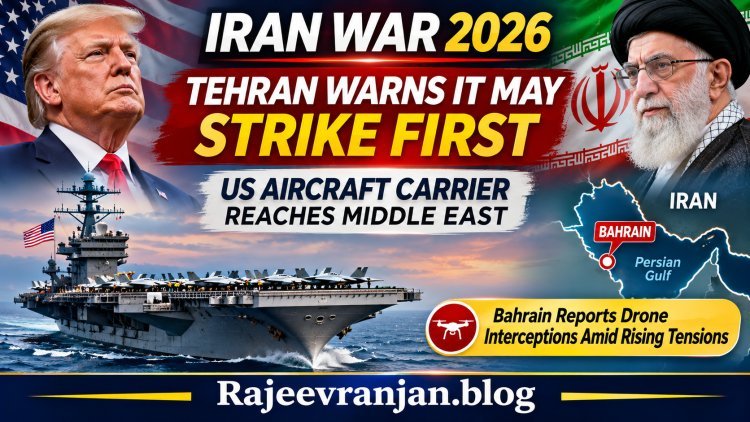

Iran War Latest: Tehran Warns It May Strike First Before Another US Attack as American Carrier Arrives in Middle East
Iran has warned that it may take military action before the United States launches another attack, raising concerns about renewed escalation in the Middle East. The warning comes as an additional American aircraft carrier reportedly arrives in the region, Bahrain intercepts Iranian aerial attacks and diplomatic efforts remain deadlocked.
TEHRAN / WASHINGTON | November 16, 2026
The confrontation between Iran and the United States has entered another uncertain phase after Tehran warned that it would not necessarily wait for Washington to launch a new military offensive before responding.
Iranian Deputy Foreign Minister Kazem Gharibabadi made the warning during remarks broadcast on Iranian state television on November 15.
He suggested that American diplomatic engagement could be intended to gain time for further military preparations rather than produce a lasting settlement.
The statement came as American military deployments increased across the Middle East.
According to Al Jazeera, a US official confirmed that the aircraft carrier USS Theodore Roosevelt had arrived in the region, joining two other American carriers operating within the US Central Command area of responsibility.
Meanwhile, Bahrain reported intercepting several Iranian aerial attacks after Iran's Islamic Revolutionary Guard Corps claimed a drone strike against an American radar installation.
The United States subsequently warned its citizens in Bahrain about heightened security risks.
Although Iran's warning has intensified fears of a wider confrontation, there is no verified announcement that Tehran has launched a new pre-emptive offensive against the United States.
The developments illustrate the growing difficulty of preventing another major escalation while negotiations remain unresolved.
What Did Iran Say About Striking Before Another US Attack?
Iran's latest warning came from Kazem Gharibabadi, the country's deputy foreign minister for legal and international affairs.
Speaking to state television, Gharibabadi said Iran would not automatically wait for the United States to initiate another military operation.
He also suggested that Washington might be using negotiations to buy time for additional attacks.
His remarks conveyed deep Iranian distrust of American diplomatic intentions.
According to reporting published on November 16, Gharibabadi described the country as remaining in a state of war despite ongoing diplomatic exchanges.
The comments were accompanied by criticism of Washington's response to Iran's proposed conditions for ending the conflict.
Gharibabadi argued that the American approach delayed some of the steps Tehran considered necessary.
The warning represents a significant rhetorical development because it raises the possibility of Iranian action based on an anticipated threat rather than a completed American attack.
However, the statement does not establish that Iran has made a final operational decision to attack.
Nor does it identify a specific date or confirmed target.
The distinction matters because statements about military readiness can serve diplomatic and deterrent purposes without necessarily indicating that an offensive is imminent.
Why Is Iran Warning of Pre-Emptive Military Action?
Tehran's warning reflects the continuing breakdown of trust between the two governments.
The present conflict began on February 28, 2026, when the United States and Israel launched military operations against Iran.
The confrontation subsequently expanded across the region, affecting American military facilities, maritime traffic and neighbouring countries.
Although Washington and Tehran have exchanged proposals through diplomatic intermediaries, they remain divided over how hostilities should end.
Iran has repeatedly demanded an end to military operations and restrictions affecting its economy.
The United States continues to insist on security guarantees addressing Iran's nuclear programme.
From Tehran's perspective, continued American military deployments create uncertainty about whether negotiations will prevent another attack.
Washington, meanwhile, views its regional military presence as a means of protecting American personnel, supporting partners and maintaining pressure.
This combination creates a difficult security environment.
Military movements intended by one government as deterrence may be interpreted by the other as preparation for an offensive.
That dynamic increases the possibility of miscalculation.
USS Theodore Roosevelt Arrives in the Middle East
The arrival of the USS Theodore Roosevelt adds another important dimension to the crisis.
According to Al Jazeera's November 16 reporting, a US official confirmed that the aircraft carrier had entered the Middle East.
The vessel joins two other carriers already operating in the US Central Command area.
Aircraft carriers provide the United States with significant military capabilities, including aircraft operations, surveillance and support for regional missions.
Their presence can also serve as a visible demonstration of military readiness.
However, an aircraft carrier deployment does not automatically establish that an attack has been ordered.
Such deployments may support deterrence, defensive operations or contingency planning.
The specific operational instructions given to the USS Theodore Roosevelt have not been established in the reporting reviewed.
Nevertheless, the additional deployment is significant because it comes as Tehran questions American intentions and warns against renewed attacks.
The simultaneous increase in military presence and confrontational rhetoric makes diplomatic communication particularly important.
Iran Claims Drone Attack on US Radar Facility in Bahrain
The tensions have been accompanied by actual military incidents in Bahrain.
On November 15, Iran's Islamic Revolutionary Guard Corps claimed that it had launched six drones against an American air-defence radar installation at Bahrain's Al-Rifaa military facility.
Iranian state media described the operation as retaliation for what Tehran characterized as hostile American actions.
Bahrain's military acknowledged aerial threats but said its air-defence systems intercepted Iranian attacks before they reached their intended targets.
Reuters reported that neither American nor Bahraini authorities immediately confirmed the Iranian claim that the radar installation had been successfully struck.
The conflicting accounts are important.
Iran's announcement establishes that the IRGC claimed responsibility for an operation.
Bahrain's statements establish that its authorities reported intercepting aerial attacks.
Neither statement, by itself, independently establishes damage to the American radar installation.
The latest incident followed another reported confrontation involving Iranian drones and American military assets in Bahrain.
Such incidents create the danger of additional retaliation, particularly when governments disagree about what occurred and whether defensive or offensive actions are justified.
US Embassy Issues Security Alert in Bahrain
The United States has responded to the deteriorating security environment by issuing a warning to American citizens in Bahrain.
The US Embassy in Manama advised citizens to exercise heightened vigilance because of threats involving Iran and Yemen's Houthi movement.
The advisory also warned about possible flight cancellations, airspace closures and other travel disruptions.
According to November 16 reporting by Anadolu Agency, the embassy highlighted the possibility that American government personnel, facilities and businesses could become targets.
The warning followed Bahrain's announcement that its air defences had intercepted Iranian aerial attacks.
The embassy indicated that routine citizen and visa services would continue.
For travellers and residents, the advisory represents a warning about potential risks rather than confirmation that every part of Bahrain is experiencing active fighting.
People travelling through the region should monitor official government notices and airline communications.
The security alert demonstrates how the confrontation is affecting ordinary civilian activity, including travel and business operations.
Iran's Seven Conditions Continue to Complicate Peace Talks
Diplomatic disagreements remain central to the crisis.
Iran has outlined several conditions it considers necessary for a negotiated settlement.
These include a permanent end to hostilities, relief from economic sanctions, access to frozen assets and the removal of restrictions affecting maritime trade.
Iranian Parliament Speaker Mohammad Bagher Ghalibaf said on November 15 that an agreement remained possible if Washington accepted Tehran's conditions.
However, he also warned that renewed American military action could broaden the conflict.
Gharibabadi similarly criticized the American response, arguing that Washington was postponing important commitments.
These statements indicate that Tehran continues to link negotiations to concrete economic and security measures.
The United States, meanwhile, has maintained demands involving Iran's nuclear activities and regional security.
The problem extends beyond disagreements over the final terms.
Both sides also disagree about which government should act first.
Iran wants meaningful relief from pressure.
Washington wants assurances before removing important restrictions.
This sequencing dispute remains one of the principal obstacles to a settlement.
What Is the United States Saying About Further Military Action?
Washington's recent public statements have emphasized the possibility of avoiding another major offensive.
On November 13, US Secretary of State Marco Rubio said additional military action against Iran was unnecessary in the circumstances he described.
He argued that economic pressure had significantly weakened Tehran.
Rubio also identified preventing Iran from obtaining a nuclear weapon as a principal American objective.
President Donald Trump has similarly suggested that further large-scale attacks might not be required if the situation does not deteriorate.
However, American military forces remain deployed in the region, and restrictions affecting Iranian maritime trade continue.
The combination of military readiness and diplomatic engagement creates uncertainty.
Washington may intend to deter Iranian action, but Tehran may interpret additional deployments as preparation for renewed strikes.
The difference between those perceptions is central to the present crisis.
Strait of Hormuz Incidents Add to Regional Tensions
The Strait of Hormuz remains another major source of instability.
The waterway connects the Persian Gulf with the Gulf of Oman and is essential for international oil and liquefied natural gas transportation.
Recent reports have described additional maritime incidents involving tankers and naval mines.
Iranian authorities have claimed that commercial vessels struck mines in the strait.
However, the precise circumstances and responsibility for individual incidents require independent verification.
The United Nations has also expressed concern about the growing human cost of maritime insecurity.
According to Associated Press reporting, UN information indicates that dozens of seafarers have been killed, injured or reported missing during incidents connected to the wider confrontation since February.
For international shipping companies, the danger extends beyond direct attacks.
Insurance expenses, route disruptions and uncertainty over access can affect commercial decisions.
The continued instability around the strait therefore has consequences well beyond the countries directly involved in the fighting.
Yemen's Conflict Creates Another Risk of Escalation
The wider regional situation has also deteriorated in Yemen.
Houthi forces have claimed attacks against targets in Saudi Arabia, including infrastructure associated with transportation and energy.
The Saudi-led coalition has reported intercepting missiles and drones.
Meanwhile, Yemen's internationally recognized government has described movements of its forces near strategically important coastal areas.
The United Nations refugee agency has warned about fighting approaching displacement camps in Lahj Governorate.
These developments demonstrate that the confrontation involving Iran and the United States is unfolding alongside other regional conflicts.
However, individual Houthi claims should not automatically be attributed to direct Iranian operational control without supporting evidence.
The danger is that attacks involving different armed groups and governments may trigger responses that intensify the wider confrontation.
What Does the Latest Iran War Escalation Mean for India?
India has a significant interest in preventing further instability across the Gulf.
The country depends heavily on imported petroleum and maintains important economic relationships with Middle Eastern nations.
The Strait of Hormuz is particularly important because a substantial share of Gulf energy exports passes through the waterway.
Additional military incidents could affect shipping costs, insurance arrangements and the availability of energy supplies.
However, the extent of any impact on Indian fuel prices would depend on wider market conditions and government pricing decisions.
India also has a large community of citizens living and working across the Gulf region.
Heightened security alerts, airspace restrictions and transport disruptions can create practical difficulties for travellers and expatriate workers.
For Indian businesses, prolonged uncertainty can complicate logistics and commercial planning.
A sustained diplomatic settlement would therefore have economic and security implications extending beyond the immediate conflict.
What Could Happen Next?
Several developments will determine whether the confrontation escalates.
The first concerns American military activity.
Further deployments or new strikes could influence Iran's calculations about whether it faces an imminent threat.
The second involves Iran's response.
Tehran's latest warning suggests it may consider acting before another American offensive, but its actual intentions remain uncertain.
The third concerns diplomatic negotiations.
Any progress on sanctions, nuclear restrictions and maritime security could reduce the risk of further military confrontation.
Finally, developments in Bahrain, Yemen and the Strait of Hormuz will remain important because local incidents can affect the wider security environment.
None of these outcomes is inevitable.
The immediate challenge is preventing military preparations and threatening statements from developing into another major confrontation.
Iran's Warning Signals a Dangerous New Phase
Iran's declaration that it may not wait for another American attack marks an important development in the public confrontation between Tehran and Washington.
The warning comes amid additional American naval deployments, disputed drone incidents in Bahrain and continuing disagreements over peace proposals.
Both governments have expressed positions that leave room for diplomacy.
However, neither has confirmed a comprehensive settlement resolving the conflict.
As of November 16, 2026, Iran's warning represents a stated possibility of pre-emptive action—not verified evidence that a new offensive has begun.
The danger lies in the possibility that either government could misinterpret the other's military preparations.
For the wider Middle East, preventing another escalation will depend on whether negotiations can establish credible commitments while reducing the risk of further attacks.