


PM Modi’s Diplomatic Masterstroke: Deep Concerns Shared with President Pezeshkian Amid Middle East Infrastructure Strikes
Prime Minister Narendra Modi spoke with Iranian President Masoud Pezeshkian to convey Eid greetings and express grave concern over attacks on critical energy infrastructure.
 Rajeev
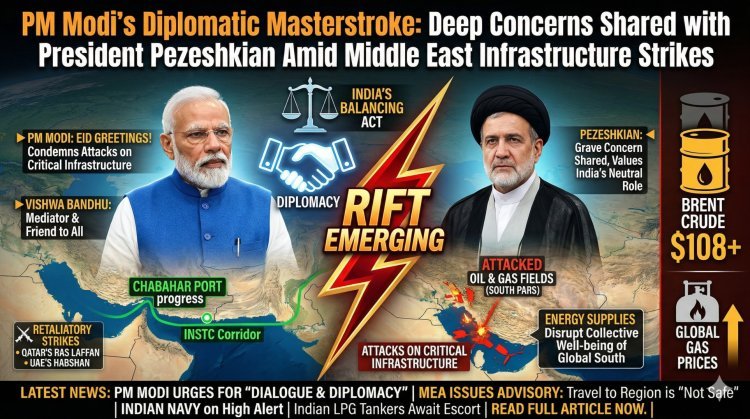

A Call for Restraint: PM Modi Navigates Middle East Crisis in High-Level Dialogue with Iran
NEW DELHI / TEHRAN | March 21, 2026 In a significant diplomatic move aimed at de-escalating the "Energy War" in the Persian Gulf, Prime Minister Narendra Modi held a telephone conversation today with Iranian President Masoud Pezeshkian. While the call was initiated to convey warm greetings on the occasion of Eid-ul-Fitr, the dialogue quickly transitioned into a serious discussion regarding the deteriorating security situation in the region.
1. Condemning the Sabotage of Critical Infrastructure
The highlight of the conversation was PM Modi’s firm stance against the targeting of civilian and energy infrastructure. Following the recent strikes on Iran’s South Pars gas field and retaliatory threats toward Gulf neighbors, the Prime Minister emphasized that such actions destabilize the global economy.
"The Prime Minister expressed his deep concern over the recent spate of attacks on critical infrastructure, noting that the disruption of energy supplies poses a threat to the collective well-being of the Global South," a statement from the Prime Minister's Office (PMO) read.
2. India’s Role as a "Vishwa Bandhu"
India has consistently maintained a policy of strategic autonomy. By speaking directly with President Pezeshkian, PM Modi has reinforced India’s role as a "Friend to the World" (Vishwa Bandhu), capable of talking to all sides.
-
The Message to Iran: India urged for a return to the path of dialogue and diplomacy, stressing that "war is not an option in this era."
-
Strategic Interests: With Indian-flagged tankers currently navigating the Strait of Hormuz, the safety of Indian seafarers and energy security remains a top priority for New Delhi.
3. Strengthening the "Chabahar Connection"
Beyond the immediate conflict, the two leaders briefly touched upon the long-term progress of the Chabahar Port. Despite regional tensions, both nations reaffirmed their commitment to the International North-South Transport Corridor (INSTC), which connects India to Central Asia through Iran.
4. The Eid Outreach
The timing of the call, coinciding with Eid-ul-Fitr, served as a "soft power" tool to maintain a human connection amidst military tension. PM Modi extended his best wishes for peace and prosperity to the people of Iran, a gesture that was warmly reciprocated by President Pezeshkian.
A Voice of Reason
As the U.S. signals a potential "winding down" and Israel maintains its offensive posture, India’s proactive engagement with Iran serves as a stabilizing force. PM Modi’s call is a clear signal that India will not remain a silent spectator when global energy security is at stake.